Showing posts with label oregon trail. Show all posts

Oregon Trail Last week & the Mid 1800s

 January 17, 2022

Wyoming Fact & Fiction

We are back from a quick trip to visit family in southeast Nebraska. My two hometowns, where I grew up in Fairbury, Nebraska, and now in Guernsey, Wyoming, are Oregon Trail towns.

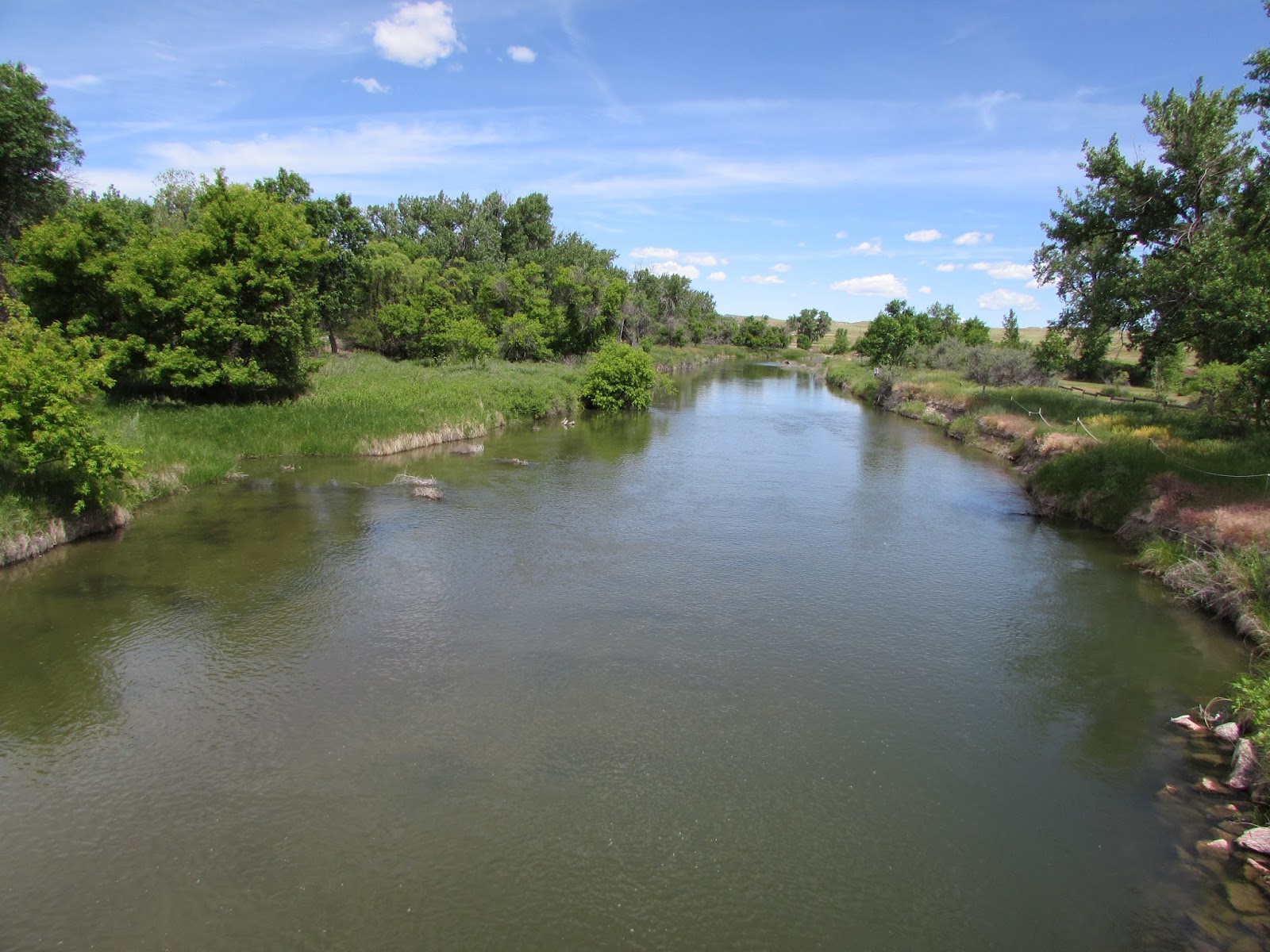
Traveling the Oregon Trail - Every time we go back to visit, I think about those Prairie Schooners rumbling along at 10 to 15 miles per day. My, growing up, home town, sits near one of the first difficult river crossings – the Little Blue. The crossing was treacherous if the wagons got there early in the year.

Little Blue looked peaceful when I snapped this last July.

By the time they reached Guernsey, most wagons were following the south side of the North Platte River. The Mormon Trail runs along the north side of the river, only a few miles from the Oregon Trail on the south by the time it gets here.
North Platte in mid-June in Guernsey, Wy. 

The driving distance from here in Wyoming to where I grew up in Fairbury is 485 miles, about eight to nine hours for us oldsters who stop several times along the way. The wagons would have taken more than a month, likely closer to six weeks. But hundreds of thousands made the trip, with about 20,000 who died along the way. Cholera and other sickness and disease killed most of the thousands who died along the way. Indians, who have killed hundreds of thousands, maybe millions on TV, old-time radio, and movies, actually killed about 400. 

Most who traveled walked instead of overtaxing their animals, primarily Oxen, with extra weight.

Not an Oxen but good looking Longhorn

The wagon itself was only about 4X10. Even in our tiny house world, forty square feet is not much.
A landmark of the trail - Chimney Rock in western Nebraska


One Book You Might Need in Your Library – Patrick T. Holscher’s – On This Day In Wyoming History.

So what happened in Wyoming History today from the book? Kendall Wyoming had a low temperature of -52. Now that is cold! Thanks for the info, Patrick.


Shout Out for this Blog - It is always nice to be noticed, and this week I received word that this blog is now listed in FeedSpot as one of the Top 15 Wyoming Blogs & Websites. Click the link to see the list. I read several of these sites – good stuff, no cost! 


Wyoming Trivia – two questions today

Q1 - What are Oxen?

Q2 - Where did emigrants on the Oregon Trail hope to be by the 4th of July

Trail Ruts near Guernsey - about a 1/2 mile south of our house.


Answers

Q1 - Oxen are no different in origin than other cattle. They are simply neutered bulls trained to pull.

Q2 - Independence Rock


See you next week!


Wyoming - The First Cattle

Living only a few blocks from the North Platte River, I often think about how important it once was. Not that it is unimportant today, supporting wildlife and providing power along with, much needed the past few days, irrigation water down stream and providing recreation for tens of thousands of people year round.
North Platte River in the Red Cliffs area a mile north of Guernsey, Wyoming

What I am talking about is how important, as a boundary, it once was.  When cattle were first brought into southeast Wyoming, all lands north of the river were Indian lands. Wandering, and often hostile bands of native warriors made sure the land would not be used for cattle grazing.
The first cattle in the northern part of the state were brought in by Nelson Story in 1866, who bought more than a thousand cattle in Texas for ten dollars a head and drove them to Wyoming. After reaching Fort Laramie, he took the herd up the Bozeman Trail to Fort Phil Kearny. Because of Indian problems in the area he was ordered to hold the cattle at the fort until something could be worked out. After a three week wait, Story became impatient and drove the cattle from the fort at night. The herd was soon located and drove off in all directions by area tribes, and in the days it took to round up the cattle more than 30 Indians were killed.
These Longhorns of today are a bit, okay, a lot, bigger than the 1866 version

Nelson Story went on to establish himself, and the cattle ranching business, near Bozeman, Montana, where he became both rich and influential.

Today more than one and a quarter million cattle can be found in Wyoming, and more than two and a half million in Montana. Guess story knew what he was doing. 

We took some friends from Texas out to the Ruts yesterday - always fun!

Markers Along the Oregon Trail

Traveling the Oregon Trail must have been quite an ordeal. Along with the lack of food, lack of good water, lack of fuel and the constant fear of attack from Indians, travelers had to put up with walking most of the way. They experienced freezing cold mornings and often scorching afternoons. But finding the way west was, after the first few years, not as difficult as many novels and stories seem to make it. Many good scouts, or pilots as they were sometimes called, worked the trail, many had earlier trapped and traded in the west and knew much of life on the trail.

Wagons followed the Platte River across present-day Nebraska and looked forward to their first view of the west, Chimney Rock and soon after if the days were clear Laramie Peak.

Chimney Rock – Near Bridgeport Nebraska and along Highway - 26, was a towering marker letting travelers know they were leaving the flat and easy part of the journey west. Chimney Rock stood more than 400 feet above the North Platte River and could be seen for days from the wagon trains. Today Chimney Rock is still striking but stands about 100 feet less than it once did.
Chimney Rock


Laramie Peak – Often Laramie Peak could be seen before the wagons reached Chimney Rock. The highest point of the Laramie Range, the peak stands 10,276 feet high. By most standards a mountain a bit over 10,000 feet high is not much, but when viewed from the prairie, after weeks of traveling the flat land, it was most impressive. The peak, as it is referred to by locals now, also meant the wagons would soon be turning north with the river toward present-day Casper, Wyoming. As a side note, famed mountain man Jim Bridger* often claimed he’d been in the mountains so long that when he came west, Laramie Peak was, “nothin’ but a hole in the ground.”
 *Bridger came into this country on his first trip west 195 years ago.
Laramie Peak as it looked from the wagon trains


The Diet of a Mountain Man

We read and watch daily opinions about our overweight society, “Americans are too fat,” we are continually told. Maybe so, today anyway, but not always. I smile each time I remember the story of Jim Bridger making his own supper. He skinned and gutted a jack rabbit and a nice sized trout, skewered them and propped both over the fire for roasting. Once they were cooked to his taste, likely not long, he ate both quietly and drank an entire pot of boiled coffee to wash down the meat. No seasoning of any kind, maybe smoke flavor from the fire, but that’s it. This was not uncommon for early hunters/trappers in the American West. Meat and coffee. Surprising to some, that many of these men also drank a lot of tea, it was as popular as coffee for many of the early explorers.
Cooking in a Mountain Man Camp
It took several years before the diet in the west changed much. Changed, but it still remained monotonous, with western Americas often eating the same few things for days or weeks at a time.  Wild game, fruits, and wild onions, in season, and washed down with copious amounts of coffee and tea with little else. Meat could be preserved by smoking and drying and often was.
Wild fruits and berries were always a treat

Not until the Oregon Trail got busy and the railroad ran through the state did the variety of foods available start to change. With places like Fort Laramie, and a quarter of a century later railroad stops, getting regular shipments of foodstuffs it helped. Flour and cornmeal were generally available along with dried fruits (usually apples), sugar, rice, dried beans and peas. Not much but much better than it was.

Early food, including meats, were often boiled, unlike today’s diet, heavy with fried foods. There was not a lot of fried meats until bacon became a staple along the trail west, soup, and roasted meats were much more an everyday part of the diet than today.  

So there you have it roasted meats and a few boiled dried vegetables, day after day after day, guaranteed to keep one’s weight under control. But, be careful with the gravy, cornbread, and biscuits, all favorites when flour and cornmeal were readily available in the west.
Buffalo - Staple of the diet in the west for many years

Indian Wars In The West

In 1825 President James Monroe, after looking at reports from his top advisors, created, what was called, the Indian Frontier between the Mississippi River and the Rocky Mountains. It was believed at the time that this area was unfit for anything other than the native tribes and the wandering herds of bison.


The frontier designation came shortly after the government got out of the trade business with Americas western frontier. For decades the United States Government had licensed traders in the west, allowing them to build trading posts/forts, referred to by the government as factories. When the government gave up the selling of trade licenses for specific monopolies of trade territories, it cost the government some money, but they were no longer considered a significant economic boon to the country.


The Bureau of Indian Affairs, formed in March of 1824, by Secretary of War, John C. Calhoun, as part of his department and without asking for, or getting authorization from Congress. Calhoun recognizing that trappers and traders were going to operate in the West without the benefit of traders licensed by the government, but still wanted some type of organization in the western wilderness. He appointed, also with anyone’s approval, Thomas L. McKenney as the first Superintendent of Indian Affairs. McKenney called himself, the head of the Indian Office. He was removed by President Jackson in 1830 because of his belief that the Indian was morally and intellectual the equal of white’s.
President Jackson

In 1834, the Indian Intercourse Act was passed, forbidding whites from going into Indian lands without permission from the commissioner of Indian affairs. That date is important because there were already hundreds if not thousands of company trappers, free trappers, traders, hunters, and wanders, already in the forbidden, to whites, Indian lands.
From this came the new Army of the West. It took a few years but by 1849, the Bureau realized the need for a presence in Wyoming, purchased Fort John, and changed it to a military post, renaming it Fort Laramie.
Fort Laramie's Old Bedlam
From that point, troubles persisted. People moved west without permission, young military commanders wanted to fight Indians not make peace and the tribes grew more and more aggressive as the bison on the plains were shot up.

During his brief, 16 months, Presidency, Zachary Taylor, moved Indian Affairs to the U. S. Department of the Interior, believing it was a better fit for the unsettled lands.

Some have argued that the BIA created as many problems as it solved. Five years late, 1854, the Grattan Massacre just east of Fort Laramie began histories Plains Indian Wars period.


Wyoming the Railroad and What If

The transcontinental railroad was a brainchild of Eastern businessmen and politicians in the 1830s. It took a while, about two decades before any real planning took place and another decade before work was started. It took President Lincoln to finally push through legislation to build it. The Central Pacific started building in 1863 and the Union Pacific in 1865. Promontory Summit was reached and the railroads joined in 1869.


Wyoming was a big part and a big challenge for the railroad. The original route was to follow the Oregon Trail, but the Pony Express proved there was a better route through southern Wyoming to South Pass, the only feasible way to cross the mountains. This route saved a couple of hundred miles and was no harder to build.  Although original plans called for a route that was nearly the same as the finished railroad, there was a controversy about the route. Texas wanted a southern route, using better weather as their public reason. Privately they wanted the railroad for the huge economic benefit they knew it would bring. When the Civil War started, Texas was out and the tracks through Wyoming were not far away.
Trains are a bit faster today
Not everyone was happy with this, Denver had lobbied for the railroad, but no route including Denver was ever considered. But the early people of Denver, knowing that they could connect to the railroad and reap most of the benefits of its northern neighbors. Thus was born the Denver Pacific, a bit over 100 miles of track connecting Denver to Cheyenne completed one year after the completion of the Transcontinental Railroad.

It was another 20 years before Wyoming became a state in 1890.  Most of the early population lived along the railroad, it brought jobs and with jobs came the people. It is always interesting to speculate as to what could have happened, what if.  How long would it have taken for Wyoming to become a state without the railroad? As the least populated state today, would it be even smaller if it would have taken another 20 or 30 years to have adequate rail service? Would the cattle drive era been a time when cowboys drove cattle south from Wyoming to the railroad in Texas?


I may have had too much time to think about offbeat subjects today. Hey, what if . . . . . .

Wyoming Timeline and Mark Twain Too


Archeological evidence suggests that humans were living in Wyoming for thousands of years before it became famous for trappers and traders. The first trappers had pioneered, by the 1830s, what would become the Oregon Trail.
Deep Ruts of the Oregon Trail 
Meanwhile back east wheat crops failed in1836, and in 1837 panic spread as banks failed and depression stretched across America and Europe. It was hard times, a time when people started to question their lives and what they were doing with them. Time to move west. Horace Greeley would not utter his famous, “Go West Young Man, go West and grow up with the country,” for another two and a half decades, but Americas were moving and they were moving west.

The great fort at the confluence of the North Platte and Laramie rivers, destined to become the most famous stopping off point on the Oregon Trail, Fort William (1834) and then Fort John (1841), and finally Fort Laramie, (1847), was a welcome relief for westward travelers. The fort was well supplied and attempted to cater to the needs of all types of travelers.
Laramie River on the grounds of Fort Laramie
From 1841 until the end of the civil war as many as a half million men, women and children traveled the trail west. Some wanted to farm, others a new life, and a few, gold and riches, but they all came through, only a handful stayed. Wyoming was much like a modern-day Interstate highway, people quickly traveled through, in a hurry to get somewhere else.

 Even Mark Twain seemed in a hurry to get through and didn’t seem overly impressed with the Wyoming scenery. “We passed Fort Laramie in the night, and on the seventh morning out we found ourselves in the Black Hills, with Laramie Peak at our elbow (apparently) looming vast and solitary -- a deep, dark, rich indigo blue in hue, so portentously did the old colossus frown under his beetling brows of storm-cloud. He was thirty or forty miles away, in reality, but he only seemed removed a little beyond the low ridge at our right.” This quote is from Twain’s trip through the state and recounted in his novel, Roughing It, (page 55), published in 1871.

Two things have always struck me about the Twain quote. First why would a stage pass on through the most famous stopover in the west, and at night? Second, how did it take a week to write about Laramie Peak being at his elbow? This area, with the peak at his immediate left elbow, would be on the trail between present day Guernsey and Glendo. The trip from Fort Laramie, through Guernsey to Glendo is a bit less than 45 miles. If Twain and his stage coach had only traveled that far in six days, they were creeping at a snail’s pace. Wagon trains traveled twice that speed or better. Maybe his notes or his memory was a bit off on this point, or it is possible he was having one of those, “are we there yet,” times.
Laramie Peak from the trail near Guernsey
  When Wyoming became a recognized territory in 1868, a few came. Later the railroad (1869), brought people and business to the southern part of the state.  Spreading across the state were would-be homesteaders and ranchers who brought in cattle and helped build settlements in the wide open spaces of Wyoming. Enough settled for the territory to become a state by 1890.

Interesting that many history sources mention the first travelers on the trail were going to Oregon and California and later travelers headed to Utah, Colorado, and Montana, not many mention Wyoming.

Not today!

Today Wyoming is no longer a pass through state. It has become a destination for tourists and for business, still small in population, the West lives on in this rugged state.
Mark Twain's view hasn't changed much
Now that’s funny – my grammar and spell checker highlighted three errors in the Mark Twain quote, not sure Mr. Twain would like that. He didn’t like editors messing with his stuff, liked the way it looked after he wrote put it down on paper.


Fort Laramie - Protecting the West


In 1834, it was Fort William named after post founder, trapper/trader William Sublette.By 1841, the post was owned by the American Fur Company and renamed  Fort John. In 1849, with gold rushers heading west, it was purchased by the United States Army for $4,000. With so many folks heading west, the government was convinced it needed to start protecting the trails.
Barracks at Fort Laramie

In 1849, the first three companies of cavalry arrived at the fort, including Company G, 6th Infantry, which would become the permanent garrison at Fort Laramie. Many of the forts early enlistees, spoke broken or no English. Even in those days it was tough to find workers for $13 a month. The good news was reenlistment would add another two bucks a month. Not only were many of the new recruits recent immigrants, most had never ridden a horse. Fort Laramie had a large number of foot soldiers, so this was not much of a problem.
Across Parade Ground to Officer Quarters

Something I have always found of interest, the army had companies of men into the 1880s then they became troops. Same group, different name. I often run across these terms used incorrectly when I am reading in my favorite genre, historical fiction.

Here is the makeup of a troop/company.

1     Captain
1     First Lieutenant
1     Second Lieutenant
1     First Sergeant
5     Line Sergeants
4     Corporals
2     Trumpeters
2     Farriers (horseshoers and
           Horse doctors – army trained or self-trained veterinarians)
78    Privates (more or less, at Fort Laramie normally a few less)
 
Jail Cells - solitary at the Fort
In the new research I am doing for a future book on Fort Laramie, I have found several instances where the Fort Commander held a rank lower than Captain – must not have been a very popular place.
Remains of the old Fort Hospital on the hill

Although they were never close to having a full regiment of men, it was discussed when the Indian wars escalated along the Oregon, Mormon and Bozeman trails. That would have been quite a change as a regiment was made up of ten troops, meaning the number of soldiers at Fort Laramie would have gone from a normal 300 or so to 1,000.  Note – After the Civil War a  regiment was increased to 12 troops, not sure why.
There was always plenty of action around the fort

Laramie River near the fort


5 Periods of Wyoming History

Wyoming historians divide the history of the state into five periods. Thought it might be fun to take those five periods and try to list my favorite broad fact about each. So, here goes.
These are my favorites, please let me know what yours are.

1.    Exploration - trappers and traders

Without a doubt, Jim Bridger is the most famous early Wyomingite as all three, explorer, trapper, and trader. He also could be listed as one of the all-time great storytellers in Wyoming history.

2.    Emigration -  Oregon Trail
Many things could fall into place here, but the sheer numbers alone seem to be my favorite trail fact. Travel started about, 1843, peaked in 1846-1869, and by the early 1880s, it ended. During that period of time, 400,000 travelers used this main thoroughfare west. On average 10% died before reaching their western dreams.
3.    Indian Campaigns/Wars
Remember – this has to be something in Wyoming, thereby ruling out Custer on the Greasy Grass River.
 My top fact, The Gratton Massacre in 1854. Considered the first battle of the Sioux War, which by many, including myself, consider to be the beginning of the Indian Wars in the west.
Camp on the Laramie River not far from the site of the Gratton fight
4.    Territorial days
For me this is an easy one – Giving the vote to women happened when Wyoming was a territory in 1869, twenty-one years before statehood. Interesting that it may have been more for the publicity than for the rights of women.
Esther Morris - leader of the Women's Rights movement in Wyoming
5.    After Statehood
Many things could belong here, but I decided not to list people. Instead my favorite, after statehood fact about Wyoming is the wide open spaces, a state with only a half million people. Giving citizens and visitors incredible views in every county in the state.


Oh, if I were to list people they would be, Nellie Tayloe Ross, and Buffalo Bill Cody. Ross because she was the first women governor in the United States and Cody because of his legend, much bigger than his real accomplishments, but never the less important in making the old west into the movie, novel, and television wild west.
The west, Wyoming style

Relief from the Heat

Tired of all this heat?
Hey, remember last February 4 - yea, me neither? But I have photos.
Still hoping summer is about over?


Jim Bridger and his Uncle the President

So much about Jim Bridger remains a mystery. He was orphaned at age 13 and apprenticed by a relative to a blacksmith. Early historians often noted the relative as a well-meaning one. More recently some believe that there was some money coming to the well-meaning, relative and that may have been what made him so well-meaning.
Not much is known of Bridger’s parents other than their dying young and the fact that throughout his life Bridger insisted his mother was President Tyler’s sister. He went on to say that she was disowned after marrying his uneducated father.


Bridger hated the labor in the blacksmith shop but worked hard at it anyway. He had enjoyed his previous job working with riverboats on the wharf. Of course, that gave him a chance to jaw with river men and trappers. Those were the rugged men he liked and were all about what he would become.


A man we think we know so much about, but maybe we really only know but what he wanted us to know.


Afraid I don't look much like a Mountain Man - trapper, but my friends look good

Oregon Trail Ruts - Guernsey, Wyoming

Wet Spring means lots of wildflowers. Today we took a trip to the Oregon Trail Ruts south of Guernsey. This is the time of year the wagons would have been rolling through this area. 

Wonder how many years the flowers were this spectacular.

All photos from the Trail Ruts this evening.