Showing posts with label Oregon Trail Ruts. Show all posts

Wyoming - The First Cattle

Living only a few blocks from the North Platte River, I often think about how important it once was. Not that it is unimportant today, supporting wildlife and providing power along with, much needed the past few days, irrigation water down stream and providing recreation for tens of thousands of people year round.
North Platte River in the Red Cliffs area a mile north of Guernsey, Wyoming

What I am talking about is how important, as a boundary, it once was.  When cattle were first brought into southeast Wyoming, all lands north of the river were Indian lands. Wandering, and often hostile bands of native warriors made sure the land would not be used for cattle grazing.
The first cattle in the northern part of the state were brought in by Nelson Story in 1866, who bought more than a thousand cattle in Texas for ten dollars a head and drove them to Wyoming. After reaching Fort Laramie, he took the herd up the Bozeman Trail to Fort Phil Kearny. Because of Indian problems in the area he was ordered to hold the cattle at the fort until something could be worked out. After a three week wait, Story became impatient and drove the cattle from the fort at night. The herd was soon located and drove off in all directions by area tribes, and in the days it took to round up the cattle more than 30 Indians were killed.
These Longhorns of today are a bit, okay, a lot, bigger than the 1866 version

Nelson Story went on to establish himself, and the cattle ranching business, near Bozeman, Montana, where he became both rich and influential.

Today more than one and a quarter million cattle can be found in Wyoming, and more than two and a half million in Montana. Guess story knew what he was doing. 

We took some friends from Texas out to the Ruts yesterday - always fun!

Westward Ho the Wagons

I can remember many years ago watching or listening to  various programs that ended with some form of the phrase – “and the rest is history.”

 In 1841 when the Bidwell-Bartleson party headed west the rest was indeed history. This first great wagon train heading west not only made history, but it also led to the populating of the West and later the middle of the country. The next year, 1842, Dr. Elijah White led a group of more than 100 on the all new Oregon Trail. Two years later four wagon trains carried more than 2,000 hopefuls West.  The next year the numbers more than doubled. By 1869 more than half a million people had traveled along the trail to Oregon, California, and later to the Salt Lake Valley of present-day Utah. 
Trail Ruts cut deep from thousands of wagons - Guernsey Wyoming


The goal for all of these travelers was the same. Make the 2,000 plus mile trip in 150 days taking along enough food and finding enough fresh water along the way to make it.  Taking a day a week off, as most trains did, this would mean the wagons needed to average about 15 miles each day six days each week for five months. Today if we drove for eight hours each day for 130 days averaging 60 miles per hour we could circle the earth two and a half times. What does all this mean? The west coast was a long way to travel, farther than anywhere on earth in today's world. Once the new would-be settlers started west, in all likelihood, they could never go back. What a commitment these people were making. 
A view down the trail. When the first wagons came there were not nearly
as many trees along the North Platte River as today


All of the above are my thoughts as we get ready to take off on a 4,000-mile vacation next week,  and we will only be gone 16 or 17 days. My, how times have changed.
Fall at Fort Laramie, the most famous, and most welcome stop on the trail.

The Curious Case of Lieutenant Hugh Fleming


The Grattan Massacre, Aug 19, 1854, is often listed as the event that started the Indian wars on the plains. Anyone who is interested in Wyoming history knows the story of the killing of the cow from a Mormon wagon train and Grattan leading his troops to their death in the ensuing battle. But very few know the story of the commanding office at Fort Laramie, who either ordered him or allowed him to take the troopers on the ill-fated journey.


Brevet Second Lieutenant Hugh B Fleming was the commander at Fort Laramie at the time. The fact that a Brevet Second Lieutenant was in charge is a bit of a mystery itself. Fleming was promoted from cadet, upon his graduation from West Point, to the rank and sent to Fort Laramie. One year later he was in command. I am not sure how officers were chosen for command, but it is likely that Fleming was neither ready nor capable of this command, only a year removed from Cadet status at West Point.


Fleming was in charge but undoubtedly was not meant to be the permanent commander. In 1854 alone, four different men commanded the Fort. Fleming followed, Lt. Richard Brooke Garnett and proceeded Major Andrew W. Evans who was followed by Major William Hoffman who stayed through 1857. It is possible that Fleming was ushered out as soon after the August Grattan massacre as the Army could make the move.


It was not this brief time as the commander alone that left his stamp forever on the Indian wars of the west. In June of 1853, Fleming was sent by Fort Commander Lieutenant Richard B. Garnett to a Miniconjou Sioux encampment that had fired upon Sergeant Raymond and captured an army supply boat near the fort. Although no one was injured and the boat was soon recovered, Fleming was sent with orders to demand the Indians turn over, to the army, the person who had fired at them. Fleming took along 23 men and an interpreter. His orders in addition to bringing back the shooter allowed for Fleming to capture and bring back two or three prisoners if the Miniconjou would not turn over the one who fired on them.  


The tribe refused to turn over the wanted man and Fleming marched his men into the center of the village to take prisoners. A battle started and three warriors were killed and three more wounded. Fleming grabbed two more as prisoners and returned to Fort Laramie. A few days later a group of Miniconjou came to the Fort, asking to parley. Whatever happened here, the tribe was not satisfied.  It took a bit over a year before Grattan and his men were killed, but Lt. Fleming and his two very bad decisions may have directly led to the Indian or Sioux wars in the west.


Fleming went on to a long but rather ordinary career in the military, serving as a recruiter and not seeing action in the Civil War, he retired as a Major.


Note* I am pretty deep into research on a new book about Fort Laramie and have found dozens of stories, like this one, that seem to give a different and deeper view of history. When researching I try to be very painstaking in getting it right. In ten minutes of looking at online sites on the Grattan Massacre I found it happened on August 17 or August 19 in either 1853 or 1854. As I told my students for 42 years, check and verify before putting it on paper. By the way -  It happened on August 19, 1854.
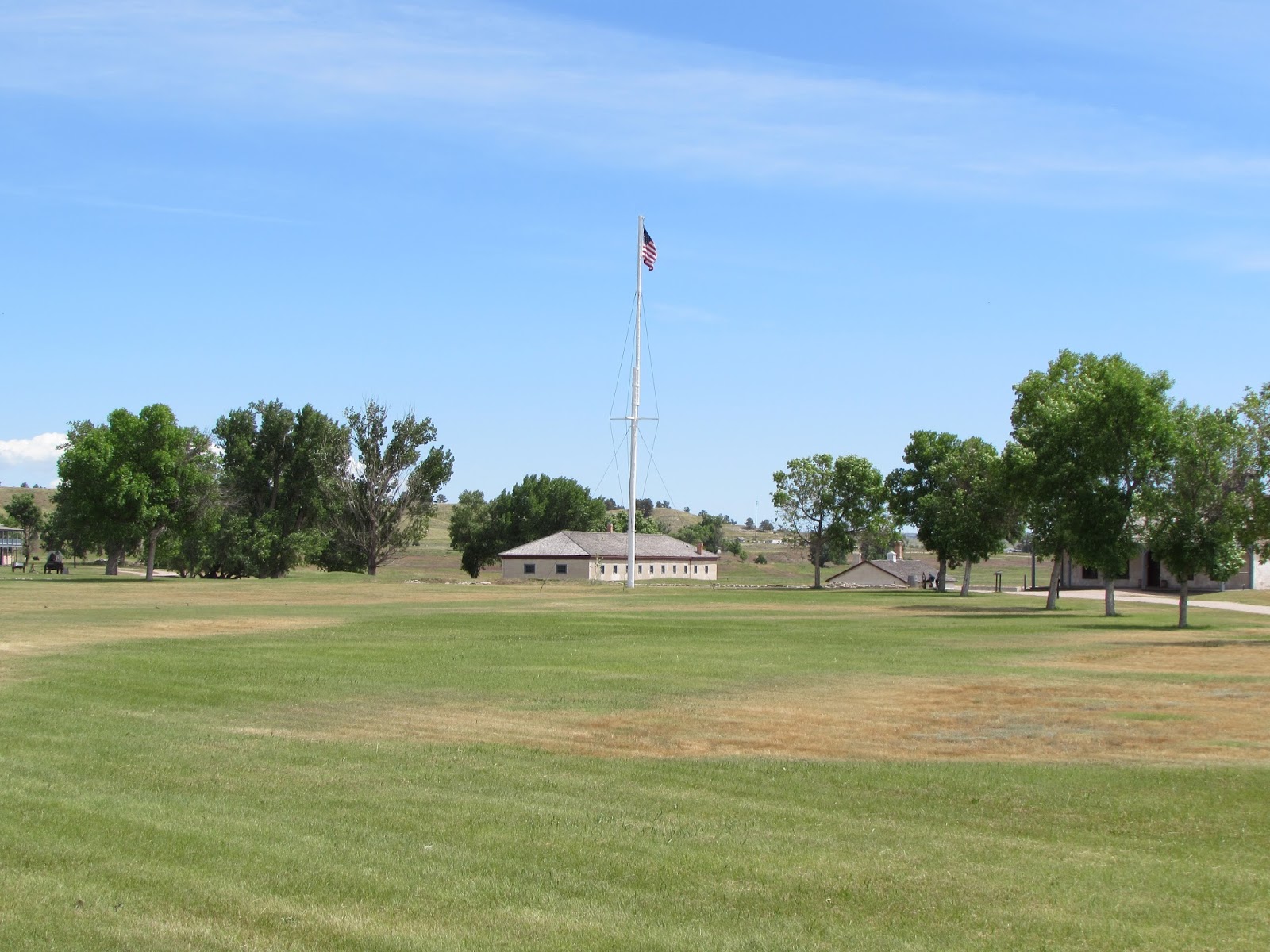
Couldn't resist - here I am at Fort Laramie on the Fourth of July - thanks for reading