Showing posts with label William Sublette. Show all posts

The Ashley-Henry Party Opening the West

In 1822,  General William H.Ashley organized the Rocky Mountain Fur Company. Of all the famous mountain men that books and movies were made about, it seems most of them were part of this first group of mountain men. Ashley along with his partner Andrew Henry put together this group of hardy, explorers, trappers and traders. The group included Jim Bridger, William Sublette, Thomas Fitzpatrick, Robert Campbell, Jim Beckwourth, Mosses (Black) Harris, Hugh Glass, Jedediah Smith, Etienne Provost and David E. Jackson.
Off to the mountains, they headed to make a fortune and some did,
 but about half never made it back
Bridger became one of the greatest of all mountain men and, without a doubt, the best story teller. He along with Fitzpatrick, Provost, and The Stuart party are given the credit for discovering South Pass. I have always enjoyed the stories of Jim Bridger and enjoyed re-telling his tall tales to my students. I blog about him every few months, one of my favorites can be found here.

William Sublette established Fort Laramie, first named Fort William and later was credited with creating an 80-mile cut-off which was then named after him, the Sublette Cut-off.
On the grounds of Fort Laramie, looking north

Fitzpatrick, the famed, Broken-Hand of the Rockies, had a long and distinguished career as an explorer, trailblazer, guide and Indian agent, instrumental in the Fort Laramie Treaty of 1851.
Robert Campbell made enough money from the fur trade to become successful businessmen, outfitting John C. Fremont for his western expedition.

Jim Beckwourth was born a slave in Virgina. After he was freed, he soon found his way west. In 1856 a book was published about his life in the mountains, the book, The Life and Adventures of James P. Beckwourth: Mountaineer, Scout, and Pioneer, and Chief of the Crow Nation of Indians. The book sold well enough to be printed in Europe as well as the United States.

Mosses (Black) Harris after his initial time as a trader/trapper became one of the most famous of all wagon guides on the trails west.
Jedediah Smith is commonly referred to as the greatest mountain man that ever lived.

Etienne Provost became an important figure in the fur trade of the American southwest, headquartering out of Taos New Mexico.

The city of Jackson Wyoming and the area, Jackson Hole were named after David E. Jackson. Jackson started as a clerk with the Ashley-Henry party but later became a full partner.
Not a bad place to have named after you
Huge Glass’s greatest claim to fame may be that he was attacked by a grizzly bear and lived to tell the story. Several documentaries and movies have been made about Glass and the incident. The newest, Revenant, has just been released to theaters.
Bison covered the plains and foothills when the first trapper/traders came west


Fort Laramie - Protecting the West


In 1834, it was Fort William named after post founder, trapper/trader William Sublette.By 1841, the post was owned by the American Fur Company and renamed  Fort John. In 1849, with gold rushers heading west, it was purchased by the United States Army for $4,000. With so many folks heading west, the government was convinced it needed to start protecting the trails.
Barracks at Fort Laramie

In 1849, the first three companies of cavalry arrived at the fort, including Company G, 6th Infantry, which would become the permanent garrison at Fort Laramie. Many of the forts early enlistees, spoke broken or no English. Even in those days it was tough to find workers for $13 a month. The good news was reenlistment would add another two bucks a month. Not only were many of the new recruits recent immigrants, most had never ridden a horse. Fort Laramie had a large number of foot soldiers, so this was not much of a problem.
Across Parade Ground to Officer Quarters

Something I have always found of interest, the army had companies of men into the 1880s then they became troops. Same group, different name. I often run across these terms used incorrectly when I am reading in my favorite genre, historical fiction.

Here is the makeup of a troop/company.

1     Captain
1     First Lieutenant
1     Second Lieutenant
1     First Sergeant
5     Line Sergeants
4     Corporals
2     Trumpeters
2     Farriers (horseshoers and
           Horse doctors – army trained or self-trained veterinarians)
78    Privates (more or less, at Fort Laramie normally a few less)
 
Jail Cells - solitary at the Fort
In the new research I am doing for a future book on Fort Laramie, I have found several instances where the Fort Commander held a rank lower than Captain – must not have been a very popular place.
Remains of the old Fort Hospital on the hill

Although they were never close to having a full regiment of men, it was discussed when the Indian wars escalated along the Oregon, Mormon and Bozeman trails. That would have been quite a change as a regiment was made up of ten troops, meaning the number of soldiers at Fort Laramie would have gone from a normal 300 or so to 1,000.  Note – After the Civil War a  regiment was increased to 12 troops, not sure why.
There was always plenty of action around the fort

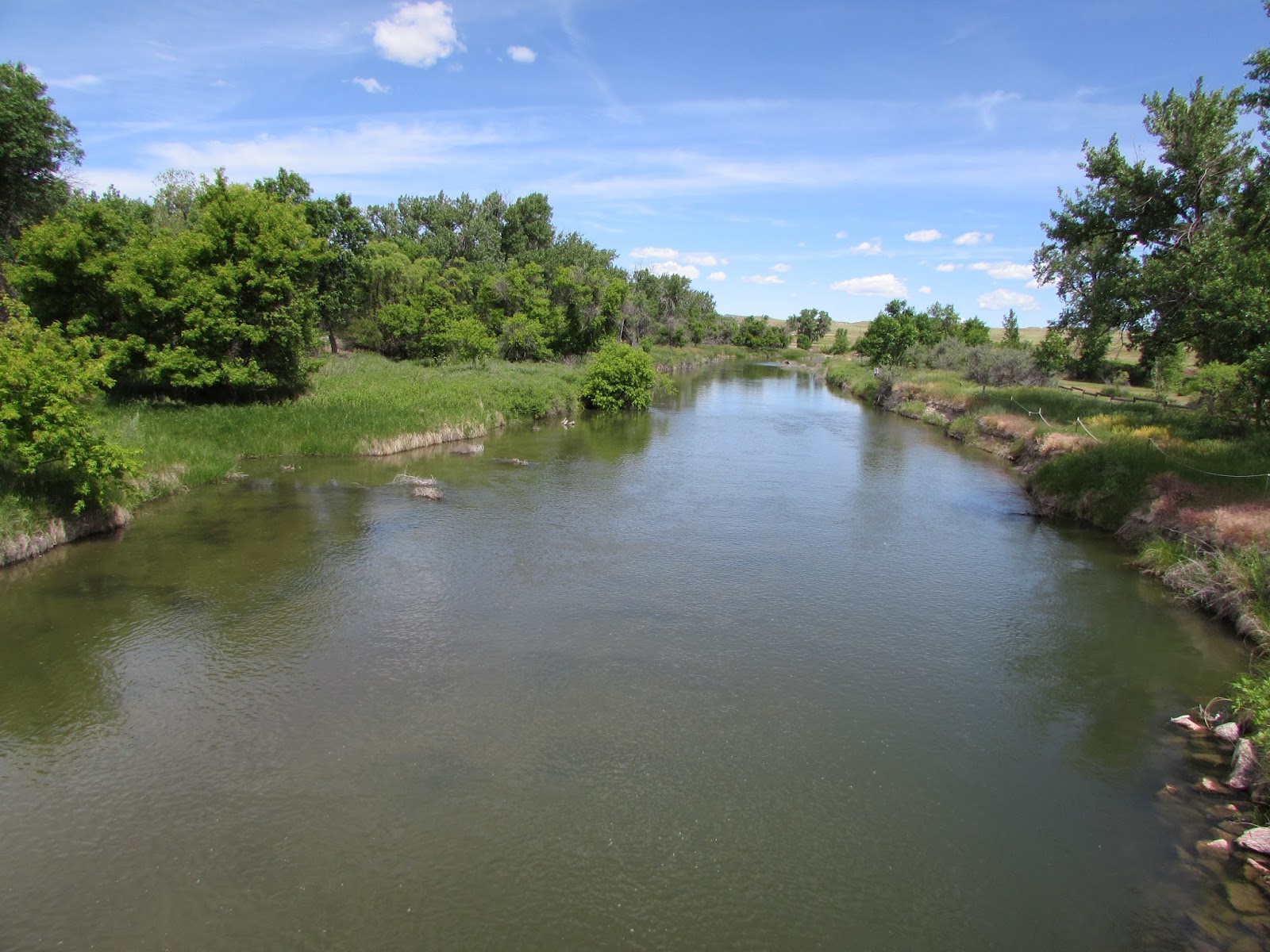
Laramie River near the fort


Fort Laramie and the Plains Indian Culture


Until 1834 Americas vast buffalo plains were wild and untouched by eastern society and business. All that changed when William Sublette built the small, Fort William, on the Laramie and Platte Rivers of today’s Wyoming. Society and eastern business came west and stationed itself behind the 18 foot high stacked earth and cottonwood walls of the fort the trappers already called Laramie.
Much of the fur trade in America’s northwest and south were already controlled by far removed big business and now the great free trappers and traders of the plains and Rocky Mountains had eastern business in their midst.
White men had hunted and trapped this area for two decades, living, dressing, eating and hunting like their nomad brothers of the plains. Many married into the tribes, happy with the roaming freedom of the plains Indians.
Over the Laramie River from the Fort
With the building of Fort Laramie came a separation of cultures. The walls of the fort kept the Indians out and let the white men in. When allowed inside, Indians were treated more like intruders than guests, a most opposite approach from the tribes who had welcomed whites into their world a few years earlier.
Trapper and Trader at Fort Laramie

In the year 1834 and the west was going through a huge change, a change that would bring bloodshed to the plains for more than a half century. The east had come west.

Tenderfoot


Hey There Tenderfoot

In 1830  William Sublette, one of the founders of Fort Laramie I posted about last week, brought five cattle into the Wind River area of Wyoming. These were the first cattle into the territory of Wyoming, maybe the first Wyoming rancher.

Local Indians were fascinated by the docile creatures, waiting their turn to let a cow lick their hand. Three years later Robert Campbell brought a few cattle to the Green River Rendezvous. The cattle had walked over 1400 miles and arrived with very sore feet. The cattle’s feet had became so bad, on the way west, that the men driving the cattle made shoes for them from raw buffalo hide. These footsore cattle spanned a new term for someone recently arriving in the west – tenderfoot.

The Three Williams, John and a Fort Called Laramie


The famous Fort Laramie of the west was once Fort William. In June of 1834 the foundation log was laid at the fort on the North Platte and Laramie Rivers. William Anderson and William Sublette got into a gentlemen’s argument over what the fort should be named. Anderson wanted to name it Fort Sublette and you guessed it, Sublette thought Fort Anderson sounded like pure poetry on the plains. Anderson even offered a bottle of champagne (likely the only one for miles around) to sway Sublette.

Didn’t work, they continued the argument while downing the champagne. Tired of listening to the argument, although he did get a fair share of the champagne, William Patton offered a suggestion, “Let’s call it Fort William, all of our first names.” The name stuck and Fort William It was.

By 1841 the fort was named after John Sarpy a fur trader at the fort. By Gold Rush time it was Fort Laramie a three year old military post. The new name was given to it by mistake in Saint Louis when a not very efficient clerk, addressed something to Fort Laramie instead of Fort William on the Laramie. And that name stuck.