Showing posts with label Cheyenne. Show all posts

A Ride With The President

In late May of 1903 the president of the United States, Theodore Roosevelt,  rode 50 miles from Laramie to Cheyenne. The story is well known in Wyoming and to Roosevelt and presidential scholars. Not much has been said about those accompanying him, and I thought it might be interesting to take a look at some of the riders who rode with the president up the mountain trail.

Francis E. Warren - U.S. Senator from Wyoming
Warren was the man that did it all for the State of Wyoming. Served as territorial Governor twice before being elected as Wyoming's first governor. Shortly after becoming Governor he was elected to the Unites States Senate. Warren served as a Senator from 1890-93 then was elected again in 1895 and served until his death in 1929. At the time of his death, he had served longer than any other U.S. Senator and was the last Civil War Veteran to serve. Warren was also a Civil War Medal of Honor winner.  Warren's daughter married John J. Pershing in 1905. Pershing went on to lead the American Expeditionary Force in WWl.

Frank Hadsell - U.S. Marshal
Appointed a U.S. Marshall for Wyoming in 1872, Hadsell is best known as one of the posse leaders who tracked down Butch Cassidy and the Wild Bunch after the Wilcox Train Robbery.
Wild Bunch

Joe LeFors - Deputy U.S. Marshal
LeFors was appointed by Hadsell, reportedly after asking repeatedly. He bragged of being with Hadsell after the Wilcox Train Robbery but most likely was not. He did lead a posse after the Wild Bunch robbed the train at Tipton Wyoming. LeFors is best known for bringing in Tom Horn. In modern days LeFors name is well known among western movie lovers because it is mentioned as the mysterious man in the white hat chasing Butch and Sundance in the film Butch Cassidy and the Sundance Kid.

N.K. Boswell - Albany County Sheriff
Boswell was the first sheriff of Albany County and most responsible for cleaning up- actually; they strung them up – Laramie’s crooked Marshall Steve Long along with his half-brothers, Ace and Con. Today he may be best known as the man who built the historic N.K. Boswell Ranch south of Laramie near present day Wood’s Landing.

R.S. Van Tassell - Cheyenne area rancher
One of the largest landowners in Wyoming history. One of his holdings, his Laramie County Ranch, was where Roosevelt and his companions stopped several times and changed horses at least once was listed as approximately 21,000 acres. During the ride Van Tassell who was near 70 years old at the time set such a fast pace that President Roosevelt, nearly 30 years his junior, reportedly said, “Say, Van, you old rascal, I believe you're trying to show me up.” Van Tassell for much of the 50 plus mile ride rode his favorite mount, Gypsy. Van Tassell kept and rode a horse named Gypsy for more than 50 years. Obviously several different horses, but most certainly a good way to remember your horse's name.

Seth Bullock - Black Hills Forest Reserve Supervisor

A long time friend of the president. Bullock was a Lawman from Deadwood South Dakota, a position he took over the day after Wild Bill Hickock was murdered.  He met Roosevelt in 1884 when he was in Deadwood and Roosevelt was a lawman in North Dakota. Roosevelt once said of his friend, "Seth Bullock is a true Westerner, the finest type of frontiersman." Bullock, although never deployed was a captain in company A of Roosevelt's famous Roughriders. When Roosevelt was inaugurated, Bullock rode in the parade along with Tom Mix to honor his friend. It was Roosevelt, as president, that appointed Bullock to the position in the Black Hills.

Oh What Can We Do

A little different slant on today’s posting. I seldom post anything, on any of my blogs, about political goings on. No, not the presidential race, actually no race at all, but instead the all-important money. In politics, money matters.


Wyoming as I am sure all readers of this blog know is going through some tough times, extremely tough. Natural gas prices are down, crude prices are low and for all practical purposes, it looks like the coal industry may be on its last legs. So what can we do?

I, like most, am not sure, but what I do feel strongly about is where we are cutting money. Now don’t take this wrong, we need to cut, what we once had may be gone forever. In the last day or two, I have read several articles about cuts, most talking of why every area needs to be cut.

Every area, really – WHY? This is turning into the equivalent of the modern-day idea that everyone is a winner. Which by the way, they are not. We do not need to keep everyone happy by cutting something from everyone. Cut where and what we must, but not everything.


Tourism

Yesterday I read of deep cuts to the tourism advertising budget. Tourism is fast becoming our number one industry and soon will be. Instead of cuts, this is the one area where we need to spend more, not less. Tourists and their money is Wyoming’s lifeline, and we need it now more than ever.


If we take money from tourism, especially from advertising, or from State Parks and Cultural Resources, we are giving up. Might as well just throw up our hands and ask Washington for money, like so many others.

Just my thoughts but remember the old saying – Put Your Money Where Your Mouth Is? We talk about the importance of tourism and supporting our parks and cultural areas because they bring money into the state and reflect well on Wyoming. It is time to back it up.


Oh – Oh – Where Should We Go?

Nearly everyone has heard of Yellowstone, Grand Teton, Jackson Hole and Devils Tower, I have visited and love everyone, but we have more, so much more. How about a trip to see one of the following.·        Hot Springs State Park·        Buffalo, Wyoming and the area around·        Cody, the city, and Museum·        The Trails Center in Casper·        Cheyenne, the capital and Frontier Days·        Any and all of Wyoming’s National Forests and Mountain Ranges·        Fort Laramie – The fort that opened the West·        The incredible Civilian Conservation Corps Museum at Guernsey State Park·        Wild horses, Buffalo, Bears, Elk, Deer and other wildlife·      Hunting, Fishing, backpacking, camping, hiking, skiing, snowboarding, snow machining or how about a Cowboy or Cowgirl game in Laramie?


That is just ten quick things off the top of my rather worn out mind. I am sure there are many more, people, places and things that need to be visited in our great state. Things to do year round, summer, fall winter, spring. We need to keep this in the minds of tourists everywhere, it might be our lifeline to the future.


**All photos today are things I believe everyone enjoys about Wyoming
There you have it, Now if I can just get down from my pedestal . .

Hey, Don't Do That - Not Here!

Often, when doing research, for a new book I run across stories that are just too good to not pass on.

The Trader
Such is the tale of early Wyoming, would be trader, H. E. Palmer. Shortly after the Civil War, Palmer came west intending to set up a post to trade with both Indians and whites. The war in the east may have been over in 1866, but in the west, it was only beginning. Palmer hired three interpreters, all part Native Indian, brought along four wagon loads of goods and built a store.  The store on Clear Creek, near present-day Buffalo, he built with the best available material – sod.
Nice Soddy south of Scottsbluff,  Nebraska

His Grand Opening
His first customers, a group of Cheyenne warriors arrived and Palmer was ready to trade. He offered his pipe, well packed with tobacco, and all smoked. Palmer was sure this, a sign of peace would be great for his trading business. Instead of buying they tossed aside everything but their weapons and told Palmer to leave.  The chief told Palmer they would let him and his men go if they would get off this Buffalo land immediately.

Well – That Didn’t Last Long
After leaving with nothing but their wagons and the clothes on their backs the Cheyenne took the sod trading post apart and relayed the sod where it had been pulled from the earth. Like many hunting and wandering people, the Cheyenne did not farm and could see no reason to destroy mother earth by taking up the sod, even if it were to build a trading post that would soon be lost in history.
It is interesting to note that Indians on the Plains to the East had been building with sod for generations, but not out here. Wyoming was teepee country.

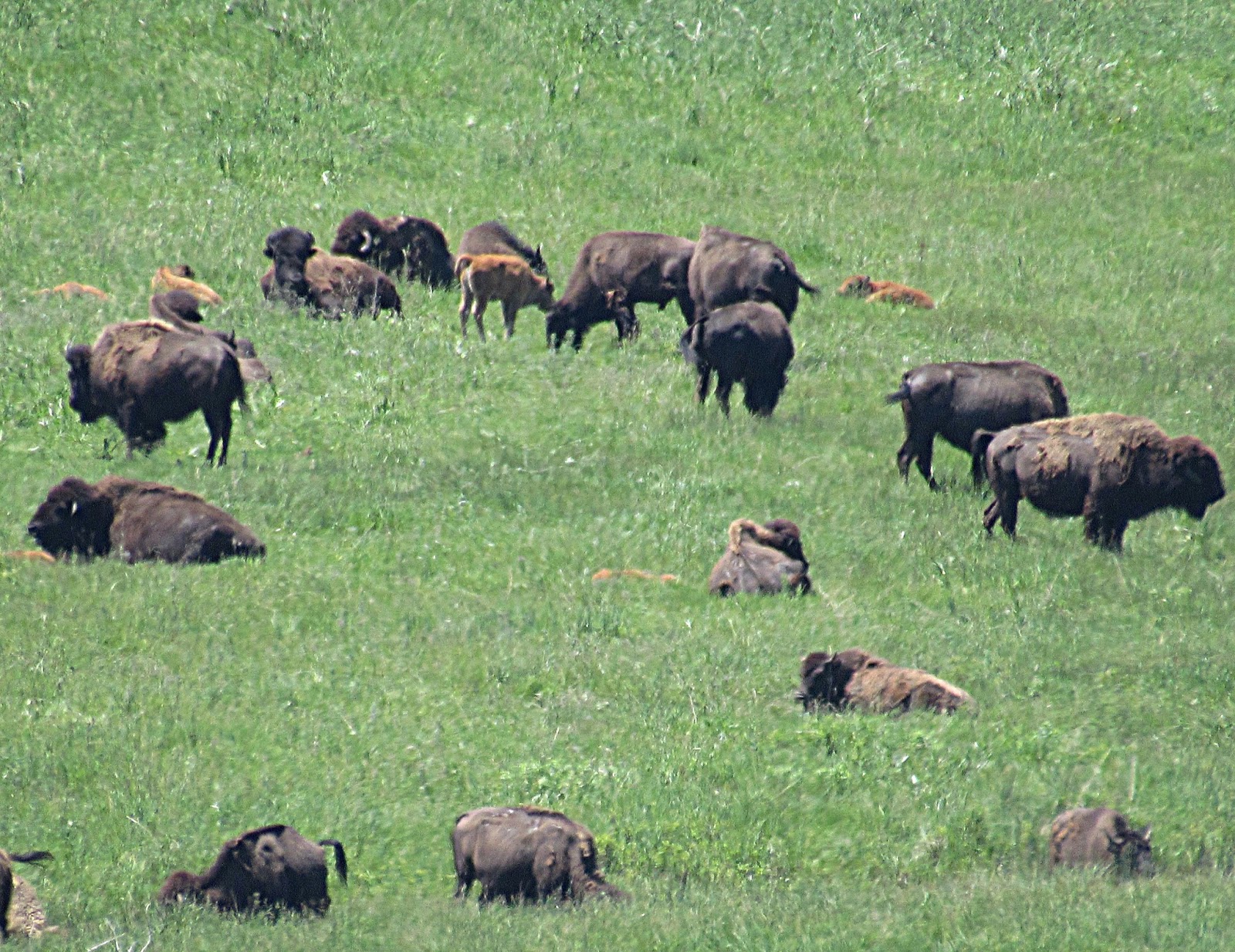
The Buffalo in History
“Historically the Buffalo had more influence on man than all other Plains animals combined. It was life, food, raiment, and shelter to the Indians. He buffalo and the Plains Indians lived together, and together passed away.”

Walter Prescott Webb from, The Great Plains, published 1931, Ginn and Company

Speaking of Politics


From July of 1868 to July of 1890 Wyoming was an officially recognized territory of the United States. General Ulysses S. Grant had been elected president, taking office in March of 1869. The time had come, but not until May when Grant got around to appointing a territorial governor. Like all presidents, past and present, political appointments where the rule of the day the first few months in office. The plum appointments were made first, Wyoming was not high on the list, too far away and too isolated for most of the east coast crowd. But, Grant still had a list of old pals, from the army and those who supported him politically clamoring for positions, even if they were in the west. His appointment to be Wyoming’s first governor was 33-year-old, John Allen Campbell.


 Campbell had served on the staff of Major General John Schofield during the Civil War. Campbell entered the war as a Lieutenant and left a breveted Brigadier General. After the war, he was part of the American reconstruction team in the south. His ties with Grant’s friend Schofield, and his work as a writer and officer in the war, of course on the Union side, led to his appointment.

By most accounts Campbell was a popular governor, part of that was because of the appointments he made to complete the territorial government. The new Territorial Secretary was Edward Merwin Lee, a former prisoner of war, Union General. He went on to found the Wyoming Tribune in Cheyenne. Campbell also appointed Benjamin Gallagher as the Auditor. Cheyenne banker John W. Donnellan was appointed treasurer. Donnellan came to Cheyenne after serving as a Colonel in the Union Army.
Wonder if those easterners knew Wyoming looked like this?

Campbell was reappointed in 1873 later became assistant sec of state and then American consul in Switzerland in 1877 where he served until 1880 when he returned to the United States, where he died later that year at age 44.

Wyoming the Railroad and What If

The transcontinental railroad was a brainchild of Eastern businessmen and politicians in the 1830s. It took a while, about two decades before any real planning took place and another decade before work was started. It took President Lincoln to finally push through legislation to build it. The Central Pacific started building in 1863 and the Union Pacific in 1865. Promontory Summit was reached and the railroads joined in 1869.


Wyoming was a big part and a big challenge for the railroad. The original route was to follow the Oregon Trail, but the Pony Express proved there was a better route through southern Wyoming to South Pass, the only feasible way to cross the mountains. This route saved a couple of hundred miles and was no harder to build.  Although original plans called for a route that was nearly the same as the finished railroad, there was a controversy about the route. Texas wanted a southern route, using better weather as their public reason. Privately they wanted the railroad for the huge economic benefit they knew it would bring. When the Civil War started, Texas was out and the tracks through Wyoming were not far away.
Trains are a bit faster today
Not everyone was happy with this, Denver had lobbied for the railroad, but no route including Denver was ever considered. But the early people of Denver, knowing that they could connect to the railroad and reap most of the benefits of its northern neighbors. Thus was born the Denver Pacific, a bit over 100 miles of track connecting Denver to Cheyenne completed one year after the completion of the Transcontinental Railroad.

It was another 20 years before Wyoming became a state in 1890.  Most of the early population lived along the railroad, it brought jobs and with jobs came the people. It is always interesting to speculate as to what could have happened, what if.  How long would it have taken for Wyoming to become a state without the railroad? As the least populated state today, would it be even smaller if it would have taken another 20 or 30 years to have adequate rail service? Would the cattle drive era been a time when cowboys drove cattle south from Wyoming to the railroad in Texas?


I may have had too much time to think about offbeat subjects today. Hey, what if . . . . . .

Cheyenne - The RR Town

On the fourth of July in 1867, General Grenville Dodge set the spot for Wyoming’s first railroad terminal. Crow Creek was the spot. He named this spot Cheyenne after the Indian tribe in the area. It didn’t take long for a city to grow from the terminal.

Robert Strahorn, while preparing his Handbook, asked one of the first settlers of the city if he could point out the first house erected in Cheyenne. “The old settlers replied, “ well, one fine day, early in July, 1867, four or five hundred of us pitched our tents here, where there wasn’t a sign of civilization, and about half of us woke up at daylight the next morning to find that the other half were living in board shanties.” **
**From Velma Linford’s, Wyoming Frontier State.
1890 Train


Cheyenne, at the time, was constantly referred to as a creation of the Union Pacific Railroad. Within weeks a city blossomed. By the end of summer, more than 300 businesses were open in Cheyenne. By November when the first rails made it to town, 4,000 people were living there. A year later the population dropped to 1,500 but the town remained and grew, reaching a population 4,500 people by the early 1880s.


Fifty-nine railroads were incorporated in Wyoming between 1869 and 1900. Seems like we should have tracks running all over the state. Many of these railroads were only on paper and never able to raise the money to build any miles of track. But some track was getting built, a reported 290 miles in the first few years of twentieth century.
Train heading west

Cheyenne - Dog Soldiers of Wyoming

A somewhat, obscure in history, tribe called the Staitans were friends with, and later absorbed into the much better known Cheyenne. The Staitans were in Wyoming by the early 1700s, maybe earlier, but by the early 1800s they were no more, absorbed, peacefully, by the Cheyenne. When the Staitans were flourishing they were considered the most warlike of tribes on the plains. They thrived in the east central area of today’s Wyoming, reaching to the edge of the Laramie Range. 


Much of the well-known Cheyenne culture was taken from the ancient Staitans including the ceremony of the Medicine Arrows, (four arrows, two for war, and two for hunting). They also adopted the Sun Dance and the Medicine of the Buffalo Head, from these people.


The Cheyenne were sometimes called Dog Soldiers and likely got that name from the French word Chen, meaning dog.  Later the Dog Soldiers were but one faction of the tribe but the entire tribe still remained know as the Dog Soldiers to most plains people of the 1800s.  The Cheyenne were driven from their home in present day Minnesota by the Sioux, who called them, Sha-hi-e-na.

Sha-h-e-na, literally meant those who spoke a language which was not understandable. Tribal groups that spoke an understandable language they were said to, “talk right,” those who did not, “talked wrong.” The Cheyenne were said to speak, only wrong words.”


With our state Legislature now in session and all the politicians in town it is interesting to note they are meeting in our state capitol. A city, Cheyenne, named after wrong talking people. Hummmmmm!

Sunset over the Laramie Range in Eastern Wyoming


Wyoming's First Tribal People


Much has been written, motion pictures and television shows have been made, and a lot has been taught about Indians in the west. In Wyoming the focus is on the: Sioux, Cheyenne, Arapahoe, Shoshones and Crow. But of these tribes only the Shoshones were here long term.

In 1700 the tribes of Wyoming included, along with the Shoshones, the Comanche, Kiowa and Staitans. By 1800 the Comanche had moved south and the Crow and Cheyenne found a place to live in Wyoming. The Sioux were soon to follow, arriving shortly after 1800.

Interesting that so little is written about the century and a half of the more peaceful time for Native people in Wyoming. The first mountain men/trappers came around 1820 and by the 1840s wagons were rolling on the Oregon and Mormon trails, and the west of movies and television was born.

The Battle Where the Girl Saved Her Brother


Sounds like a very unusual name for an important battle with the Sioux under Crazy Horse allied with warriors of the Cheyenne under Little Hawk. This strong group was involved in an ongoing series of battles with the famous General George Crook during the Indian Campaign of 1876.  This encounter, which history books call, “Battle of the Rosebud, Montana,” was one of these fights.

One of the Indian leaders, Two Moons was heading a group of about 200 warriors and one women, Buffalo-calf-Road-Women, who refused to let her brother, an under chief named, Comes-In-Sight, go to battle alone. When Comes-In-Sight’s horse was shot from under him, Buffalo-Calf-Road-Women, rushed to the rescue. Riding her pony into the battle she scooped up her brother, saving him.

Eight days later, and not far away, Custer and his men of the 7th were wiped out near the Little Big Horn River in present day Montana.


Incompetence and Politicians –Governor Moonlight


Colonel Thomas Moonlight was likely the worst commander in the history of Fort Laramie and may well have been responsible for the escalation of the Indian wars in Wyoming and the west.

Black Foot and Two Face (Oglala Chiefs) brought in a white woman, Lucinda Eubanks, who Big Foot had purchased from the Cheyenne who’d kidnapped her on the Little Blue River* in southeast Nebraska, several months earlier. She was in bad shape after being badly abused (by her captors before Big Foot and Two Face) and Moonlight who seemed to make decisions based on emotion and bad judgment  ordered the Sioux Chiefs hanged with trace chains by the neck. The two died a slow agonizing death and were left hanging, as an example, for months. The Sioux retaliated in kind.

And just what terrible punishment did Moonlight face for this torture and killing without due process or a trial of any kind?  He bounced around in the army for a few more years then went into politics in Kansas and was later appointed Governor of Wyoming Territory by President Cleveland (January 5, 1887). Governor Moonlight took the oath of office January 24, 1887 served until April 9, 1889, staying in government service as U.S. Minister to Bolivia for President Cleveland from 1893 to 1897.
*I grew up on the Little Blue River in southeast Nebraska but never heard this story untill I moved to Wyoming-not too far from Fort Laramie. Most of our knowledge of local history was centered around Wild Bill and the Rock Creek Station shoot-out.


The Treaty of Fort Laramie


The famous Great Council of 1851 (Treaty of Fort Laramie) is well recorded in History books, especially Wyoming History. But by 1890 when Wyoming became a state the famous treaty location was actually in Nebraska. Fort Laramie (Wyoming) itself only covers a few acres and at the time of the Great Council camps of both whites and Indians were spread out for miles. Grass was eaten down to nothing pushing all involved farther and farther from the actual fort as the government waited on gifts from the east to arrive.


This treaty was supposed to solve the problem of Indian wars against the white men on the plains but many historians point to this as the beginning of the Plains Indians wars of the west. The council that tried to keep Indians away from the trails by giving payments to the tribes for the game they lost after being relocated away from the North Platte River. Although all tribes were invited it was the Sioux, Arapaho and Cheyenne that were closest to the trails and most dangerous to travelers, these tribes were among the first and longest lasting of the Plains Indians trying to stop expansion into their territory.


The United States government made only one payment thus breaking the treaty that they had pushed so hard for. The treaty would be redone in 1868, but it to would also fail and wars on the plains would continue until 1890 and Wounded Knee.


Laramie Wyoming

What a crazy place I live in.
No, not that way crazy, but a crazy name.

Laramie, named after a French-Canadian trapper, Jacques LaRamie. He came to Wyoming Territory to trap no earlier than 1816 and was killed by the Arapaho in the winter of either 1818 or 1819. According to Jim Bridger who came to the area a few years later LaRamie was well liked and respected as an honest trader by Indians of the area.

So why was he killed? No one knows but likely for whatever possessions he had with him at the time. And no one can say with absolute certainty that it was Arapaho who killed him, although most stories back up this belief.
Today the city of Laramie is named after him along with: Laramie Peak, the Laramie Plains, and the Laramie Range of the Rockies, Laramie County (Home of Cheyenne, Wyoming’s state capital), the Laramie River, the Little Laramie River, and maybe others I cannot think of right now.

So what did he do that warranted naming more things after him than any other person except James Bridger? No one knows, but Laramie City was a true wild and wooly Wild West town in the late 1860s when the railroad first came to town. Jacques LaRamie, a true symbol of the times long past seemed to be a fitting name for an area changing so rapidly.

LaRamie was a pioneer, trapper, explorer and trader in this area and we don’t even know his real name. There were many Jacques with French last names during this time in history so somewhere along the way historians assigned him Jacques as his first name. LaRamie may have been one of many trappers who went by only one simple name (and to think people today think, Elvis and Cher came up with this idea). Not sure why historians thought he needed anything other than just LaRamie.

-N-