Showing posts with label Grattan Massacre. Show all posts

Indian Wars In The West

In 1825 President James Monroe, after looking at reports from his top advisors, created, what was called, the Indian Frontier between the Mississippi River and the Rocky Mountains. It was believed at the time that this area was unfit for anything other than the native tribes and the wandering herds of bison.


The frontier designation came shortly after the government got out of the trade business with Americas western frontier. For decades the United States Government had licensed traders in the west, allowing them to build trading posts/forts, referred to by the government as factories. When the government gave up the selling of trade licenses for specific monopolies of trade territories, it cost the government some money, but they were no longer considered a significant economic boon to the country.


The Bureau of Indian Affairs, formed in March of 1824, by Secretary of War, John C. Calhoun, as part of his department and without asking for, or getting authorization from Congress. Calhoun recognizing that trappers and traders were going to operate in the West without the benefit of traders licensed by the government, but still wanted some type of organization in the western wilderness. He appointed, also with anyone’s approval, Thomas L. McKenney as the first Superintendent of Indian Affairs. McKenney called himself, the head of the Indian Office. He was removed by President Jackson in 1830 because of his belief that the Indian was morally and intellectual the equal of white’s.
President Jackson

In 1834, the Indian Intercourse Act was passed, forbidding whites from going into Indian lands without permission from the commissioner of Indian affairs. That date is important because there were already hundreds if not thousands of company trappers, free trappers, traders, hunters, and wanders, already in the forbidden, to whites, Indian lands.
From this came the new Army of the West. It took a few years but by 1849, the Bureau realized the need for a presence in Wyoming, purchased Fort John, and changed it to a military post, renaming it Fort Laramie.
Fort Laramie's Old Bedlam
From that point, troubles persisted. People moved west without permission, young military commanders wanted to fight Indians not make peace and the tribes grew more and more aggressive as the bison on the plains were shot up.

During his brief, 16 months, Presidency, Zachary Taylor, moved Indian Affairs to the U. S. Department of the Interior, believing it was a better fit for the unsettled lands.

Some have argued that the BIA created as many problems as it solved. Five years late, 1854, the Grattan Massacre just east of Fort Laramie began histories Plains Indian Wars period.


The Curious Case of Lieutenant Hugh Fleming


The Grattan Massacre, Aug 19, 1854, is often listed as the event that started the Indian wars on the plains. Anyone who is interested in Wyoming history knows the story of the killing of the cow from a Mormon wagon train and Grattan leading his troops to their death in the ensuing battle. But very few know the story of the commanding office at Fort Laramie, who either ordered him or allowed him to take the troopers on the ill-fated journey.


Brevet Second Lieutenant Hugh B Fleming was the commander at Fort Laramie at the time. The fact that a Brevet Second Lieutenant was in charge is a bit of a mystery itself. Fleming was promoted from cadet, upon his graduation from West Point, to the rank and sent to Fort Laramie. One year later he was in command. I am not sure how officers were chosen for command, but it is likely that Fleming was neither ready nor capable of this command, only a year removed from Cadet status at West Point.


Fleming was in charge but undoubtedly was not meant to be the permanent commander. In 1854 alone, four different men commanded the Fort. Fleming followed, Lt. Richard Brooke Garnett and proceeded Major Andrew W. Evans who was followed by Major William Hoffman who stayed through 1857. It is possible that Fleming was ushered out as soon after the August Grattan massacre as the Army could make the move.


It was not this brief time as the commander alone that left his stamp forever on the Indian wars of the west. In June of 1853, Fleming was sent by Fort Commander Lieutenant Richard B. Garnett to a Miniconjou Sioux encampment that had fired upon Sergeant Raymond and captured an army supply boat near the fort. Although no one was injured and the boat was soon recovered, Fleming was sent with orders to demand the Indians turn over, to the army, the person who had fired at them. Fleming took along 23 men and an interpreter. His orders in addition to bringing back the shooter allowed for Fleming to capture and bring back two or three prisoners if the Miniconjou would not turn over the one who fired on them.  


The tribe refused to turn over the wanted man and Fleming marched his men into the center of the village to take prisoners. A battle started and three warriors were killed and three more wounded. Fleming grabbed two more as prisoners and returned to Fort Laramie. A few days later a group of Miniconjou came to the Fort, asking to parley. Whatever happened here, the tribe was not satisfied.  It took a bit over a year before Grattan and his men were killed, but Lt. Fleming and his two very bad decisions may have directly led to the Indian or Sioux wars in the west.


Fleming went on to a long but rather ordinary career in the military, serving as a recruiter and not seeing action in the Civil War, he retired as a Major.


Note* I am pretty deep into research on a new book about Fort Laramie and have found dozens of stories, like this one, that seem to give a different and deeper view of history. When researching I try to be very painstaking in getting it right. In ten minutes of looking at online sites on the Grattan Massacre I found it happened on August 17 or August 19 in either 1853 or 1854. As I told my students for 42 years, check and verify before putting it on paper. By the way -  It happened on August 19, 1854.
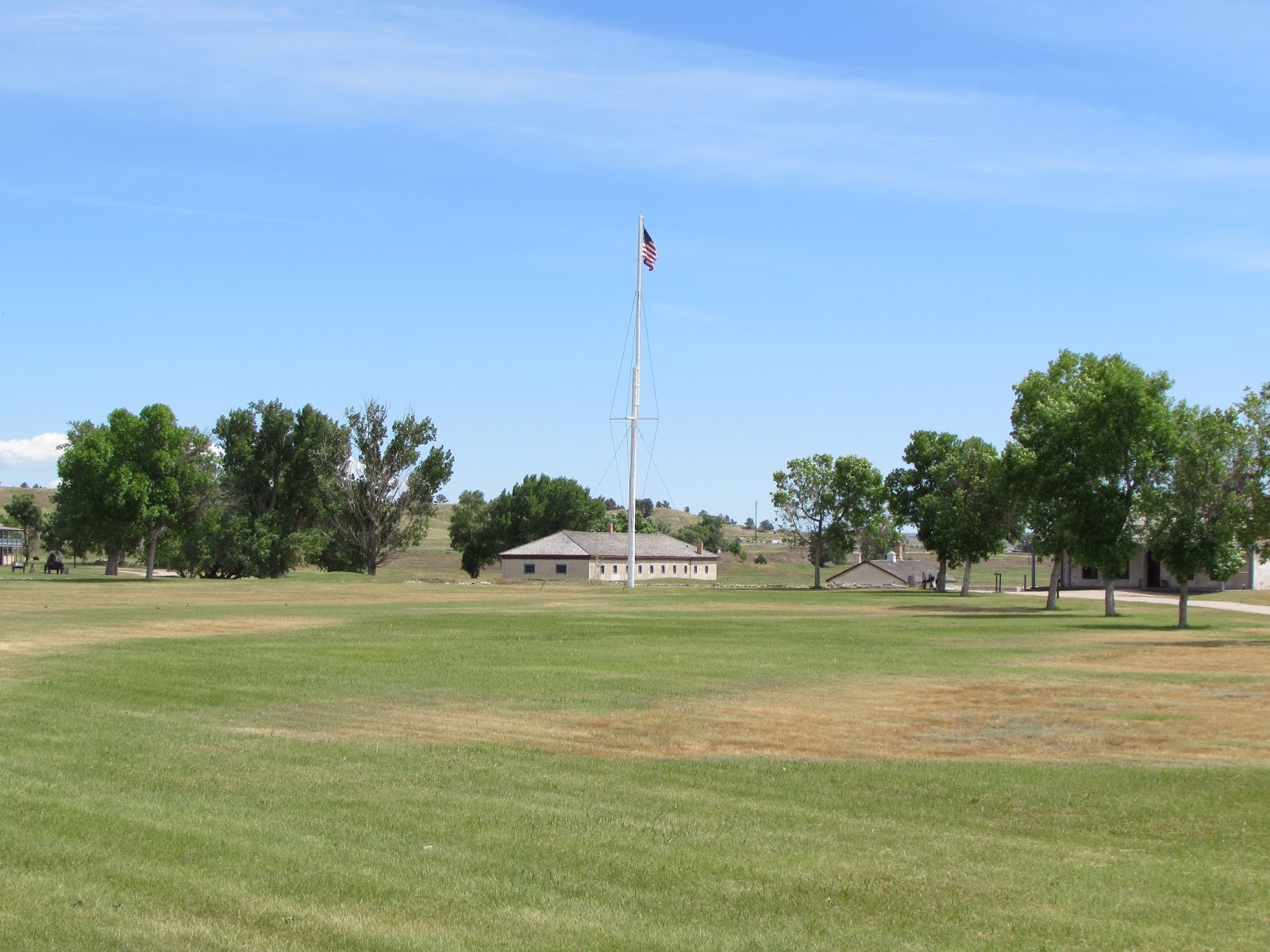
Couldn't resist - here I am at Fort Laramie on the Fourth of July - thanks for reading

Longest Parade in the West - Fort Laramie 1851


The Longest Parade in the West – Fort Laramie 1851

Every student of American West history knows the treaty of Fort Laramie was signed in 1851. Not many know what a spectacle it was. I have posted about this treaty before but it is fascinating and I only live a few minutes from the old fort. Thought I might post something other than the typical.

So, what is that about the parade? When everyone got ready to finally sign, the tribes had been at Fort Laramie for weeks.  In typical Indian fashion the camps were moved to allow for enough grass for the horses. By the time the treaty was signed the tribes were 36 miles downstream at the point where Horse Creek flows into the North Platte River. The reason they were so far down stream? The signing was to be in September but the tribes hoping for trade opportunities and some freebies started arriving by the first of July.

 Government dignitaries, dubious luminaries, and army officers traveled over three days from their accommodations at the fort to get to the place of the signing ceremony. They traveled in fancy coaches colorful buggies or rode decorated horses complete with accompaniment from an army band. A three day, 36 mile long parade—whoopee!

Must have been quite a site at the signing, the government stuffed shirts, most of Fort Laramie’s 300 troopers, 10,000 Indians, 30,000 Horses and 10,000 dogs barking out of tune to the Fort band.

The treaty was a pretty good one, lasted from 1851, all the way up to the Grattan Massacre in 1854. As far as treaties in the west go, this one was pretty long lasting. The next forty years became the Indian wars period of the American west.

Interesting that one of the west’s most famous treaties was the start of the Indian wars in the west.  Important to remember that is was not the cause. The causes were many, but intrusion of people from the east on Indian land sums it up pretty well. When the 49ers trekked across Wyoming for the California gold fields the battles in the west were inevitable.