Showing posts with label history of wyoming. Show all posts

Health is Back and So is My Writing

It has been an interesting few weeks since I last posted on this site. Two weeks of Covid, a week or more of recovery, and then what we felt like was a well-deserved vacation.

Vacation - We spent some time, as always, looking at history and hiking as we traveled in the American southwest. It was a relatively quick trip, a couple of days in Santa Fe, (I love the architecture there).

Cliff Dwellings in the Gila National Forest

Then a couple more in Silver City, NM. We found the Silver City area, which we had never visited before, much to our liking.
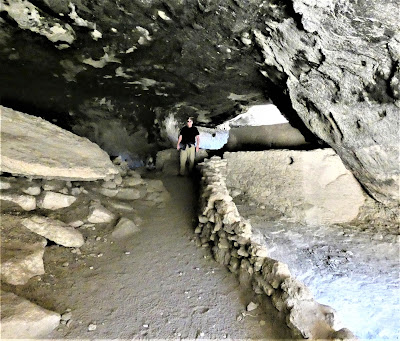
One of the few sites where visitors can carefully walk through the dwelling area. 

After Silver City, we spent several days in and around Tucson, AZ. All and all, a fine trip, relaxing, educational, warm, and fun, but as always at our age, exhausting at times.

Unlike some petroglyphs, in the Gila Forest were simply painted on rock - no scratching or carving.


Tombstone – We spent a delightful afternoon in Tombstone. It was much like we imagined, very touristy, i.e., Keystone SD or Estes Park Colorado. We saw lots of fictional history and a bit of real history. And as everyone should when you visit Tombstone or Deadwood, we watched some excellent gunfights. It really was lots of fun!

Downtown Tombstone last week. Fairly busy for mid-week. 

Wyoming - Enough about us – did you know Wyoming’s first post office was established today in 1850. Where? Fifteen minutes down the road from where we live – it was established in Fort Laramie. Thanks to Patrick T. Holscher and his excellent book – On This Day in Wyoming History, for that bit of information. 

Laramie - as in old Jacques LaRamie

 Dec 20, 2021

Laramie 


La Ramie, as in the man who has more things named after him than any other person in Wyoming. His name (maybe) was Jacques LaRamie. In Wyoming, we have the Laramie Range, Laramie Peak, Fort Laramie, the city of Laramie, the Laramie River, many Laramie streets, and probably other things I cannot think of right now. Why the (maybe) when I mentioned his first name was Jacques?

Some historians tell us that Jacques was a popular French-Canadian name, and someone writing history tagged him with it. Some believe his name was Baptiste. Others are convinced his first name was Joseph. Doesn’t sound nearly as good as Jacques. Joe Laramie – not much of a ring to it. 

J. Edmond Laramee, who claimes to be a descendant of Jacque, relates that his parents were Joseph and Jeanne Laramee of Quebec. It sounds plausible, except that Joseph and Jeanne had no children with the first name of Jacque. The couple had five sons, one of which was Joseph, but no Jacque. 


We didn’t know his surname either, not for sure, as there were also multiple spellings of his last name. At some time along the way, we modern agers settled on Laramie because it was easier to say and spell. We also do not know how he died. As most early histories were written (some fact and some fiction), he died a heroic death, either killed by Indians (the Arapaho vehemently denied this), or he fell on the ice, broke his leg, and fought on for days or weeks before passing. 

Was he a great spokesman for and leader of the free trappers, or was he simply a man who was friendly with all who, after his death, other trappers liked to tell stories about? We will never know, but it doesn’t matter. He still represented that early time in Wyoming history the way we want it to be – whether true or not. 


In my many years teaching Wyoming history, I sometimes referred to Laramie as Pierre or Joe as a reminder of how fickle history can be. 


Hope all of you have a most Merry Christmas!


Wyoming and the Old West

 Few people even know the true definition of the term “West”; and where is its location? – phantom-like it flies before us as we travel.  George Catlin

We often see mention of the West, the Old West, and the Wild West. Are they the same? Well, yes and no.

I know a great answer.


The West - Many historians, including myself, like to use the 98th Meridian as the beginning of the west. This line would be drawn from San Antonio, Texas north through Fort Worth and Oklahoma City. From there, it cuts through the middle of  Kansas and Nebraska, passes Pierre, South Dakota, and then through Bismarck in North Dakota. Confusing? Yes, but manageable if you pull out a nice map.


I like this area for the beginning of the west because this is generally the area where farming gives way to ranching, rainfall dependable to arid.

The Old West – The old West period didn’t last long, generally from the Civil War until 1890 and the Wounded Knee Massacre. It was also the time of most of the Indian Wars of the west. This period was a time of rapid settlement throughout the west. It brought about cattle drives, sod houses, plow follows the rain theories, and the Homestead Act (signed by President Lincoln on May 20. 1862.


The Wild West – The wild west was made up of more Indian wars, gunfighters, bank robberies, rowdy saloons, and corrupt gamblers – most, if not all, a figment of the imagination made up in Hollywood. I watch many old western movies and series shows. I look at them much like I do fantasy, not true, but entertaining.


Wyoming – Like most of us in the state, I have lots of Wyoming logo hats, shirts, pullovers, and hoodies. I wear them almost everywhere and have, over the years, got many comments. Three years ago, we were sitting in front row seats at a theatre in Branson, Missouri. A couple sat down beside us from New York. He asked, looking at my pullover, “are you from Wyoming?”

We said, "yes"

His reply – “cool, we were there a few years ago and loved it.”

So many still see Wyoming as an old-fashioned place to live, and it probably is, but we love it here.


A Trip Back In Time

Horses grazing in river bottom meadow at Fort Laramie. This photo could have been from 150 years ago. The fort is one of my favorite places and a place that all western history buffs should visit.

Seems to me that in present day vacations too often lead to zip lines, scary theme park rides and shopping mall adventures - too bad.
Ruins at Fort Laramie - to me kind of an ancient Greece look

Not at the Fort, but not far away
Exploring the past can be as much fun as a theme park adventure, and who knows you might just learn something.
Not into history?  Climb a mountain and take a look back to where you came from, fun stuff.
This mountain, in the Laramie Range, is about 50 miles west of Fort Laramie looking back toward the Fort.

False Fronts in the Old West

I have long enjoyed the look of old west false front buildings. Not many left any more.
False fronts were used on business buildings to give a more dignified look and a more permanent look to the building and business. People moving in from the east were supposedly impressed by the eastern appeal of these buildings. Store keepers and town builders felt the false fronts, turning one story building into two stories, gave the appearance of a busy commercial district.

One interesting story says the false fronts were used in Colorado to hide the mountains from the new easterners, thus not reminding them they were not back east any longer. Today mountain views are one of the great things about the mountain west and they can cost homeowners a lot of money. How times have changed. 


The Photos are from main street in Hartville Wyoming a great old west tiny (population less than 100) town.

For Sale Business Building

Hartville Post Office

The Old Fire House - There is a Very Nice New One Now


And a Fixer Upper


Wyoming Super Moon

Read a story about a super moon and had to check it out. Here is what I learned.
 All photos from Guernsey State Park, August 10, 2014.


While I was waiting for the moon, yes, I know, sounds a bit odd. I caught a mighty fine sunset.

And I couldn't resist a sunset in black and white, strange, but it just seems to work.

Fort Laramie and the Trail West


Fort Laramie changed the trail for many travelers.  For years the Oregon Trail passed along on the south side of the North Platte River. Especially after Fort Laramie, the north side was considered too difficult.


Fort Laramie a mile in the past


 But in later years, on the trail, the north side was utilized as a good alternative to the south.  North of Guernsey, Wyoming is a very big hill, Immigrant Hill, might be a small mountain, that should have deterred even the most fool hardy of travelers, but it did not. 


The Trail west between Fort Laramie and Guernsey, WY

Often wagons had to be towed up the hill, but the same was happening a few miles earlier on the south side of the river, as wagons needed to be towed up Mexican Hill. Finding good graze was a constant problem on trails west. Paths on both sides of the river made a chance to find good grass a possibility – as long as you were not the last train west for the year.


Standing on the Oregon Trail one mile west of Fort Laramie, looking west.

The trip to Fort Laramie was pretty flat, just drive I-80 across Nebraska and you will see what I mean. It does rise about 3,000 feet from the Missouri River to Fort Laramie but it takes 500 miles to do it.  Once the travelers left Fort Laramie, trail hardships became a reality.


 The trail now would rise a thousand feet in a hundred miles which was not too bad. But getting up and down some of the smaller chains of mountains that start to transverse the country at this point was a problem.


Life was good for the travelers, and then they left Fort Laramie.  The tough climb up and down all the way to the Continental Divide became, lighten the wagon miles.


Fort Laramie Today


Photos from March 2014

Wyoming Storm Coming In


The clouds were heavy but blue was still peaking through when I took these photos yesterday. A half foot of snow was soon to follow, but for me it was a beautiful day. All photos are from the area between Laramie and Wheatland.

Love driving through Wyoming where photo opportunities abound. These Pronghorn were facing away, but typical to their behavior, when I stopped they had to take a look at me. 

Wish I were a little quicker, we saw a group of seven Bald Eagles including one very close up immature Bald. But they are not crazy about stopping SUVs, so I missed my opportunities. I will settle here for some, newly, snow covered mountains. 

For those of you that are in the track of this snow storm, stay warm  and stay safe.


The Mighty Sioux


In a sacred manner I live

To the heavens I gazed

In a sacred manner I live

My horses are many


In my part of the west the Sioux were the largest tribe. It was the tribe of Sitting Bull, Crazy Horse, Red Cloud, Spotted Tail, Roman Nose, American Horse and Old Man Afraid of His Horses, to name a few.

At the height of its glory the seven divisions of the tribe stretched from Yellowstone in the west to the middle of Wisconsin on the east. Of the seven divisions, the Teton Sioux of South Dakota, Nebraska and Wyoming was by far the largest with an estimated number of more than 20,000 in 1890. So big in fact that it too was divided into seven groups.

Before the wars on the plains started the Sioux were a happy wandering people. As more and more of their land was taken from them the Tribes were backed into a corner and fought. Outnumbered, it was a losing battle from the start. Most historians today agree that the government’s failed Indian policy is what started the wars. And why did the government’s Indian policy fail? The government planned and wanted it that way. Sad but true!

Longest Parade in the West - Fort Laramie 1851


The Longest Parade in the West – Fort Laramie 1851

Every student of American West history knows the treaty of Fort Laramie was signed in 1851. Not many know what a spectacle it was. I have posted about this treaty before but it is fascinating and I only live a few minutes from the old fort. Thought I might post something other than the typical.

So, what is that about the parade? When everyone got ready to finally sign, the tribes had been at Fort Laramie for weeks.  In typical Indian fashion the camps were moved to allow for enough grass for the horses. By the time the treaty was signed the tribes were 36 miles downstream at the point where Horse Creek flows into the North Platte River. The reason they were so far down stream? The signing was to be in September but the tribes hoping for trade opportunities and some freebies started arriving by the first of July.

 Government dignitaries, dubious luminaries, and army officers traveled over three days from their accommodations at the fort to get to the place of the signing ceremony. They traveled in fancy coaches colorful buggies or rode decorated horses complete with accompaniment from an army band. A three day, 36 mile long parade—whoopee!

Must have been quite a site at the signing, the government stuffed shirts, most of Fort Laramie’s 300 troopers, 10,000 Indians, 30,000 Horses and 10,000 dogs barking out of tune to the Fort band.

The treaty was a pretty good one, lasted from 1851, all the way up to the Grattan Massacre in 1854. As far as treaties in the west go, this one was pretty long lasting. The next forty years became the Indian wars period of the American west.

Interesting that one of the west’s most famous treaties was the start of the Indian wars in the west.  Important to remember that is was not the cause. The causes were many, but intrusion of people from the east on Indian land sums it up pretty well. When the 49ers trekked across Wyoming for the California gold fields the battles in the west were inevitable.


The Lovable Jim Bridger


Jim Bridger was quite a guy and a pretty decent scholar, despite a few shortcomings. He could use sign language as well as anyone in the early west. He spoke passable Spanish and French along with English and several Indian dialects. He could read sign and survive the toughest conditions with the best of the Mountain men. At the rendezvous he could party and tell stories, well maybe better than most. He quoted long passages from the Bible and from Shakespeare, so what shortcomings did he have? He never learned to read. A man as smart as he was could have learned, and rather quickly. Why didn’t he learn, maybe he liked learning from others and didn’t see the need to read. We will never know.

I have written other posts about Jim Bridger - see here. This post talks about Bridger's penchant for telling tall tales.

http://wyoming-fact-and-fiction.blogspot.com/2006/12/jim-bridger-story-teller.html

Laramie Peak


Laramie Peak the highest mountain in the Laramie Range of the Rocky Mountains stands 10,276 feet above sea level. The Peak, as we locals call it, doesn’t sound too impressive until you look at the land around it. Only a few miles away the land is 5,000 feet lower. This makes Laramie Peak more than a mile high from the surrounding area, now that’s impressive.

Easily seen for more than 100 miles, travelers on the Oregon and Mormon trails watched it for more than a week, wondering if they would ever reach it. Laramie Peak let voyagers know that they had reached the mountains, a place on the trail they had waited many months to reach.

Mark Twain in his famous western journey, Roughing It, wrote of the peak. We passed Fort Laramie in the night, and on the seventh morning out we found ourselves in the Black Hills, with Laramie Peak at our elbow (apparently) looming vast and solitary--a deep, dark, rich indigo blue in hue, so portentously did the old colossus frown under his beetling brows of storm-cloud. He was thirty or forty miles away, in reality, but he only seemed removed a little beyond the low ridge at our right.”

We live in a beautiful area between Fort Laramie (13 miles east) and Laramie Peak, (35 miles west)The North Platte River, Oregon and Mormon trails are less than a half mile away. We take a look at the peak every day, if the top has cloud cover the wind will blow, if the top is visible, mild weather and its never wrong.

I took these photos of Laramie Peak last week, one from atop Spotted Tail Mountain in Guernsey State Park and the small one on the right from west of town.


Tim McCoy


Tim McCoy’s, 1938 version of a Wild West show didn’t last long, bankrupt in less than a month. McCoy’s version was more of an anthropological look at the way the west once was, instead of a Wild West thrill show. With Buffalo Bill, whose show went bankrupt in 1913 after a 25 year run, and others long gone, McCoy had hoped to get Americans and then Europeans interested in the old west once again. But moving pictures and by 1938, talking ones, were enough to satisfy people’s old west cravings. McCoy seemed to be the old, too little, too late.
McCoy grew up in the east but moved to Wyoming and became a cowboy as a young man. He joined the Army during WW1 and again in WW2. He rose to the rank of Colonel in the Army Air Corps and Army Air Force. He was the Adjutant General for the state of Wyoming between the wars and given the brevet rank of Brigadier General at age 28. At the time he was the youngest Brigadier General in the history of the U.S. Army.
In 1942, McCoy ran for the Republican nomination for the open US Senate Seat from Wyoming. He lost in the primary and immediately entered the army again.
McCoy became an honorary member of the Arapaho tribe and was given the name of, High Eagle, by the tribe on the Wind River Reservation.
Tim McCoy continued making movies and touring with other wild west shows after the war ended but never had either the money or the inclination to try his own Wild West show again.
 

Fun at the Rendezvous


The Rendezvous was a place for the trappers to let off a little steam, all right, in some cases a lot of steam. Because of the over abundance of whiskey, surprisingly, some trappers made poor decisions. People were shot, bones were broken, and fortunes (at least by mountain man standards) were made and lost. Only the first Rendezvous had no whiskey, it also had no fights and no duels; it was also the shortest of the 16 rendezvous.
The trade whiskey that became such a big part of the other Rendezvous was often a wild concoction of whiskey, creek water, tobacco and hot peppers, some traders used other, secret, ingredients but these were the basics.
Even Kit Carson was dragged into a wild, Knight like, duel on horseback by a drunk trapper who wouldn’t  leave Carson’s Indian girlfriend, Grass Singing, (who Carson married within a year) alone. Both combatants were wounded, neither seriously. Carson went on to fame and the French Canadian trapper he dueled with, Shunar, was never heard of again.
So what other supplies were surprisingly popular, and expensive, at the Rendezvous.
·        Coffee –maybe not surprising
·        Tobacco—sold in twists (chew, smoke or trade)
·        Tea—yep, mountain men drank tea, and liked it
·        Peppermint candy—sweet tooth mountain men, still my favorite
·        Ginger candy—not for me, but popular in its day
·        Sugar –often poured into coffee and tea
·        Books—even those who didn’t read often bought books and paid someone to read aloud
·        Wool shirts—and we thought they all wore only buckskins
NOTE- of the 16 Rocky Mountain Rendezvous, 12 were held within the boundaries of what is today Wyoming. The majority of the fur trade and with it the mountain man era lasted only twenty years, 1820-1840, the Rendezvous started in 1824 and ended in 1840.
 

Pony Express and the Price of Stamps


The first Pony Express rider reached Fort Laramie, Wyoming Territory, on April 6, 1860. It had taken only three days from St. Joe, Missouri to reach Fort Laramie at the confluence of the North Platte and Laramie rivers. The trip would continue, following the approximate path of the Oregon Trail, for another ten days, reaching San Francisco on the Pacific coast. This was a pretty remarkable feat, Saint Joseph Missouri to San Francisco, California in a day under two weeks. Sending a letter was expensive, five dollars for a half ounce of letter. Even the Government thought this was too much; lowering the price, via government subsides, to one dollar for a half ounce in July of 1861. The Express would last only another six months, ending in late October of 1861. But, hey, it was fun for a while!
-Meanwhile -  The United States Postal Service announced proposed price changes, including an increase in the price of a First-Class Mail single-piece letter from 46 cents to 49 cents. The proposed changes, went into effect January 1, 2014.
Letters (1 oz.) — 3-cent increase to 49 cents


History Really Can be Fun


Sometimes history can be entertaining. I spent years trying to make history come alive and be relevant to today’s kids. Maybe I missed the point, I should have just made it up, or most of it anyway.

I am researching/reading a Wyoming History book published in 1918. Historians have widely panned the work, as too much fiction and not enough fact. I don’t find that true for much of the text, but some of it does read more like the society page of a hundred year old weekly than it does true history.

When the author described one member of the legislature, as one who didn’t like to speak in public, not sure we have any politicians like that anymore. It made me want to read on. Not many history books have punch lines, this one does. He goes on to say that this particular law maker was more concerned with the, after the secession was over day, than he was the law making process of the work day. The punch line – “the longest speech he ever made in his years in the state legislature, was, ‘I make a motion we adjourn.’ Now that is some pretty good history.

I.S. Bartlett    History of Wyoming, published 1918

Wyoming the Wonderful Rectangle


Remember one of the first puzzles you put together as a kid, sure we all do? It was the wooden map of the United States. Just find the shape of the state and put it in the correct place, which was properly embossed into the cardboard or wood backing for young learners. Every state had a unique shape and this made learning where each state was located fast and easy. But wait a minute, hold on here, what about Colorado and Wyoming, they are square, or almost so, properly rectangles. How did they get their rather non-unique shape? Not sure about Colorado as I am a Wyoming guy, but as for Wyoming.

Wyoming is the only state whose territory was taken from all four of the major land accusations of the United States. Parts of Wyoming have been claimed by five different countries and parts of Wyoming came under the rule of a dozen Spanish kings between 1479 and 1821. Not that it’s important but there were four kings named, Charles, four Phillips and four named Ferdinand.  

France also ruled parts of Wyoming under kings, Francis One and two, three Henry’s, Charles IX and four guys named Louis. At long last the little Emperor himself, Napoleon, gave up the French claim to Wyoming when Jefferson made the greatest land purchase in history, the Louisiana Purchase, in 1803.

Wyoming was also part of:  Utah Territory, Washington Territory, Nebraska Territory, Colorado Territory, Dakota Territory, and Idaho Territory.

It took thirty boundary changes to come up with the present day shape of Wyoming, an almost square rectangle- ahh, the government at work.

Oh- then we named it after a valley in Delaware.

Wyoming where mule deer sleep in your front yard, bear’s wander through local parks, elk, moose and pronghorn outnumber the people, mountain views are everywhere and people ski in the morning and play golf in the afternoon. It really is like no other place on earth.

It’s good to be back. 

Worst Week In Wyoming History


I may have placed myself into Wyoming History this week. The reason? The most miserable week in this states history. That would be for any one person, and one who did not die.
Started off the week with a sprained ankle, guess maybe guys my age should quit playing basketball, even if I do still have considerable game. OK, actually I did it stepping off a two inch step in Jackson Hole last weekend. By Tuesday I added a nose running, sneezing, itching eyes, cold. Thursday the flu set in. Today I am about as miserable as anyone can be.

I will attempt to remedy my maladies by watching dozens of football games in the next 48 hours, I believe it will work. And I have all the channels to give it a tremendous effort.

Wish me luck, I know it will be tough, but I have pillows properly arranged on the couch, assorted drinks, heating pads, throws, lap top, kindle reader and other goodies to get me through my time of need. And, of course, my wife is tending to me quite well. She went down to one of the local stop and rob’s and picked up a 7UP for me. When I finish it, I believe that will make, exactly one 7UP in the past several decades. Hey, tastes pretty good.

Standing Bear – A Western Superhero


Before Spiderman and Superman, America had Frank Grouard, a superhero before his time.

Frank Grouard was General Crooks most well known scout. Crook held him in such high regard he told his superiors he would not lead men into Indian Territory without Grouard as his scout. And latter said he would rather lose a third of his men before he lost Grouard. This didn’t set well with the rest of the scouts and might be why he is a somewhat misunderstood in history.

But this is not the entire story of one of the west’s most famous scouts. His life story reads more like mountain man fiction than the truth. Grouard’s father was a missionary from California who married a native islander while working in the Society Islands of French Polynesia. When Grouard’s father moved the family to Utah his mother became homesick and returned to the islands. Frank was left in charge of the family as his father was either off on a mission or trying to find his wife in the South Pacific.

This didn’t set well with Frank and he left for as the old-timers used to say, “For parts unknown.” He spent time as a bull-whacker and later worked for the Pony Express. History doesn’t say much about his time with the Pony Express but he likely worked for, more than rode for, them. Grouard, just in his late teens, was described as over six feet tall and around two-hundred pounds. He probably seemed a giant to most of the riders who weighed in closer to 100-120 lbs. But he did ride at least a few trips because on his fourth trip he was captured by the Crow. (Some sources report the tribe as Blackfeet)

He was tortured by the tribe who let him run for his life, naked and being beaten by any tribal member that could pick up a stick, as he ran.  But he outdistanced his captors and escaped, ending up at Fort Hall, nearly 70 miles away.

A year later he was captured by a band of Sioux as he rode along at a snail’s space in a blinding Wyoming snowstorm. As his captors argued, over who would get what, of his possessions another man rode up. This person seemed to be most powerful and he took Grouard as his captive. Grouard learned during the three day ride to camp he was riding with, Hunkpapa Sioux holy man Sitting Bull. When Sitting Bull rode into camp hauling Grouard, Gall and No Neck, chiefs with as much power, in the tribe, as Sitting Bull insisted he be put to death, the sooner the better. Grouard with his long black hair and skin of a pacific islander looked to them like an Indian from another tribe, therefore an enemy.

Sitting Bull didn’t often, if ever, lose what he wanted in the tribe. He announced that he had made Grouard, his brother, renaming him Standing Bear. Because it was the dead of winter Grouard was wearing a full length bear-skin coat, towering over his captors by three quarters of a foot and looked, very much, the part of a bear.

Grouard stayed with Sitting Bull and the Hunkpapa for more than six years, reaching near legendary status in the tribe for his strength, speed, size and look. All warriors within the tribe, who had ambition to lead, had to undergo the torture test and Grouard withstood the cutting of 400 pieces of flesh from his arms and allowed flaming sticks held against his body until they burned out and cooled. He endured the punishing torture for more than four hours.  Never crying out or flinching and was pronounced, “brave.”   

Depending on which western history authority is researched, Grouard either escaped or was left with blessings from the tribe after six or seven years with Sitting Bull. All of this and he had, by then, reached the grand old age of 25 or 26. He went on to become one of the most famous scouts in the west working for the U.S. Army and General Crook.

Grouard reached Little Big Horn shortly after Custer and the seventh were annihilated and was the first to report the news to Crook. He was present at Fort Robinson, Nebraska when Crazy Horse was murdered. He was also on the Yellowstone Expeditions and at the battle of Slim Buttes. He was assigned to the Pine Ridge Reservation during the Ghost Dance Uprising and was present at the Wounded Knee Massacre in 1890. Grouard later served as a U. S Marshal in Fort McKinney near Buffalo, Worming and was somehow connected to Wyoming’s Johnson County War of 1892.

Here was a man that made history and lived history.

You can get the full text of the Life and Times of Frank Grouard here-


Tom O'Day, Horse Thief and Mystery Man


The Outlaw Tom O’Day rode with the Wild Bunch, or at least they put up with him, according to some Butch Cassidy experts. He is sometimes referred to as a forward scout, you know the guy who goes in and cases the joint, before the robbery. Others say he may have been kept around for comedic relief, like the time he got too drunk to even watch the horses properly.

Regardless of which Tom O’Day the real guy was, he is interesting and certainly much more than just a footnote in Wyoming and Wild West history. Almost any mention of the Wild Bunch and you will find Tom O’Day’s name.

In November of 1903 O’Day was tired of working for wages for area ranchers and decided to run off a few horses to sell for himself, something he had done in the past and was quite good at. He rustled fifteen head of fine horses and took off for the rugged lands of the Owl Creek Mountains of central Wyoming.

The penalty for horse stealing in 1903 Wyoming was five years a horse, so O’Day was looking at 75 years worth of horses. It was a good business if you got away with it. Each prime horse could be worth two or three months wages. O’Day liked his chances, a little bit of work; hide the horses for a few weeks in a mountain pass, then run them into Montana to sell. Easy street, for the next few years, was just around the corner.

But, things didn’t work out so well for Tom O’Day, he got caught, likely because he stole the horse flesh from Bryant B. Brooks, an important Wyoming politician of the day. The judge was soft hearted toward the amicable O’Day and sentenced him to six year in the Wyoming state penitentiary in Rawlins.

Well of all the crazy stuff! Bryant Brooks was elected as Wyoming’s seventh governor two years later and two years after that re-elected to a second term. And then he pardoned O’Day with a year and a half left on his sentence.

Who says politicians can’t be understanding fellows at time?  

O’Day went straight after leaving prison, moving to a Nebraska farm where he lived and worked happily ever after until his death in 1936. Or maybe he moved to Deadwood where he worked as a greater in a gambling and other entertainment business up to his death in 1930. Some Wild West historian’s note O’Day left prison, never to be heard from again until his death in Iowa in the 30s.

OK, so no one knows what become of the horse thief after leaving prison. Well at least we know he left other peoples horse flesh alone for the rest of his life----maybe.