Showing posts with label Neil Waring. Show all posts

A Trip Back In Time

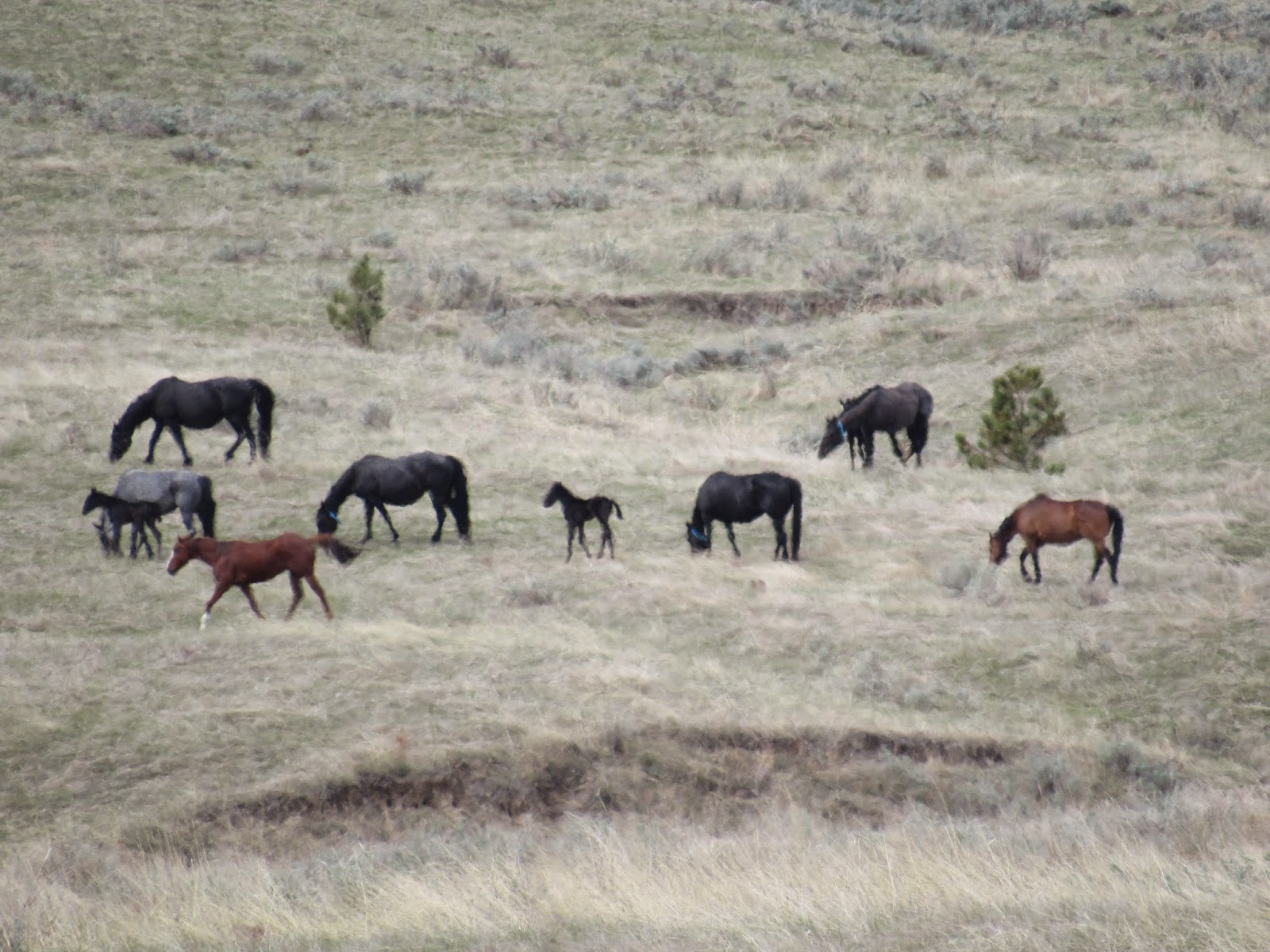
Horses grazing in river bottom meadow at Fort Laramie. This photo could have been from 150 years ago. The fort is one of my favorite places and a place that all western history buffs should visit.

Seems to me that in present day vacations too often lead to zip lines, scary theme park rides and shopping mall adventures - too bad.
Ruins at Fort Laramie - to me kind of an ancient Greece look

Not at the Fort, but not far away
Exploring the past can be as much fun as a theme park adventure, and who knows you might just learn something.
Not into history?  Climb a mountain and take a look back to where you came from, fun stuff.
This mountain, in the Laramie Range, is about 50 miles west of Fort Laramie looking back toward the Fort.

The Cattle Drive

Before the Civil War, Texas was the land of cattle. After the war that started to change, there were too many cattle. And the long drive became part of American history. The drives became a part of Americana for the next 15 years and later became the subject countless books, movies, and television productions. Cattle sales could yield another few dollars a head after the long drive and this was after paying the drovers and expenses.

Not all beef made it to the railroad terminals in Missouri, Kansas and Nebraska, some were sold to forts along the way. But most were moved north to the railroad and shipped east. A little-known fact is that some of the cattle were taken east and then exported to European markets. When the markets waned, the cattle were still marching north to supply ranches and farms in Nebraska, Wyoming, Montana, and other points north and west.


So many herds were moving that in 1884 the Texas Cattleman at the National Stock Growers Convention talked about building a trail, six miles wide and fenced from Texas to Canada. The trail would have entered Wyoming at Pine Bluffs and followed the already well know Texas Trail north through Douglas and Sheridan and on into Montana. The idea went so far as to be introduced as a bill in Congress but went no further. Good thing – two years later the cattle boom went bust.


So many cattle marched north at about 15 miles a day that a few rules of the road or drive were honored, they included.

ü No passing the herd in front of you
ü Do not drive your cows onto range occupied by another herd
ü Don’t pick off another herds strays
ü Do not eat from another man’s herd

Git Along, Little Dogies (traditional trail ballad, first published 1910)
As I was walking one morning for pleasure
I spied a cowpuncher riding along
His hat was throwed back and his spurs were a-jingling
And as he approached he was singing this song

Whoopee ti yi yo, git along little dogies
It's your misfortune and none of my own
Whoopie ti yi yo, git along little dogies
You know that Wyoming will be your new home 
Needed many good horses to drive the herds north.

The Peace Council of 1866

Between the famous peace treaties of 1851 and 1868 was the lesser known attempt at a peace council in 1866 at Fort Laramie. Colonel Henry B. Carrington came with more than 2,000 troopers and 226 mule teams pulling freight wagons loaded with a few gifts and tons of supplies, enough to stock an entire post in the west.
Fort Laramie today as seen from the Oregon Trail North and West

This meeting, for peace, never had a chance. Red Cloud and Man Afraid of His Horses were asked to take part and did go to the fort. But once there refused all efforts put forth by the representatives of the U.S. Government. Why did they refuse? Because the soldiers were representing business and government interests who wanted to build a new road, the Bozeman Trail, to the gold fields. With trails came forts, the native peoples wanted nothing to do with any of this.

One fort, Fort Connor, also known as Fort Reno or old Fort Reno located in Johnson County, Wyoming near the present city of Buffalo was already in a place unacceptable to the tribes. The fort was in prime buffalo hunting country and an area set off limits by the Fort Laramie Treaty of 1851.

Red Cloud stood firm, no roads and no forts. Never the less the treaty was signed, signed for the gifts brought by the white soldiers. The treaty signed by, under chiefs or sub-chiefs who had no power to sign off on anything that affected their entire tribe. Because of this the treaty was never respected and did nothing for peace in the area. Instead of peace it actually increased hostilities and led to what historians later referred to as the years of the bloody Bozeman.


The three forts built or restocked and fortified as a result of this 1866 meeting, Reno/Connor (built 1865), Phil Kearny and C.F. Smith were in a constant state of battle over the next decade and did little to protect gold seekers heading to Montana. Of the three forts, Phil Kearny seemed to be the worst in the eyes of the Indians living and hunting in the area. In one six-month span, the fort or soldiers on detail from the fort were attacked 50 times. All three forts were closed and abandoned by august of 1868.

Oldest House in Wyoming

Did you know the oldest house in the world is in Wyoming? This may not be a completely accurate statement but it is true if you look at this house the way I do. How do I look at it? I look at the building material not the structure itself.
How old is it? This is why it is the oldest, it is 150,000,000 years old, maybe more. The house was built of dinosaur bones from one of many digs at nearby Como Bluff. 


The Bluff is near the small Wyoming village of Medicine Bow, the town made famous in Owen Wister’s, “The Virginian.”
Como Bluff Area
Como Bluff digs have yielded bones of hundreds of dinosaurs, included two of the most complete skeletons ever found. One of many remains found here was the famous thunder lizard, Brontosaurus, the 75 foot long amphibious Sauropod.
Brontosaurus-Rex

I have always found the idea of dinosaurs roaming Wyoming and other parts of the earth fascinating, but I know very little about them. I am learning more from my grand-kids every time they visit and we watch, Walking With Dinosaurs.


Seems kids like to study the giant animals. I do not think we spent much time, maybe no time at all studying dinosaurs when I was in elementary school, maybe I was daydreaming of recess at the time. It was a long, long time ago when I was in elementary school, perhaps dinosaurs were still walking around at the time and not that interesting to study.

The 1835 Rendezvous - Times are Changing

Twelve of the famous Mountain Man Rendezvous were held in what today is Wyoming’s south pass country. The 1835 Rendezvous may very well be the one that opened up the west for settlers. A doctor, Dr. Marcus Whitman and a minister, Reverend Samuel Parker were present, representing occupations not before seen in the mountains. Whitman handed out various medicines, did some surgeries and generally helped trappers and Indians alike. Parker made friends with the tribes and preached from his, white man’s book of God.


Five years later the fur trade was ending, and less than a decade after that 49ers were racing across Wyoming on their way to the gold fields of California

More Pronghorn

Recently I have been doing research and reading personal accounts of early homesteading and town building in eastern Nebraska where I grew up. I ran across a story of antelope (pronghorn) hunting in that area in the 1860s. I had never heard of Pronghorn in that area and I decided to do some digging.


When Lewis and Clark and the Corps of Discovery explored the west in the early 1800s there were an estimated 35 million pronghorn antelope in North America. One hundred years later the population was estimated at 13,000 with extinction coming within the next decade. Today there are nearly a million pronghorn in Wyoming several hundred thousand thrive on the hard grass, yucca, cacti and sagebrush in the high grass prairies of this state.


It took full protection in every state to increase the heard, full protection for fifty years, but it worked. Much of the west has enough pronghorn for an annual hunting season as game managers watch and manage the herds carefully across the west.


Today pronghorn are a tourist attraction in the west, most of the year they are easy to spot and a joy to watch, especially running, up to 55 MPH.


.


The Legend of the Bouncing Buffalo

The Legend of the Bouncing Buffalo

Long before the bow and arrow native peoples were hunting bison for food. After the bow and arrow were perfected and commonly used for hunting, nature and the lay of the land were still important for big annual hunts, hunts needed to feed the people through long hard winters.


One of the most interesting legends of the hunt is set in and around what today is the tiny village, (212 population in 2010 census) of Chugwater, Wyoming.
Chugwater today


~The Legend~

Long ago, long before the coming of the white man, the valley of the cliffs, (Chugwater Valley), was the home of a powerful Mandan chief. One day he was gored and trampled by a bull buffalo. He survived but would not be able to hunt again that season. He ordered his son, the Dreamer, to lead the next hunt.

The son, in one of his dreaming states at the time, only grunted at the request and continued to dream. The old chief, disgusted with his son, went through the tribe hoping to find a worthy son, a son he could adopt and one that would lead the hunt. But the Dreamer had been listening when his father spoke. The Dreamer had heard his father’s request and called for a council of hunters where he told them of his new plan, a plan that came to him in a dream. He told them to cut the nearby herd and stampede as many as they could toward the bluffs and run them off. The plan worked and when the buffalo tumbled off the cliffs their bodies struck the boulders and rocks below with a chugging sound, such as chug, chug, chug.

From that time on Native Indians and the soon to come white man called the nearby stream, “The water at the place where the buffalo chug.” The name was later shortened to Chugwater.


Not part of the story but an interesting side note is that Francis Parkman in his famous work, The Oregon Trail, camped and spent time with the Sioux at Chugwater Creek and describes it in his book.

Pronghorn

Seems like I never get tired of watching the many North American Pronghorn around the state. Doesn't matter if they are standing or running. Few people realize that pronghorn, like the bison, once numbered in the millions in the American west. Also like the bison they were shot to near extinction for meat and skins. Pronghorn are a curious animal and hunters could often shoot dozens or more in a day. At one point in the late 1800s so much meat was for sale that one could purchase an entire carcass for a few pennies.


Not sure how many pronghorn there are today in Wyoming but the number is often reported as more than the number of people here in the cowboy state. Wyoming’s people population is a bit over half a million, so that is a pretty good number of pronghorn, but is likely high by about 200,000 or so. Still a good number and if you are watching, pronghorn can be seen just about anywhere in Wyoming.


The Wyoming Game and Fish Department does an outstanding job of managing the population, allowing hunting to keep pronghorn numbers constant.


Thinking about taking a drive-about sometime tomorrow, watch a few North American Pronghorn, or as most westerners call them, antelope.

It Was Once Summer

Seems like June and July were not so long ago. But it was more than half a year. Guess that means we are getting closer to summer. After this latest snow and cold snap, I am ready. These photos are a look back to a few hours we spent on a fantastic evening June 28, 2014 in Guernsey State Park.

June Wildflowers

Snapped as we headed home

Evening Light Plays With Color Below Echo Cave

Setting Sun Turns the Lake Golden

How Long Ago, Who ?


Using the Medicine Wood

 Medicine Bow is one of the most impressive mountains in south eastern Wyoming. The Mountain, most often called, Medicine Bow Peak, is part of  a small range called the Medicine Bow's. Nearby is the tiny village of Medicine Bow and Medicine Bow River.

Took This Shot of Medicine Bow Peak Last Sunday

Where did the name Medicine Bow come from? Good solid birch trees that made terrific hunting bows for native peoples roaming and hunting the area. Many different woods and even the antlers of big horn sheep and elk were used in various parts of the west to make hunting bows. The Birch wood found along today's Medicine Bow River must have made exceptional bows. So good they said it was, “good medicine,” the medicine wood.


Powerful Animals Took a Powerful Bow


 See the town of Medicine Bow here - http://www.medicinebow.org

Cheyenne - Dog Soldiers of Wyoming

A somewhat, obscure in history, tribe called the Staitans were friends with, and later absorbed into the much better known Cheyenne. The Staitans were in Wyoming by the early 1700s, maybe earlier, but by the early 1800s they were no more, absorbed, peacefully, by the Cheyenne. When the Staitans were flourishing they were considered the most warlike of tribes on the plains. They thrived in the east central area of today’s Wyoming, reaching to the edge of the Laramie Range. 


Much of the well-known Cheyenne culture was taken from the ancient Staitans including the ceremony of the Medicine Arrows, (four arrows, two for war, and two for hunting). They also adopted the Sun Dance and the Medicine of the Buffalo Head, from these people.


The Cheyenne were sometimes called Dog Soldiers and likely got that name from the French word Chen, meaning dog.  Later the Dog Soldiers were but one faction of the tribe but the entire tribe still remained know as the Dog Soldiers to most plains people of the 1800s.  The Cheyenne were driven from their home in present day Minnesota by the Sioux, who called them, Sha-hi-e-na.

Sha-h-e-na, literally meant those who spoke a language which was not understandable. Tribal groups that spoke an understandable language they were said to, “talk right,” those who did not, “talked wrong.” The Cheyenne were said to speak, only wrong words.”


With our state Legislature now in session and all the politicians in town it is interesting to note they are meeting in our state capitol. A city, Cheyenne, named after wrong talking people. Hummmmmm!

Sunset over the Laramie Range in Eastern Wyoming


Baby It's Cold Outside

Today it is cold -  very cold, high of 0, yep zero, zilch, no degrees at all. Wind chill tonight will dip to 40 below.
When this happens in Wyoming we say, "feels like a touch of winter in the air."


I know, I know, by now you are all feeling very bad for me. But before you do I might mention that in my part of Wyoming I still was able to play golf seven days in December. Most years I play in every month, other years I miss playing in January. And, I will play with a light sweatshirt but if I need more than that, no golf. We do get lots of nice colder weather hiking in though.

If you are in my part of the country, bundle up and stay warm. 

Happy New Year!


Saw this Guy a Couple of Blocks From Home Today

Cedar Wax Wing Looking Out at Winter
I Am Not Cold - But Was I Supposed to Fly South?

Snow at Last

Now that summer is officially over with snow yesterday and last night, guess I can get into my normal grumpy winter mood. Here in the cowboy state we get most of our yearly moisture in the form of snow. It reminded me of this line from a C. J. Box book -

“Wyomingites, Joe had observed, didn't know what to do when it rained except get out of it, watch it through the window, and wait for it to go away.” C. J. Box Open Season


With snow on the ground today, I couldn't wait to get outside. By afternoon the wind was gone, the sun peek-a-booed in and out and the temperature went to 30. Another great day out west.

The Colors of a Wyoming Winter

Winter looks like it has reached us here in Wyoming. The days have still been pretty pleasant and only a bit of snow has fallen but the landscape has taken on the look of winter. We live in a wonderful, more temperate, part of the state but that hasn't kept Mother Nature from painting everything with brown and gray. If you take the time to look around it is still possible to find some natural color and beauty, even if it is December.


For many people winter is a time to stay inside, I like going out into the cool weather. I find the stark landscape this time of year much to my liking, until spring that is. Here are a few shots I took this week.
Sun Splashed Pine and Ice on the River
A Study in Reflection
Fawn in Tall Grass

Dinner Time
Going South
A Winter Day
Winter Color
Tiny Cedar illuminated  by the Setting Sun -Christmas Tree

and finally

Stark in any Season