Showing posts with label Indian wars. Show all posts

Fort Fetterman

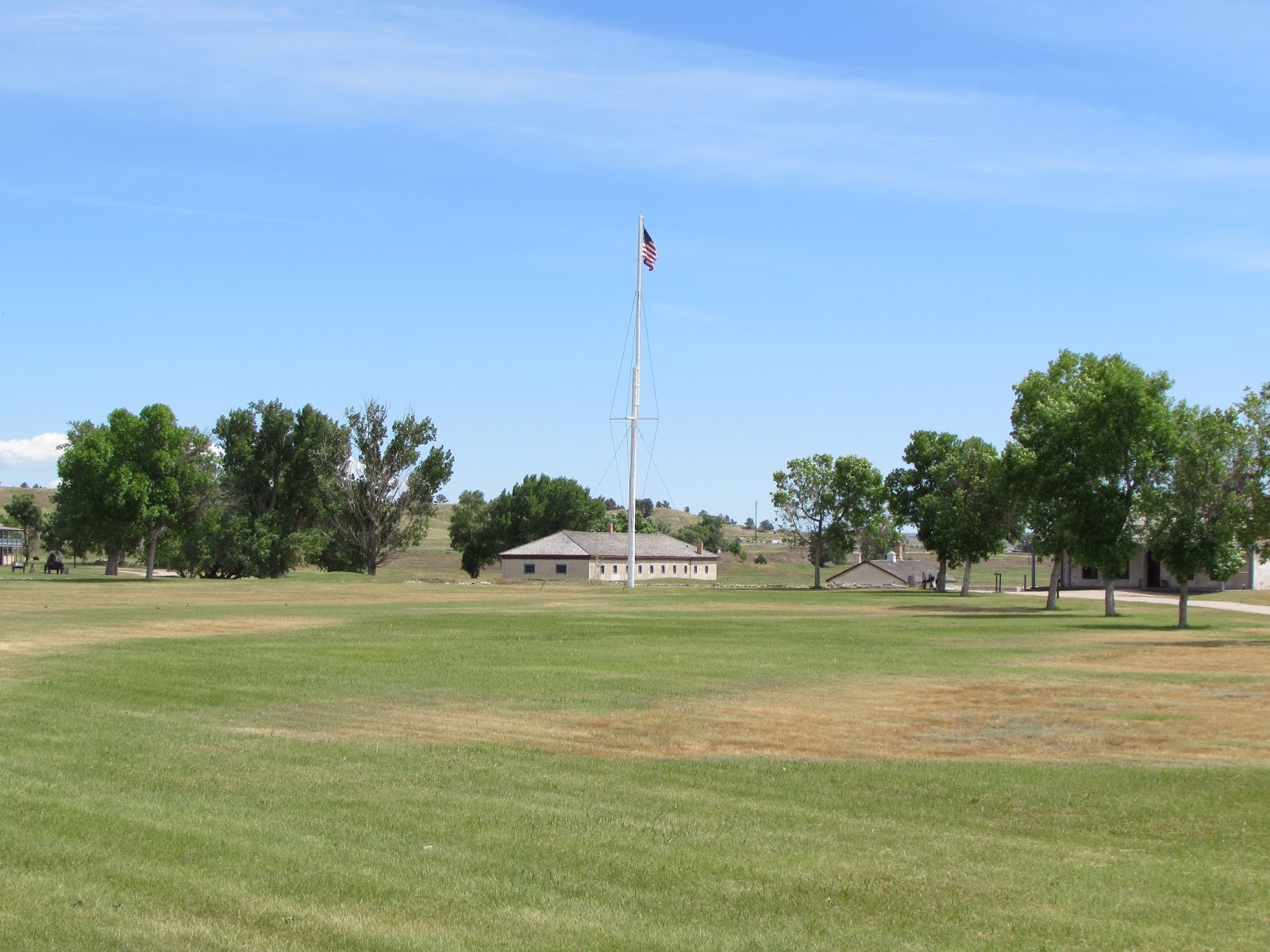
On July 31, 2016, Fort Fetterman turned 149 years old. Fetterman became an unnamed military fort on July 18, 1867. It was designated as a supply fort for the Indian wars. Two weeks after it opened it got its name, Fort Fetterman. The wooden fort was named after Captain William J. Fetterman who along with his entire company of 81 men was killed near Fort Phil Kearny seven months earlier.

Fort Fetterman today

photo -  www.conversecountytourism.com  

Within a few years, Fetterman reached the pinnacle of its success serving as the starting point for several Indian expeditions. After only 15 years, in 1882, the government gave up on the fort. The Indian wars were all but over, and the government no longer needed the fort. But it didn’t go away, not immediately.  It went on to enjoy a brief life as a woolly and wild frontier town, but by 1886 it was only a memory.

Fort Fetterman lives on, yet today in history, through the stories of famous people who passed through. Calamity Jane spent some time there; stories vary widely as to how much, and the writings of Owen Wister are only two areas that perpetuate the life of the fort. Wister, most famous for writing, The Virginian, describes Fort Fetterman City (after the closure of the fort) in his novel, Lin McLean, published in 1897. He changes the name calling the fictitious city, “Drybone,” but it is unmistakable that he wrote about Fetterman City.


A Stream a few miles west of the fort


The Curious Case of Lieutenant Hugh Fleming


The Grattan Massacre, Aug 19, 1854, is often listed as the event that started the Indian wars on the plains. Anyone who is interested in Wyoming history knows the story of the killing of the cow from a Mormon wagon train and Grattan leading his troops to their death in the ensuing battle. But very few know the story of the commanding office at Fort Laramie, who either ordered him or allowed him to take the troopers on the ill-fated journey.


Brevet Second Lieutenant Hugh B Fleming was the commander at Fort Laramie at the time. The fact that a Brevet Second Lieutenant was in charge is a bit of a mystery itself. Fleming was promoted from cadet, upon his graduation from West Point, to the rank and sent to Fort Laramie. One year later he was in command. I am not sure how officers were chosen for command, but it is likely that Fleming was neither ready nor capable of this command, only a year removed from Cadet status at West Point.


Fleming was in charge but undoubtedly was not meant to be the permanent commander. In 1854 alone, four different men commanded the Fort. Fleming followed, Lt. Richard Brooke Garnett and proceeded Major Andrew W. Evans who was followed by Major William Hoffman who stayed through 1857. It is possible that Fleming was ushered out as soon after the August Grattan massacre as the Army could make the move.


It was not this brief time as the commander alone that left his stamp forever on the Indian wars of the west. In June of 1853, Fleming was sent by Fort Commander Lieutenant Richard B. Garnett to a Miniconjou Sioux encampment that had fired upon Sergeant Raymond and captured an army supply boat near the fort. Although no one was injured and the boat was soon recovered, Fleming was sent with orders to demand the Indians turn over, to the army, the person who had fired at them. Fleming took along 23 men and an interpreter. His orders in addition to bringing back the shooter allowed for Fleming to capture and bring back two or three prisoners if the Miniconjou would not turn over the one who fired on them.  


The tribe refused to turn over the wanted man and Fleming marched his men into the center of the village to take prisoners. A battle started and three warriors were killed and three more wounded. Fleming grabbed two more as prisoners and returned to Fort Laramie. A few days later a group of Miniconjou came to the Fort, asking to parley. Whatever happened here, the tribe was not satisfied.  It took a bit over a year before Grattan and his men were killed, but Lt. Fleming and his two very bad decisions may have directly led to the Indian or Sioux wars in the west.


Fleming went on to a long but rather ordinary career in the military, serving as a recruiter and not seeing action in the Civil War, he retired as a Major.


Note* I am pretty deep into research on a new book about Fort Laramie and have found dozens of stories, like this one, that seem to give a different and deeper view of history. When researching I try to be very painstaking in getting it right. In ten minutes of looking at online sites on the Grattan Massacre I found it happened on August 17 or August 19 in either 1853 or 1854. As I told my students for 42 years, check and verify before putting it on paper. By the way -  It happened on August 19, 1854.
Couldn't resist - here I am at Fort Laramie on the Fourth of July - thanks for reading

37 Years at Fort Laramie


Fort Laramie today
Fort Laramie, like many western forts, was often staffed with European immigrants. Many times these men were ill-equipped for army life in the west. But they were fast learners and on most occasions survived and many thrived as soldiers during the Indian wars. But maybe none so well or as long as Leodegar Schneider. Schneider spent the first 15 years of his life in Switzerland but by his 23ed birthday was in the United States Army.

Schneider fought in the Seminole wars in Florida and several other east coast Indian campaigns. In 1849 when Fort Laramie became a military post, after more than a decade in the army, Schneider along with the rest of his company was sent to the famous Wyoming fort. And he stayed, stayed at Fort Laramie for the next 37 years. The 37 years made him the longest serving soldier at Fort Laramie.

Schneider started as the post’s assistant librarian, later became the first sergeant, and ended as the ordinance sergeant, a highly sought after position. When Schneider came to the fort it was a handful of adobe buildings, it grew to the largest Indian wars fort in the west.  When he left, he along with the fort had seen it all.  He fought in battles along the Bozeman and tried to keep the peace on the Oregon and Mormon Trail. 


 He watched the beginning and end of the Indian wars in the west, the Great War between the states in the east, the passing of tens of thousands on the Oregon Trail. Schneider witnessed the signing of two of the most famous treaties of the west, the treaties of 1851 and 1868, both signed at Fort Laramie. He met mountain men lie Jim Bridger and saw the beginning and the end of the Pony Express. He watched bits of the pushing of the trans-continental railroad through southern Wyoming and  walked along tracks being built to the north. He watched progress, the taming of the west, millions of buffalo changed to cattle inside fences. If anyone ever witnessed the passing of the frontier it was Leodegar Schneider and his 37 years of service at Fort Laramie.

Not a life of novels and movies, but to this old history guy, pretty darned interesting.

Jim Bridger - The Rest of His Story


Jim Bridger may well be the most celebrated of all the mountain men who lived and worked in the mountain west. So famous that today, roads, streets, trails, bridges, a power plant, schools, a fort, museum collections and many more things were named after the famous, hunter, and fur trader.

The inscription on his tomb stone reads (in part) – “Celebrated as a hunter, trapper, fur trader and guide. Discovered Great Salt Lake 1824, the South Pass 1827 [1823]. Visited Yellowstone Lake and Geysers 1830. Founded Fort Bridger 1843. Opened Overland Route by Bridger's Pass to Great Salt Lake. Was a guide for U. S. exploring expeditions, Albert Sidney Johnston's army in 1857, and G. M. Dodge in U. P. surveys and Indian campaigns 1865-66."

But that is not all the man was. For decades a popular American radio host, Paul Harvey, aired a program called, “The Rest of the Story,” – well here is a bit of the rest of the story of James Felix Bridger, a most remarkable man.

Today Wyoming is known as a ranching and oil producing state. Guess who was the states first cattleman and first oilman? Jim Bridger. Bridger was not the first to have cattle in Wyoming but he may, very well, have been the first to buy and sell cattle, a thriving part of his business from his fledgling trading enterprise at Fort Bridger. And along with his buddy, Kit Carson, he skimmed oil from a seep just west of present day Casper Wyoming. What did they do with it? Well, they mixed it with flour and sold it as axel grease for wagons heading west – and it worked pretty good.

 Bridger also took on special projects for the government. At the request of the army he blazed a new trail from near his Casper oil seep, up though Wyoming’s Big Horn Basin and into the gold fields of Montana. - (The Bridger Trail) - This trail allowed people a chance to avoid the bloody Bozeman Trail. If people would have listened to him and used his new trail maybe a large part of the Indian wars of the west could have been avoided.

The Mighty Sioux


In a sacred manner I live

To the heavens I gazed

In a sacred manner I live

My horses are many


In my part of the west the Sioux were the largest tribe. It was the tribe of Sitting Bull, Crazy Horse, Red Cloud, Spotted Tail, Roman Nose, American Horse and Old Man Afraid of His Horses, to name a few.

At the height of its glory the seven divisions of the tribe stretched from Yellowstone in the west to the middle of Wisconsin on the east. Of the seven divisions, the Teton Sioux of South Dakota, Nebraska and Wyoming was by far the largest with an estimated number of more than 20,000 in 1890. So big in fact that it too was divided into seven groups.

Before the wars on the plains started the Sioux were a happy wandering people. As more and more of their land was taken from them the Tribes were backed into a corner and fought. Outnumbered, it was a losing battle from the start. Most historians today agree that the government’s failed Indian policy is what started the wars. And why did the government’s Indian policy fail? The government planned and wanted it that way. Sad but true!

The Indians Wars in the West Didn’t Last Long


Starting with the 1854 Grattan Massacre, and ending with the terrible slaughter at Wounded Knee in 1890, Wyoming and the west are full of stories of the Indian battles.

 Authors and film makers have written thousands of stories, made dozens of movies and hundreds of Television shows from this, much shorter than a life time, 36 year span.

Sure there were battles before 1854 and a few spirited fights after 1890, but the majority of the Indian Wars were finished as: farmers, ranchers, squatters, prospectors, herders, shop keepers and peddlers pushed eastern civilization westward.

With the Indian wars over there was no longer a need for forts in the west. Only Fort Washakie remained. This fort stayed open until 1909. Forts: Laramie, Bridger, Fetterman, and Kearny, were long gone by 1890 as a new era pushed out the old west.