Showing posts with label neil waring. Show all posts

Health is Back and So is My Writing

It has been an interesting few weeks since I last posted on this site. Two weeks of Covid, a week or more of recovery, and then what we felt like was a well-deserved vacation.

Vacation - We spent some time, as always, looking at history and hiking as we traveled in the American southwest. It was a relatively quick trip, a couple of days in Santa Fe, (I love the architecture there).

Cliff Dwellings in the Gila National Forest

Then a couple more in Silver City, NM. We found the Silver City area, which we had never visited before, much to our liking.
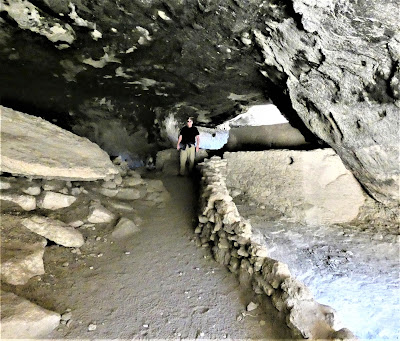
One of the few sites where visitors can carefully walk through the dwelling area. 

After Silver City, we spent several days in and around Tucson, AZ. All and all, a fine trip, relaxing, educational, warm, and fun, but as always at our age, exhausting at times.

Unlike some petroglyphs, in the Gila Forest were simply painted on rock - no scratching or carving.


Tombstone – We spent a delightful afternoon in Tombstone. It was much like we imagined, very touristy, i.e., Keystone SD or Estes Park Colorado. We saw lots of fictional history and a bit of real history. And as everyone should when you visit Tombstone or Deadwood, we watched some excellent gunfights. It really was lots of fun!

Downtown Tombstone last week. Fairly busy for mid-week. 

Wyoming - Enough about us – did you know Wyoming’s first post office was established today in 1850. Where? Fifteen minutes down the road from where we live – it was established in Fort Laramie. Thanks to Patrick T. Holscher and his excellent book – On This Day in Wyoming History, for that bit of information. 

Jim Bridger and his Uncle the President

So much about Jim Bridger remains a mystery. He was orphaned at age 13 and apprenticed by a relative to a blacksmith. Early historians often noted the relative as a well-meaning one. More recently some believe that there was some money coming to the well-meaning, relative and that may have been what made him so well-meaning.
Not much is known of Bridger’s parents other than their dying young and the fact that throughout his life Bridger insisted his mother was President Tyler’s sister. He went on to say that she was disowned after marrying his uneducated father.


Bridger hated the labor in the blacksmith shop but worked hard at it anyway. He had enjoyed his previous job working with riverboats on the wharf. Of course, that gave him a chance to jaw with river men and trappers. Those were the rugged men he liked and were all about what he would become.


A man we think we know so much about, but maybe we really only know but what he wanted us to know.


Afraid I don't look much like a Mountain Man - trapper, but my friends look good

Longmire and Other Wyoming Movies

Looks like Wyoming will not have to wait much longer for football or Longmire, both are coming this fall. Longmire will be here in early September with ten new episodes. Not sure I understand the concept of Netflix yet, all episodes will be available that same first day. I remember waiting for so many shows for the next week to bring a new story. Maybe I will just watch one episode each week for ten weeks – no probably not.

Although Longmire is popular in Wyoming, many wish it could actually be filmed here. Most will not notice, but those of us who live here do. New Mexico has a lot in common, scenery wise, with Wyoming, but not everything. But we do love our Wyoming authors, especially Craig Johnson the Longmire creator, and C. J. Box the bestselling author of Wyoming mystery novels.

Quite a few westerns have been filmed in Wyoming over the years but Hollywood tells us that our unpredictable weather and predictable short summer making filming difficult. Never the less a few good ones have been filmed here. 1953 seems to have been a good year when both, Shane and The Big Sky were filmed. The Mountain Men, filmed in 1980 is another notable Wyoming western.


Smile

Photos From Around Here

Thought I might post a few of my favorite photos from the last three month's. Actually to lazy and too hot to attempt to write anything. All photos are from my Eastern Wyoming neck of the woods.

Remains of ancient man
Lots of Pelicans
Cow Moose
The Horns are bigger and no velvet by now
A Goose out for a walk?
Osprey's are pretty cool looking
Monarch of the plains for more than a 1,000 years
Nice view
Hello
Think I will walk the other direction
Part of Rocky Mountain National Park horse and mule herd at Fort Laramie
These guys are fast - really fast

What a Shape We're In

When one looks at the shape of the various states, Wyoming certainly does not stand out. Along with Colorado, our neighbor to the south, we are rectangular, nearly square. How did that happen?
Wyoming is the only state that is made up of territory taken from all four of the United States major acquisitions. Five different countries have claimed parts of Wyoming. After that, and 30 different boundary changes, and Wyoming ended up a rectangle. Weird!
It took a few years but at last, the lands acquired from, Spain, France, England, Mexico and the Republic of Texas became Wyoming.
Why we love Wyoming
-Today’s trivia questions-
1. What are the names of the two waterfalls in the Grand Canyon of the Yellowstone? Don’t think two hard on this one.
2. How did Ned Buntline help make Wyoming famous?
3. Harry Longbaugh’s nickname is one of the great wester names. What was it?
See answers at the bottom of the page

My, oh, by the way, for today – I’m feeling great, my two kid’s chapter books are both in the top 10% of all books being sold on Amazon. See both of them plus my westerns and my nonfiction CCC book here.

Now the answers. 
1. Upper Falls, Lower Falls
2. He wrote dime novels many featuring Wyoming people. His books made Buffalo Bill a legend, hero and mythical figure in Wyoming.
3. The Sundance Kid
Wyoming high country

1.             


Happy Birthday Wyoming

Wyoming became the 44th state in the union on this day in 1890. 
Here's Lookin' at you Wyoming

The road might be lonely, but the view is spectacular
125 today and still looking good.
Not Many People

Hey, Where Did Our Horses Go?


In May of 1865, the United States government decided to move all of the Sioux that were camped in and around Fort Laramie. The 180 plus lodges were to be moved to Pawnee land in Nebraska. But when the group reached Horse Creek, the site of the 1851 conference at Fort Laramie, old animosities were aroused. The Sioux had been pushed far enough. They took a stand, killing one officer and seven soldiers. Thirteen others were wounded before the Indians escaped south across the North Platte River.
North Platte River


Col. Thomas Moonlight, the commander at Fort Laramie, took one of his famous or infamous missteps. (I have blogged about him before when he was governor many years later)Moonlight led a force of soldiers out of the fort to capture or punish the Indians. He chased but did not catch the Sioux. Exhausted, he encamped the troops for the night. The men ate and rested, meanwhile when darkness came the Sioux helped themselves to the soldiers mounts, all of them. 
Bet the soldiers were happy to be back home in their barracks at Fort Laramie

The next day the soldiers started their march back to Fort Laramie – on foot.


Sitting Bull and the Meadowlark

Animals have been part of early and ancient cultures since the beginnings of people on earth.
Birds were often a part of American Indian life and culture. Long before Wyoming (1927) and Nebraska, Montana, Kansas, Oregon and North Dakota made the Meadowlark their state bird, Indians referred to it as the Sioux bird.

Sitting Bull loved all wild creatures but held the bird special often making up songs about them and giving birds credit for saving his life more than once.

Wyoming Trivia for Today

1.   F.E. Warren Air Base – What does the E stand for? (that would be Mr. Warren’s middle name)

2. What does this lovely French Word mean? Bois De Vanche
See answers below – no peeking!


1.   Emory
2.  Buffalo Chips


Fort Laramie and Fur Trade Days

From 1820 to the early 1840s the fur trade was king in the mountain west. Furs were money in the west and money brought men searching for it. It was a wild, exciting and dangerous life. A chance for riches and a chance to never come back.

Last weekend was the annual, Fur Trade Day’s, at Fort Laramie. Several reenactor’s with some wonderful displays and great knowledge of the trapping era took part. I fear this period of time in American History is being washed away with newer history.

The great days of the fur trade lasted but two decades and a few years. Changing fashions and Gold in the west ended the Mountain Man era – too early for me. 

Oregon Trail Ruts - Guernsey, Wyoming

Wet Spring means lots of wildflowers. Today we took a trip to the Oregon Trail Ruts south of Guernsey. This is the time of year the wagons would have been rolling through this area. 

Wonder how many years the flowers were this spectacular.

All photos from the Trail Ruts this evening. 


Milton Sublette - The Lost Mountain-Man


Milton Sublette was one of five men who banded together and formed the Rocky Mountain Fur Company. They were able to buy out his brother William, Jedidiah Smith and David Jackson. But there is more to this story.
William Sublette started Fort Laramie in 1834 known then as Fort William. The name was changed to Fort John in 1841 when it became part of the American Fur Company. In 1849, it became Fort Laramie. From 1849 to its end forty years later it remained Fort Laramie a United States Army Fort.
Now back to the subject of this post, Milton Sublette.
In 1826, he took either an arrow or a hatchet to a leg in an Indian battle in the southwest. At the time, he was only 25 years old. The leg wouldn’t heal and eventually he had part of it taken off. A year or so later another piece was taken. It is possible that he had other surgeries on the often infected leg.
He lived on using a leg made of cork and used a one mule wagon to get around when he could. He died at the ripe old mountain-man age of 36 in 1837. He was buried on the grounds of Fort Laramie in a grave that was soon forgotten. But his brother Solomon came through and put a proper marker on the grave in 1843.Years after Fort Laramie was out of business Milt Sublette’s grave and the entire Fort William and Fort John cemetery were lost. In modern times, during an attempt to stabilize the ruins of the post hospital on the hill in the northwest part of the fort. Guess what?
The hospital had been built over the old post cemetery. In the process of work on the old walls and foundations, a few bodies were discovered. One with an amputated leg – Milton Sublette.  What a perfect resting place for the old mountain-man, the most famous fort of his era. 
The old Fort Hospital - Milton Sublette's Final Resting Place

New History of Guernsey State Park

My Wyoming History book is now complete. It took a lot longer than I expected but is now available. The book deals with the building of Guernsey State Park, centering on the work of the Civilian Conservation Corps in the Park.

 I like the book better than the ebook as the formatting changes on the ebook depending on what the reader is using. Normally this is not a problem, but with the nearly 200 photos in this book, the ebook, which is still fine, can be a bit odd looking in places.

Read a free preview or order a copy here.

Still Wild In Wyoming

They saw me, shortly after, okay, probably before I found them. This one is checking to make sure no more crazy with a camera was nearby.


And off they go - laughing


Also found a couple of cow moose lounging along a nice mountain stream.


A Great Wyoming Writer - Mary O'Hara

Too bad, but it seems the great works of Mary O’Hara seem to be long forgotten in Wyoming. She lived in the Cowboy state for 16 years (1930-1946) and during that time wrote many books. Three of her novels stand out today as Wyoming classics, Thunderhead, Green Grass of Wyoming and My Friend, Flicka.


O’Hara was born and raised on the east coast but spent here early writing life in California working successfully in the silent movie industry. After a divorce and, several years later, a remarriage, she moved with her new husband to Wyoming.

O’Hara’s husband, Helge Sture-Varsa was a swede with army horse raising and training experience. The two bought a ranch in the windswept high country between Laramie and Cheyenne that would become became the famous, Remount Ranch.


They tried to make a living raising sheep and may have been successful if it were not for bad timing, The Great American Depression was just around the corner. They ended up eking out a living delivering milk and raising horses but it was her writing that would pay the bills.

In 1946, after a second divorce she moved back east and continued writing, but not so much about Wyoming. She also composed music and was a rather successful musician along with her musical scores.

Her books are rich with Wyoming landscape, weather and animals and her love of horse’s shows throughout her works.

O’Hara died at the age of 95 after a rich and rewarding life of writing, composing and travel.
Still great reading today – give her a try. Unfortunately it looks, after a quick search, that none of her books have been converted to e-book formats. But there are many choices of new and used copies available from one cent up to a bit over ten dollars.


I do believe that, summer has, at long last, reached Wyoming. Feeling good!

Cheyenne - The RR Town

On the fourth of July in 1867, General Grenville Dodge set the spot for Wyoming’s first railroad terminal. Crow Creek was the spot. He named this spot Cheyenne after the Indian tribe in the area. It didn’t take long for a city to grow from the terminal.

Robert Strahorn, while preparing his Handbook, asked one of the first settlers of the city if he could point out the first house erected in Cheyenne. “The old settlers replied, “ well, one fine day, early in July, 1867, four or five hundred of us pitched our tents here, where there wasn’t a sign of civilization, and about half of us woke up at daylight the next morning to find that the other half were living in board shanties.” **
**From Velma Linford’s, Wyoming Frontier State.
1890 Train


Cheyenne, at the time, was constantly referred to as a creation of the Union Pacific Railroad. Within weeks a city blossomed. By the end of summer, more than 300 businesses were open in Cheyenne. By November when the first rails made it to town, 4,000 people were living there. A year later the population dropped to 1,500 but the town remained and grew, reaching a population 4,500 people by the early 1880s.


Fifty-nine railroads were incorporated in Wyoming between 1869 and 1900. Seems like we should have tracks running all over the state. Many of these railroads were only on paper and never able to raise the money to build any miles of track. But some track was getting built, a reported 290 miles in the first few years of twentieth century.
Train heading west