Showing posts with label guernsey wyoming. Show all posts

Oregon Trail Last week & the Mid 1800s

 January 17, 2022

Wyoming Fact & Fiction

We are back from a quick trip to visit family in southeast Nebraska. My two hometowns, where I grew up in Fairbury, Nebraska, and now in Guernsey, Wyoming, are Oregon Trail towns.

Traveling the Oregon Trail - Every time we go back to visit, I think about those Prairie Schooners rumbling along at 10 to 15 miles per day. My, growing up, home town, sits near one of the first difficult river crossings – the Little Blue. The crossing was treacherous if the wagons got there early in the year.

Little Blue looked peaceful when I snapped this last July.

By the time they reached Guernsey, most wagons were following the south side of the North Platte River. The Mormon Trail runs along the north side of the river, only a few miles from the Oregon Trail on the south by the time it gets here.
North Platte in mid-June in Guernsey, Wy. 

The driving distance from here in Wyoming to where I grew up in Fairbury is 485 miles, about eight to nine hours for us oldsters who stop several times along the way. The wagons would have taken more than a month, likely closer to six weeks. But hundreds of thousands made the trip, with about 20,000 who died along the way. Cholera and other sickness and disease killed most of the thousands who died along the way. Indians, who have killed hundreds of thousands, maybe millions on TV, old-time radio, and movies, actually killed about 400. 

Most who traveled walked instead of overtaxing their animals, primarily Oxen, with extra weight.

Not an Oxen but good looking Longhorn

The wagon itself was only about 4X10. Even in our tiny house world, forty square feet is not much.
A landmark of the trail - Chimney Rock in western Nebraska


One Book You Might Need in Your Library – Patrick T. Holscher’s – On This Day In Wyoming History.

So what happened in Wyoming History today from the book? Kendall Wyoming had a low temperature of -52. Now that is cold! Thanks for the info, Patrick.


Shout Out for this Blog - It is always nice to be noticed, and this week I received word that this blog is now listed in FeedSpot as one of the Top 15 Wyoming Blogs & Websites. Click the link to see the list. I read several of these sites – good stuff, no cost! 


Wyoming Trivia – two questions today

Q1 - What are Oxen?

Q2 - Where did emigrants on the Oregon Trail hope to be by the 4th of July

Trail Ruts near Guernsey - about a 1/2 mile south of our house.


Answers

Q1 - Oxen are no different in origin than other cattle. They are simply neutered bulls trained to pull.

Q2 - Independence Rock


See you next week!


Fort Laramie Treaty of 1868 - 150 Years


On April 29, 1868, a treaty was signed between the United States Government and the Sioux Nation.  The treaty would move the Sioux away from the war on the plains, and onto a Black Hills Reservation in Dakota Territory. This treaty following the treaty of 1851 attempted to bring peace to the frontier part of the United States. For moving to the Black Hills the Sioux were to be given food, clothing, and annuity payments, on an annual basis. The government also agreed to close travel along the Bozeman Trail along with the forts along that trail.


Starting Saturday, April 28, and running through Tuesday, May 2, Fort Laramie will be hosting – Honoring the Spirit On the Northern Great Plains. The fort is expecting nice crowds of up to 4,000 on Saturday and great crowds for the other three days of the celebration. Looks like a terrific time.


Did the Treaty Work?
It was working, as well as most treaties, for a few years, and then Custer and his men found gold in the Black Hills, which for all practical purposes ended the usefulness of the treaty. The government tried to purchase, then lease, the Black Hills so that gold seekers could head into the area. The Sioux already pushed to their limit, refused. Two years later, Custer and the Seventh Cavalry were wiped out at Little Big Horn, escalating a decade of Indian Wars in the west.


Honoring the Spirit On the Northern Great Plains, a celebration to be held the last two days of April and the first two days of May 2018. Click the links to read all about it.


Today's photos from my many trips to Fort Laramie, a terrific place, and one all western history buffs need to visit.


Westward Ho the Wagons

I can remember many years ago watching or listening to  various programs that ended with some form of the phrase – “and the rest is history.”

 In 1841 when the Bidwell-Bartleson party headed west the rest was indeed history. This first great wagon train heading west not only made history, but it also led to the populating of the West and later the middle of the country. The next year, 1842, Dr. Elijah White led a group of more than 100 on the all new Oregon Trail. Two years later four wagon trains carried more than 2,000 hopefuls West.  The next year the numbers more than doubled. By 1869 more than half a million people had traveled along the trail to Oregon, California, and later to the Salt Lake Valley of present-day Utah. 
Trail Ruts cut deep from thousands of wagons - Guernsey Wyoming


The goal for all of these travelers was the same. Make the 2,000 plus mile trip in 150 days taking along enough food and finding enough fresh water along the way to make it.  Taking a day a week off, as most trains did, this would mean the wagons needed to average about 15 miles each day six days each week for five months. Today if we drove for eight hours each day for 130 days averaging 60 miles per hour we could circle the earth two and a half times. What does all this mean? The west coast was a long way to travel, farther than anywhere on earth in today's world. Once the new would-be settlers started west, in all likelihood, they could never go back. What a commitment these people were making. 
A view down the trail. When the first wagons came there were not nearly
as many trees along the North Platte River as today


All of the above are my thoughts as we get ready to take off on a 4,000-mile vacation next week,  and we will only be gone 16 or 17 days. My, how times have changed.
Fall at Fort Laramie, the most famous, and most welcome stop on the trail.

Living in a Small Town


Since I have never lived in a town with more than 30,000 people and have spent most of my life in towns much smaller than that I do not know much about city life. One thing I do know is about life in the country, in my case in a rural Wyoming town of 1,200 people. What I know is friends and neighbors can be great.

My pickup has been down for a week, the shifter would not put it in any gear, including park. Diagnosis from the Dodge dealer, it needed a new steering shaft. Ouch! $1,800 for the shaft and several hundred in labor. I looked it up online and this seemed about right.

Here is where the great small town neighbor part comes in. My, across the street neighbor, said, “Let me see what I can find in the junkyard.” The next day he said he found one for $75.00 plus the cost to take it out. Good deal I figured maybe a $100 or so to take out. I told him to go ahead. Well, he found one, but it was already out and for $65.00.

Today I subbed at the school teaching high school history classes. When I got home he had already replaced the old with the new – all done. Then he decided that my battery cable ends should be fixed, and they needed it.  He didn’t want to see me stranded somewhere, so he put on new ends.

Now the pickup is once again running great, thanks to a kindly neighbor. I can hardly believe when we read all the bad news in today’s world that there are people like this man. Always paying it forward. 
Here is our previously, and once again, reliable pickup up on Black Mountain

Thanks a million Bob. and when I can I will pay it forward for someone myself.


Love living in small town Wyoming – where the livin’ is easy.

Forty Liars and Other Lies

With all the craziness that comes with every big election year, seems the news is full of name calling, accusations and finger pointing, it is always fun to take a look back. When we do we find that although years change, not much else does.

Over the years I have made several posts about one of my all-time favorite Wyomingites, Edgar Wilson (Bill) Nye.


In this case, the trash talking was not among politicians but newspaper editors Nye of his Laramie Boomerang and the editor of the Sweetwater Gazette, in Green River Wyoming. Here is what Nye had to say in the 1884 squabble.

We have nothing more to say of the editor of the Sweetwater Gazette. Aside from the fact that he is a squint-eyed, consumptive liar, with a breath like a buzzard and a record like a convict, we don’t know anything against him. He means well enough, and if he can evade the penitentiary and the vigilance committee for a few more years, there is a chance for him to end his life in a natural way. If he don’t tell the truth a little more plentifully, however, the Green River people will rise as one man and churn him up till there won’t be anything left of him but a pair of suspenders and a wart.

Taken from Bill Ney’s Book, Forty Liars and Other Lies

My First Edition

Sounds much like politicians or political reporters in the present day. It is always fun to read the humor of Bill Ney, some of it is timeless. Nye had a great take on life, especially life in the west. I believe all of his books are available as reprints but most all of his works can be found, free online, and give him a look.


Great way to spend a lazy summer afternoon.

This is not a bad way either

Get Along Little Dogies

Almost anyone with an interest in the history of the American West, Western movies or Television Westerns, has seen cattle drives and night herding cowboys at work. Lonely riders circling the cattle singing. The singing was both to calm the cattle and to keep the Cowboys awake and alert. It's a shame so many of these songs are lost. On the other hand, it's wonderful that some were written down and saved for poor stiffs like me to write about a hundred, or so, years later.

At times they sang about guys like this but normally it was the little ones cowboys sang about

One of my favorite songs, popular in the Hartville area of Platte County recounts the problems facing the night herder as he watches and puts up with the troubles presented by small motherless caves referred to as dogies. The term dogies might also apply to weak calves that have trouble keeping up.

-Go Slow Little Dogies-

Go slow, little dogies, why don’t you slow down?
You’ve wandered and trampled all over the ground
Oh, graze along dogies, Go slow, kinda slow
And don’t be always on the go.
Move slow, dogies, move slow.

Oh say, little dogie, why don’t you lay down?
And quit this forever siftin’ around?
My arms are weary, my seat is sore.
Oh, lay down, don’t be on the go.
Lay down, dogies lay down.


Simple song but it says a lot about the work of the cowboy on night herd. Oh, and he mentions his seat is sore. Too much time in the saddle will do that to the best of Cowboys.

This was me herding little dogies this winter - well, maybe not
But it is a very cool Wyoming Traffic Jam

Old West Shootout

Anyone who has made a serious study of Western history knows that the middle of the street, showdown gunfight is mostly a creation of pulp magazine writers and Hollywood filmmakers. There remain a few sketchy details of gun fights that might have been. Of all the stories, the most well-known gun fight may be the Wild Bill Hickok, Davis Tutt dual in July of 1865. Reportedly the combatants were 75 yards from each other and carefully drew, aimed and fired, one time, at the same moment. Hickok reportedly rested his gun across his left forearm to steady it before firing. Tutt’s shot missed while Hickok’s struck Tutt in the ribs. Tutt died a few minutes later and Hickok was arrested and later acquitted. Hickok’s killing of Tutt in Springfield, Missouri would make Hickok a Wild West legend, but this fight was far from typical.
Hickok
Most old west gunfights - and there were not very many, involved several men, or were more killings than any kind of fair fight. One such fight took place in the rough and tumble Wyoming mining and ranching town of Hartville in 1883. A cowhand named Ed Taylor called Bad Man Taylor by most was shot and killed in a favorite main street saloon. The shot, fired with a rifle through a window, did not give Taylor a chance to draw and fire, dime novel style. Onlookers believe Bad Man Taylor became a target after ambushing another cowboy a month earlier shooting him in the leg.
Today Hartville still has a number of false front buildings
Note: The one fact that most stands out, for me, is that the Hickok-Tutt fight took place a distance of 75 yards. I have a tough time hitting anything from 75 feet, let alone 75 yards. My thought is that they stood far enough from each other that each felt reasonably safe, but could keep their reputations intact by shooting at each other.  Not sure if Hickok was that good of shot or just lucky or unlucky in this case.
Not sure how long since somebody called this place, near Hartville, home


Mountain Man - Mystery Man

Although the trapper period of Wyoming history lasted only about 20 years, (1820-1840) there was some activity by mountain man/trappers before that time. Those that made it are remembered as the colorful characters they were. One of the most famous, or in some circles, infamous men was Edward Rose. Rose was the son of a white trader and an African American/Cherokee mother. He was more than likely the first resident of Wyoming’s Big Horn Basin. Rose was in the Basin as early as 1807 or 08, a decade and more before the trapper period in the west.


Rose was described by Washington Irving as, “A dogged, sullen, silent fellow of sinister aspect more of a savage than a civilized man in his appearance.” Rose, who may have been a river pirate on the Mississippi before becoming a legend in the West, purportedly left the east after being released or escaping chains put on him by the law.

Washington Irving


Rose was adopted into the Crow tribe and was at times called by one of two Crow names, Five Scalps after killing five Blackfeet in and battle, and Nez Coupe, meaning Cut Nose. The Nez Coupe moniker referred to the scar and a small missing part on the side of the tip of his nose. Westerners who know Rose never saw him without the prominent scar leaving this historian to surmise that it was a result of a mix-up on the river. 
Mississippi River near Vicksburg Mississippi - I took this shot last October

Mississippi River near Vicksburg Mississippi - I took this shot last October


The exact year of Rose’s death is unknown, but some believe he died with legendary Mountain man Hugh Glass on the Bighorn River in a fight with the Arikara in 1833. Rose would have been about 53 at the time, quite a few years for the life he led. 

Me and a Mountain Man -not saying which is which

Is That a Wagon in My Back Yard ?

My wife and I have had several discussions as to whether the Oregon or Mormon Trails passed through our back yard. Why, because we live only a quarter of a mile from the North Platte River.
Looking back at the North Platte River  from Deep Ruts Hill
The trails were not a path but an area of many paths. In some places in Wyoming, the trails are many miles wide from north to south. All of the wagons west did not follow in the ruts of others. Here in Guernsey, Wyoming there are ruts within a stone’s throw of the trail and some several miles away.
In  places, wagons cut the soft rock
Where the view of the river was lost often a deer or buffalo trial was followed. These trails, early on known as trapper trails, would eventually become the famous trails west. Wilson Price Hunt’s route west to Astoria became the approximate course of the Oregon Trail. But it was Robert Stuart’s path along the North Platte River that perfected the trail.


Flower lined game trail
The Oregon and Mormon trails became the greatest highways of American history expanding America to the Pacific Ocean. The Indians called it the Great Medicine Road of the whites. Yes, there were settlers in Oregon before the trail and thousands of people in California. But now there was a way for the common man to go west. And for the first time the Indian lands of the west became fair game for new settlement.  

President Grant’s bad Buffalo Decision

President Grant’s bad Buffalo Decision

As President of the United States, in 1874, U.S. Grant had a chance to save the American Buffalo (Bison) but he passed. At the time, there were still thousands of bison roaming the west. His decision or non-decision almost wiped out the entire species. How sad it would be if Grant’s action would have caused the American Buffalo to become extinct, and it almost did.


In 1750, Daniel Boone hunted bison in the Carolinas. Eighty years later there were no buffalo left east of the Mississippi River. Despite this, there were still an amazing number of bison roaming the western ranges of America, as many as 30 million lived on the western plains and foothills making up the great southern and northern herds.


The fur trade years, when mountain men trapped the beaver for its skin, were nearly over by 1840. Now a new fur, the buffalo robe came into fashion. Hunters and skinners came west by the dozens, slaughtering buffalo for their skins. Tails of these hunts encouraged, so called, sportsmen to come west to kill buffalo. The hunters were encouraged by both the railroad and the army each with their own personal reasons for wanting the buffalo destroyed. This brought even more pressure on the dwindling western herd as trainloads of buffalo shooters came west.


By 1870, buffalo robes were not as saleable as before and some of the pressure went away. United States Representative, R. C. McCormick of Arizona, explaining to anyone who would listen that the southern herd was gone, introduced a bill in 1871 to stop or at least curtail the wanton destruction of the buffalo in the west, now only the northern herd. The bill fell on deaf ears in Washington, never getting out of committee. He tried it again the next year and this time people started to listen. At last congress passed a similar bill to McCormick’s in 1874.

President Grant, still worried about an Indian uprising in the west, listened to his advisors and pocket vetoed the law. For anyone that has forgotten their high school history lessons this simply means congress was about to adjourn and Grant did nothing. When the congressional session ended so did all bills that were not signed.

Grant had been told privately, by his Secretary of Interior, that if the bison were gone the Indians of the west would have no choice but to adapt to a white, agricultural lifestyle. His military advisors, Generals, Phil Sheridan and William T. Sherman were very outspoken urging the killing the buffalo to end the lifestyle of the western Indians.


Ten years later most of the buffalo were gone. The few remaining were protected in Wyoming’s northwest corner by the formation of Yellowstone Park in 1872. But even here the poachers arrived attempting to kill off the last of the western herd. Finally, the government came to the aid of the buffalo (in 1886) sending soldiers to the park to run the hunters out and become the parks first police force.

At long last in 1894, President Grover Cleveland signed a law outlawing all hunting, timber cutting and mining in Yellowstone, finally protecting the last two hundred animals.
If this post has any good news it is that the bison has become an American success story, with 300,000 to 500,000 now in North America.


“When the Buffalo went away the hearts of my people fell to the ground, and they could not lift them up again. After this nothing happened. There was little singing anywhere.” 
Crow Chief Plenty Coups

Merry Christmas

Merry Christmas. I hope everyone has a great day! We had much family celebrating with us - a most wonderful day.


Buffalo


By the middle of the 1700s the great herds of bison that roamed America were estimated to be at least 60 million, and possibly as many as 100 million. But in less than a century that number was reduced to a few hundred. Many causes can be found as to why the buffalo were nearly wiped out. Certainly, drought had much to do with it, and the hide hunters, and (sport?) hunters killed hundreds of thousands. But did you know?
Buffalo on the Spit

For more than a century Wyoming bison were killed by the tribes for many and in some cases most of their needs. When the mountain men/trappers brought European trade goods everything changed.  Indians started hunting buffalo as an economic benefit for themselves and their tribes. For the first time they began killing bison for their hides and tongues which they then exchanged for trade goods. By the 1840s, the number of hides prepared for trade was far more than could ever be used by the tribes.

 One estimate guesses that Native Indians were using/eating only four out of every 100 bison they were killing as more and more American and European trade goods reached the tribes. In 1839, the American Fur Company bought 45,000 buffalo robes and in 1840, 67,000 more. All of this was before the coming of the famous buffalo hunters of the plains that slaughtered the buffalo by the tens of thousands.

Thanks to a few forward looking people, starting in 1881, today there are nearly 400,000 bison, once again, in North American.


 Buffalo

They weigh around a ton
Stand 6 feet tall at the hump 
From nose to tail are about 11 feet long
They can run for short distances as fast as 35 Mph
Reach mature full size at about 7 years of age
Can live 30 years or more

Independence Rock Wyoming


Independence Rock, the great registrar of the desert, is one of the most well-known points on the Oregon Trail. From 1843 to 1869 nearly a half million people traveled the Oregon and Mormon Trails through Wyoming.
 

But who named it, and why, Independence Rock? Today state highway 220 takes travelers from Rawlins to Casper and a state rest stop welcomes all to stop at the rock. The rock stands nearly 140 feet above the surrounding country and can be seen for miles. Independence Rock covers 25 acres, and a walk around it would be a tad more than a mile. Wind faceting, (constant blowing of sand particles against a service that polish it like a gem stone), has caused the igneous feldspar to shine more like granite than the lowly common rock it is.

A writer in the 1860s estimated there were between forty and fifty thousand names written on the rock. Some of these names were painted or penciled and soon disappeared. Most were carved and the deeper of these etchings survive to this day. John C. Fremont visited the rock in 1842 and carved a cross, filling it with India rubber. The rubber was Fremont’s attempt to make his cross long lasting, but in modern days it can no longer found. Today about 5,000 names can still be found.

So why Independence Rock? No one is sure. Some historians believe Thomas, Broken-Hand, Fitzpatrick named it in 1824, at the height of the trapper period in Wyoming, after making camp there on July 4.  Others believe General Ashley named it July 4th 1825. Some say it was none other than Captain Bonneville in 1832 naming it because it stood independent of the prairies around it.

A town grew up near the rock but soon faded, today only memories survive. It doesn’t matter who gave the large turtle shaped rock its name, what matters is this great landmark of the Oregon and Mormon Trail stands today exactly as it did in the 1800s.

Where Did All The Buffalo Go ?


The great era of the mountain man lasted for twenty years. The two decades from 1820 to 1840 opened much of the west and all of Wyoming.  But what did the mountain men do after 1840, the price of fur was down, down so low it wasn’t worth their time to trap. Many turned to the vast buffalo herds of the plains and foothills, either leading hunters to them or hunting themselves.

In the 1840s there were a reported 30 million buffalo and maybe as many as 60 million – by 1882 there were less than one thousand. Theses beasts had roamed America for hundreds of centuries sustaining cultures that dated back to nearly the Stone Age. So what happened? We hunted them to near extinction. They were easy prey, hunted for food to feed railroad workers, shot for sport by hunters from all over the world. Later thousands were killed for their tongue and hump steaks. And then the hide hunters came. $3.00 a hide when a dollar a day was a decent wage. Many hunters employed full time skinners, cooks, teamsters and general help. A good hunter killed hundreds and sometimes thousands in a year.
 

So how did this happen, sadly, government policy? Kill the food source and the Indian problem would go away, at least that was the theory, and it seemed to work. The United States government encouraged the hunting of buffalo to extension. By 1890 the Indian Wars were over and the buffalo were nearly gone.

 
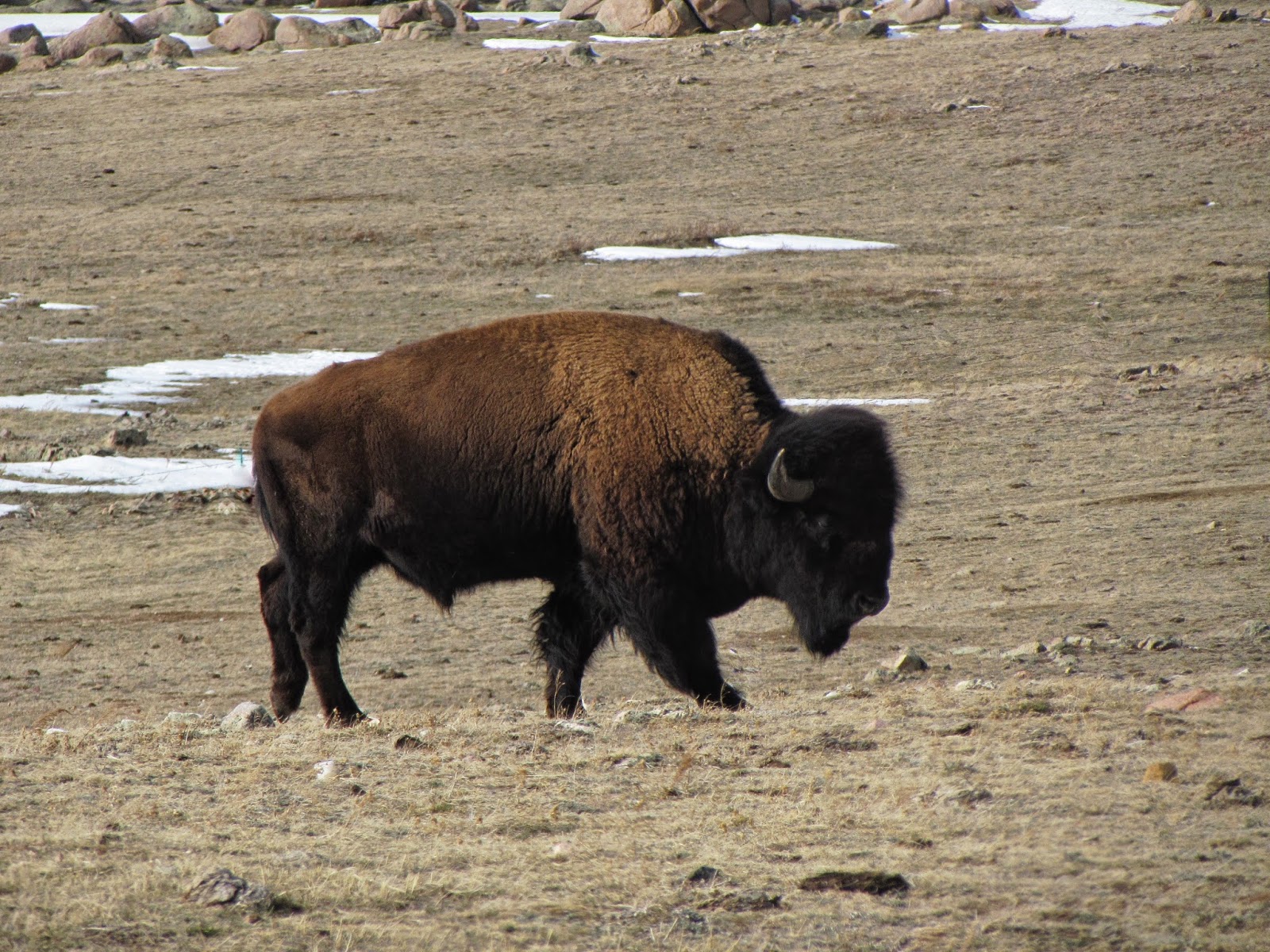
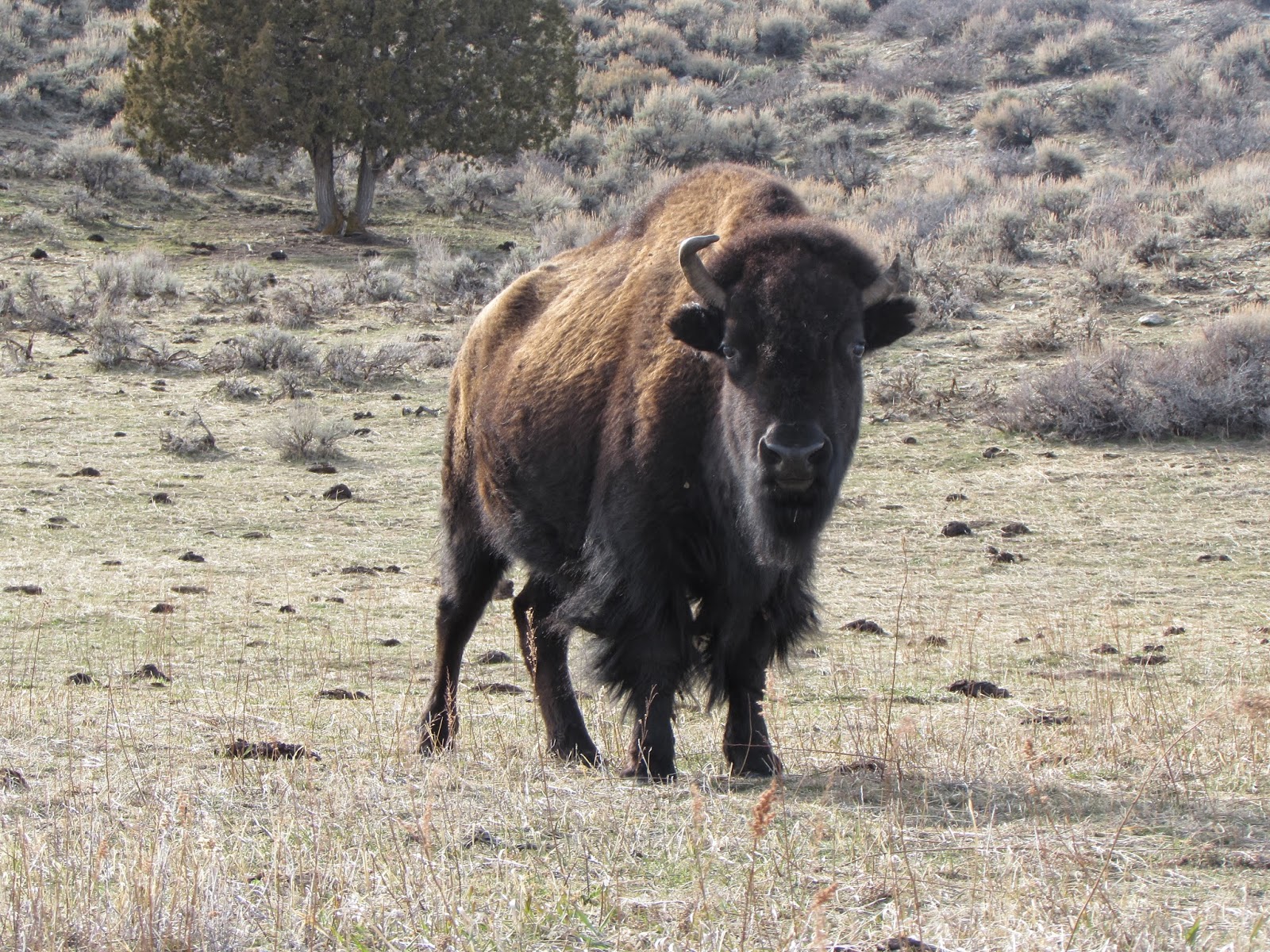
Today the Buffalo are making a strong comeback thanks to a few pure strain herds like the one in Yellowstone. I took these photos on a trip in the Laramie Range (30 miles away) last week end. These buffalo are on a huge ranch on open, unfenced range. They look pretty happy to me.

Oh Deer Me - Photo Wednesday

Love the blend of deer and vegetation


Family out on a day trip

Sometime those darn deer don't know if they are coming or going

"Hey,  where'd all the Bucks go?"

"Oh, there they are!"


Let's end this Photo Wednesday with a Bunny and a Robin -  and because this blog is read in countries other than American how about a nice pair of Canadians?

All photos taken at Guernsey, Wyoming State Park this past weekend