Showing posts with label Buffalo. Show all posts

Things To Do On A Wyoming Mothers Day

Seems to me that a good Wyoming Sunday afternoon drive cures most of my ailments.
Sometimes it is all about the view - this one from 25 miles west of town

It is always fun for Jan and me to see what wildlife are up and around, enjoying the day. 
Looks like a family outing

Wild Iris
This time of the year it is fun to what new wildflowers are blooming.
Indian Paintbrush - Wyoming State Flower
Today we took a drive to the west of town, not a long drive, only a total of about 75 miles and a couple of hours.
Prairie Dog calling out
 I thought that today I would post a few photos of our drive – it’s kind of what Wyoming is all about. 


Hope all of you enjoyed the day as much as we did.

Wyoming Wildlife

Random Thoughts on a Windy Wyoming Day
Today in my little part of Wyoming we are experiencing warm weather, in the mid-fifties, and incredible wind. Weather app says winds are blowing 25-45 with gusts to 60. Good day to stay inside.

Bison - The two main species of Buffalo in the world reside in Africa. In America we have Bison, and lots of them, over a half million by recent count.  For some odd reason, in the past two years sportscasters have started to pronounce Bison when talking about the North Dakota State Bison as if it were – Bye -zzon, instead of the correct Bye-son. Drives me nuts, but since they keep doing it, I guess no one else either notices or cares. Hope I never read a novel with hunters or native tribes are off, hunting bizzon.


Pronghorn - In that same vain people in the west have referred to Pronghorn as Antelope for years. There are 91 species of Antelope but none in the western hemisphere. As for the Pronghorn there is only one, and in Wyoming, we have a varied population that now numbers around 400,000, it was as high as 600,000 plus, as recently as 2005, but drought and bad winters have moved the total lower. I hunted Pronghorn for years and enjoyed it, but now hunt only with my camera and they are a most interesting subject.


American Sagebrush Ecosystem – Looks like sagebrush is on the decline in the west. At first, this may look to not be a problem, but like all ecosystem’s destroying or greatly changing one will gradually change others, much more than at first believed.


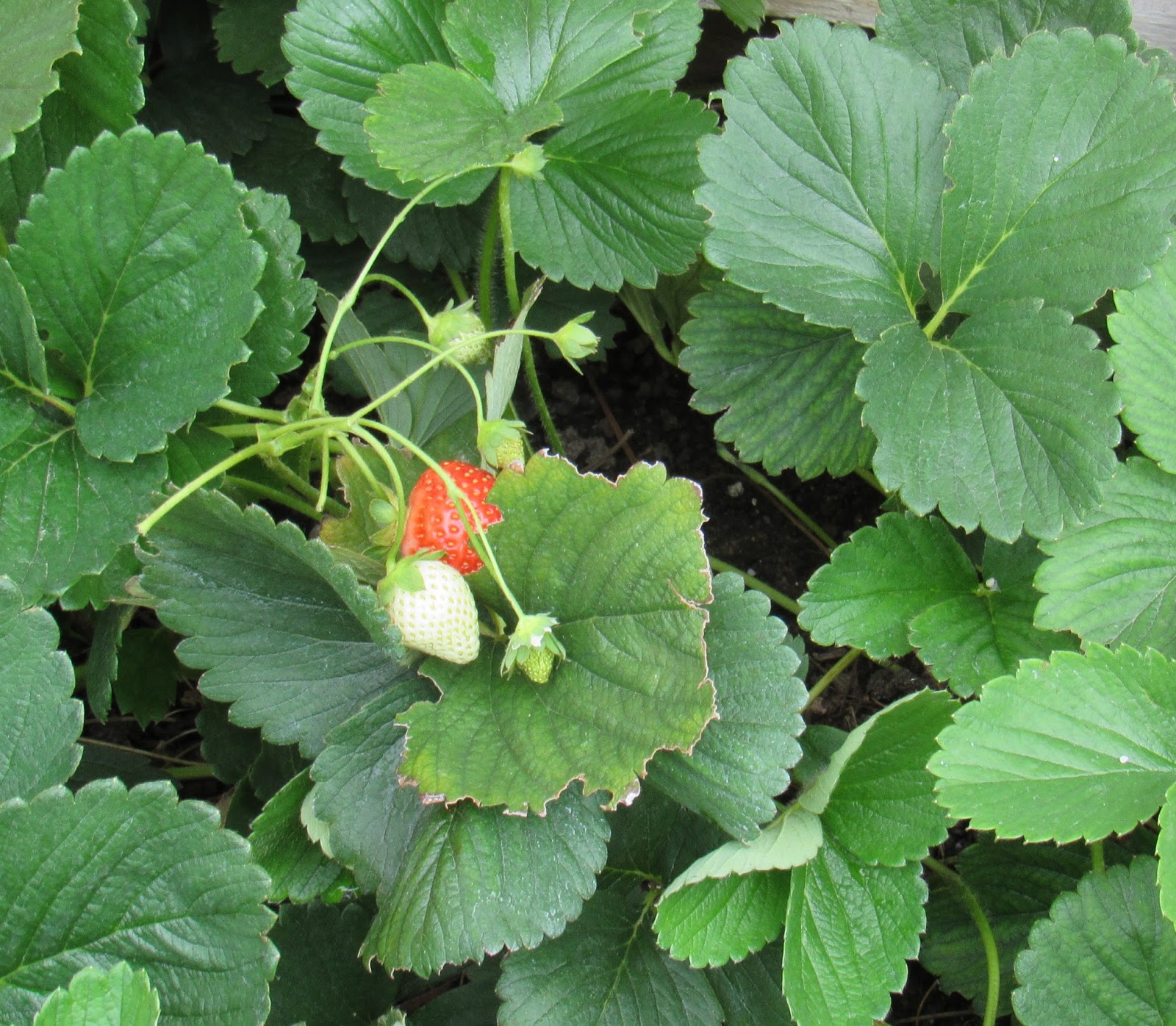
Wyoming is also home to 50,000 or so, Mule Deer. We have a terrific population around here, even in town. They can be a menace, especially when they eat the blooms from my strawberries and tops from my tomatoes. They also love to take a bite from green tomatoes, sorry deer it’s not an apple, then spit it out. How many albino mule deer are there in the state? Well, that’s a good question. I have found researchers that say one in 500,000 others that say it could be much lower, one in 20,000. That means we, have two at any one time or one every ten years. Either way, it is exciting to see one. 

Jackson Wyoming

At times I have people say to me, “Jackson, that’s not even Wyoming, I hate it when people come to Wyoming and only visit Jackson Hole, Yellowstone, and the Tetons.” Or something similar to that. I could not agree less. Jackson is Wyoming through and through. Cowboys, wildlife, horses,  mountains, rushing rivers and hard working people, sure reminds me a lot of Wyoming.
Still some Grizzlies around the Jackson Area. Stay far back

David Edward Jackson - So, who was this Jackson fella, the town was named after? He was David Edward Jackson and reportedly his friends called him Davy. He was one of the first white men to visit the area, a trapper, and partner with the firm Smith, Jackson, and Sublette. This Sublette was William, responsible for building Fort William, later to become Fort Laramie, and about as far from the Jackson area as one can get in Wyoming. Jackson after John Colter and perhaps one or two others, spent an entire year, including one of Jackson’s, legendary winters, in the area.

The story of David Edward Jackson is one that would make a terrific mini-series. It is one of those rags to riches family stories. Although I have spent all of my Wyoming years on the eastern side of the state, this story is one I told in my history classes for years.

Jackson's grandparents John Jackson and Elizabeth Cummins were convicted of crimes in London and sentenced to serve seven-year indentures in America. The two met on the ship and were married six years after arriving in what would become the United States. By 1778 the couple migrated west and by 1770 they lived in western Virgina and were acquiring large tracts of good farm land. The couple had eight children, the second was Edward Jackson, who became the father of six children, three of them boys, the second being, David, the namesake for Jackson and Jackson Hole. Their third son was Jonathan, the father of Civil War legend Thomas (Stonewall), Jackson.

Shenandoah – Yep, just like the song - David Jackson was born in the Shenandoah Mountains in what is today West Virginia. Jackson moved with his young wife, west to Missouri for cheap and good land to take up farming in the early 1820s. But then everything changed when he saw Colonel Ashley’s newspaper add. He joined the Ashley-Henery party and headed west. And the rest, they say, is history. Jackson went on to work as a businessman in the West for nearly twenty years traveling into New Mexico and as far west as California, before failing health sent him home to Missouri where he died in 1837 at age 49.


Beauty and History Too - Next time you visit, Yellowstone, The Tetons, or the Jackson Hole area, remember, there is also a lot of history to explore in the area.

The Wild West

The Wild West

In his autobiography Standing Bear, a Sioux chief said that the white man, not the Indian made the west wild. “We did not think of the great open plains, the beautiful rolling hills, the winding streams with tangled growth, as wild. Only to the white man was nature a wilderness, and only to him was the land infested with wild animals and savage people, To us it was tame. Earth was bountiful, and we were surrounded with the blessings of the Great Mystery.” Interesting!


When the whites came into Indian lands, they tried to change the native peoples way of life. Religion, living style, lifestyle, food, cooking/eating utensils, dress, war, relationships and tribal makeups and hierarchy were all wrong – according to the new people, from the east, and now in the west.

In my view, the wild west came about as more and more non-Indian’s moved and crossed the west. Civilization movements and a clash of cultures changed the American West and created our, modern, view of the wild west. But, I’m most sure that this was not something new. Civilizations change as new people become more and more a part of something, where at one time they were outsiders. People being forced to change or obliged to accept what they do not want will fight, always have, probably always will.


Sometimes we do not look at the big picture, probably it was not as wild as Hollywood has made it out. Indian encounters are much more prevalent in old television series, movies, and novels than they were in real life. But the wars in the west were genuine, and were brought on as Standing Bear so eloquently stated, when the new people saw things as savage and wild instead of the way they were and had always been.

The Diet of a Mountain Man

We read and watch daily opinions about our overweight society, “Americans are too fat,” we are continually told. Maybe so, today anyway, but not always. I smile each time I remember the story of Jim Bridger making his own supper. He skinned and gutted a jack rabbit and a nice sized trout, skewered them and propped both over the fire for roasting. Once they were cooked to his taste, likely not long, he ate both quietly and drank an entire pot of boiled coffee to wash down the meat. No seasoning of any kind, maybe smoke flavor from the fire, but that’s it. This was not uncommon for early hunters/trappers in the American West. Meat and coffee. Surprising to some, that many of these men also drank a lot of tea, it was as popular as coffee for many of the early explorers.
Cooking in a Mountain Man Camp
It took several years before the diet in the west changed much. Changed, but it still remained monotonous, with western Americas often eating the same few things for days or weeks at a time.  Wild game, fruits, and wild onions, in season, and washed down with copious amounts of coffee and tea with little else. Meat could be preserved by smoking and drying and often was.
Wild fruits and berries were always a treat

Not until the Oregon Trail got busy and the railroad ran through the state did the variety of foods available start to change. With places like Fort Laramie, and a quarter of a century later railroad stops, getting regular shipments of foodstuffs it helped. Flour and cornmeal were generally available along with dried fruits (usually apples), sugar, rice, dried beans and peas. Not much but much better than it was.

Early food, including meats, were often boiled, unlike today’s diet, heavy with fried foods. There was not a lot of fried meats until bacon became a staple along the trail west, soup, and roasted meats were much more an everyday part of the diet than today.  

So there you have it roasted meats and a few boiled dried vegetables, day after day after day, guaranteed to keep one’s weight under control. But, be careful with the gravy, cornbread, and biscuits, all favorites when flour and cornmeal were readily available in the west.
Buffalo - Staple of the diet in the west for many years

The Legend of the Bouncing Buffalo

The Legend of the Bouncing Buffalo

Long before the bow and arrow native peoples were hunting bison for food. After the bow and arrow were perfected and commonly used for hunting, nature and the lay of the land were still important for big annual hunts, hunts needed to feed the people through long hard winters.


One of the most interesting legends of the hunt is set in and around what today is the tiny village, (212 population in 2010 census) of Chugwater, Wyoming.
Chugwater today


~The Legend~

Long ago, long before the coming of the white man, the valley of the cliffs, (Chugwater Valley), was the home of a powerful Mandan chief. One day he was gored and trampled by a bull buffalo. He survived but would not be able to hunt again that season. He ordered his son, the Dreamer, to lead the next hunt.

The son, in one of his dreaming states at the time, only grunted at the request and continued to dream. The old chief, disgusted with his son, went through the tribe hoping to find a worthy son, a son he could adopt and one that would lead the hunt. But the Dreamer had been listening when his father spoke. The Dreamer had heard his father’s request and called for a council of hunters where he told them of his new plan, a plan that came to him in a dream. He told them to cut the nearby herd and stampede as many as they could toward the bluffs and run them off. The plan worked and when the buffalo tumbled off the cliffs their bodies struck the boulders and rocks below with a chugging sound, such as chug, chug, chug.

From that time on Native Indians and the soon to come white man called the nearby stream, “The water at the place where the buffalo chug.” The name was later shortened to Chugwater.


Not part of the story but an interesting side note is that Francis Parkman in his famous work, The Oregon Trail, camped and spent time with the Sioux at Chugwater Creek and describes it in his book.

Using the Medicine Wood

 Medicine Bow is one of the most impressive mountains in south eastern Wyoming. The Mountain, most often called, Medicine Bow Peak, is part of  a small range called the Medicine Bow's. Nearby is the tiny village of Medicine Bow and Medicine Bow River.

Took This Shot of Medicine Bow Peak Last Sunday

Where did the name Medicine Bow come from? Good solid birch trees that made terrific hunting bows for native peoples roaming and hunting the area. Many different woods and even the antlers of big horn sheep and elk were used in various parts of the west to make hunting bows. The Birch wood found along today's Medicine Bow River must have made exceptional bows. So good they said it was, “good medicine,” the medicine wood.


Powerful Animals Took a Powerful Bow


 See the town of Medicine Bow here - http://www.medicinebow.org

Merry Christmas

Merry Christmas. I hope everyone has a great day! We had much family celebrating with us - a most wonderful day.


Buffalo


By the middle of the 1700s the great herds of bison that roamed America were estimated to be at least 60 million, and possibly as many as 100 million. But in less than a century that number was reduced to a few hundred. Many causes can be found as to why the buffalo were nearly wiped out. Certainly, drought had much to do with it, and the hide hunters, and (sport?) hunters killed hundreds of thousands. But did you know?
Buffalo on the Spit

For more than a century Wyoming bison were killed by the tribes for many and in some cases most of their needs. When the mountain men/trappers brought European trade goods everything changed.  Indians started hunting buffalo as an economic benefit for themselves and their tribes. For the first time they began killing bison for their hides and tongues which they then exchanged for trade goods. By the 1840s, the number of hides prepared for trade was far more than could ever be used by the tribes.

 One estimate guesses that Native Indians were using/eating only four out of every 100 bison they were killing as more and more American and European trade goods reached the tribes. In 1839, the American Fur Company bought 45,000 buffalo robes and in 1840, 67,000 more. All of this was before the coming of the famous buffalo hunters of the plains that slaughtered the buffalo by the tens of thousands.

Thanks to a few forward looking people, starting in 1881, today there are nearly 400,000 bison, once again, in North American.


 Buffalo

They weigh around a ton
Stand 6 feet tall at the hump 
From nose to tail are about 11 feet long
They can run for short distances as fast as 35 Mph
Reach mature full size at about 7 years of age
Can live 30 years or more

Wyoming Buffalo


The plains Indians lived on them, the railroad was built with their help, and early travelers on the trails-west often caught a glimpse of buffalo, or bison, along their journey.

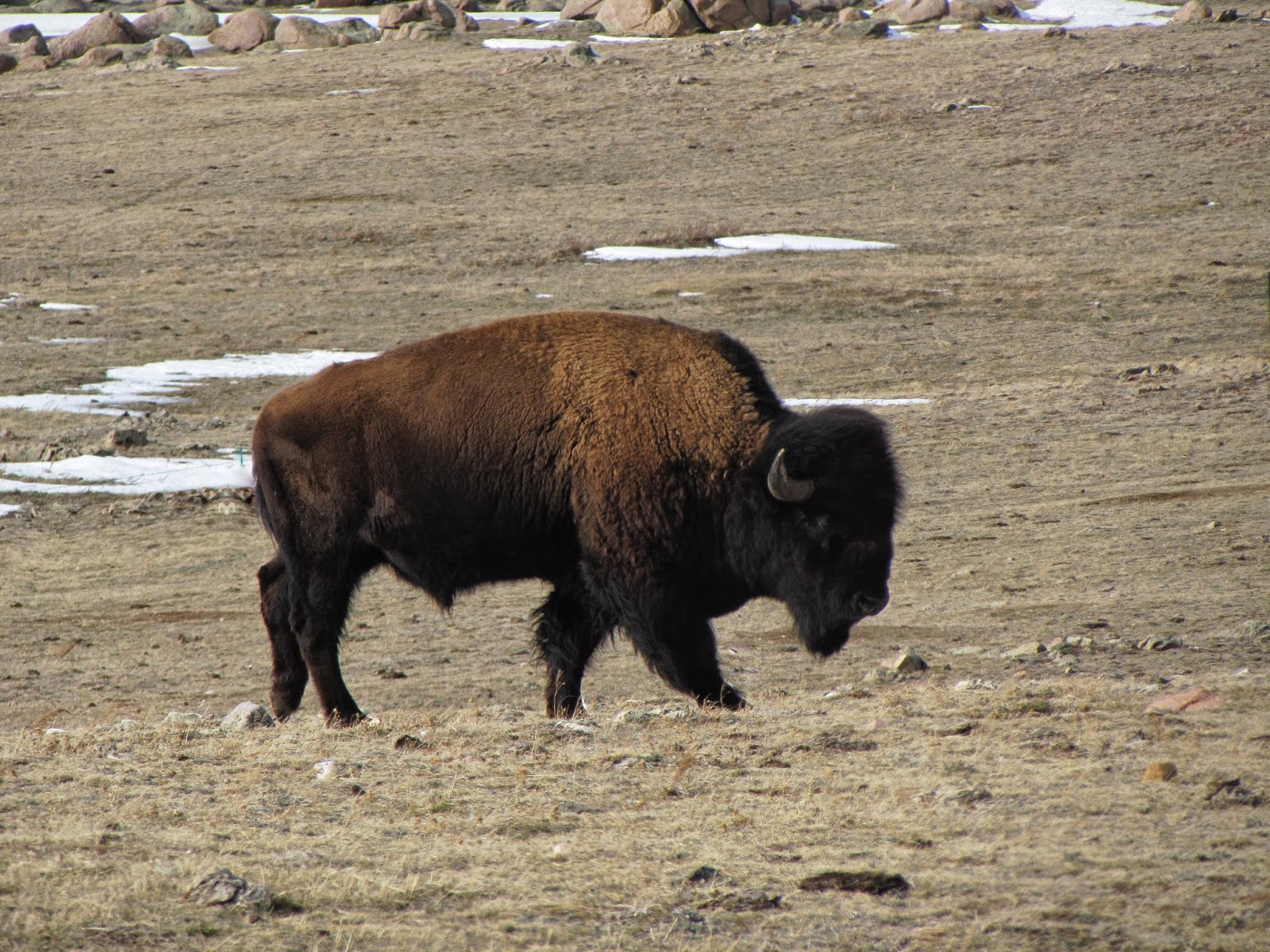
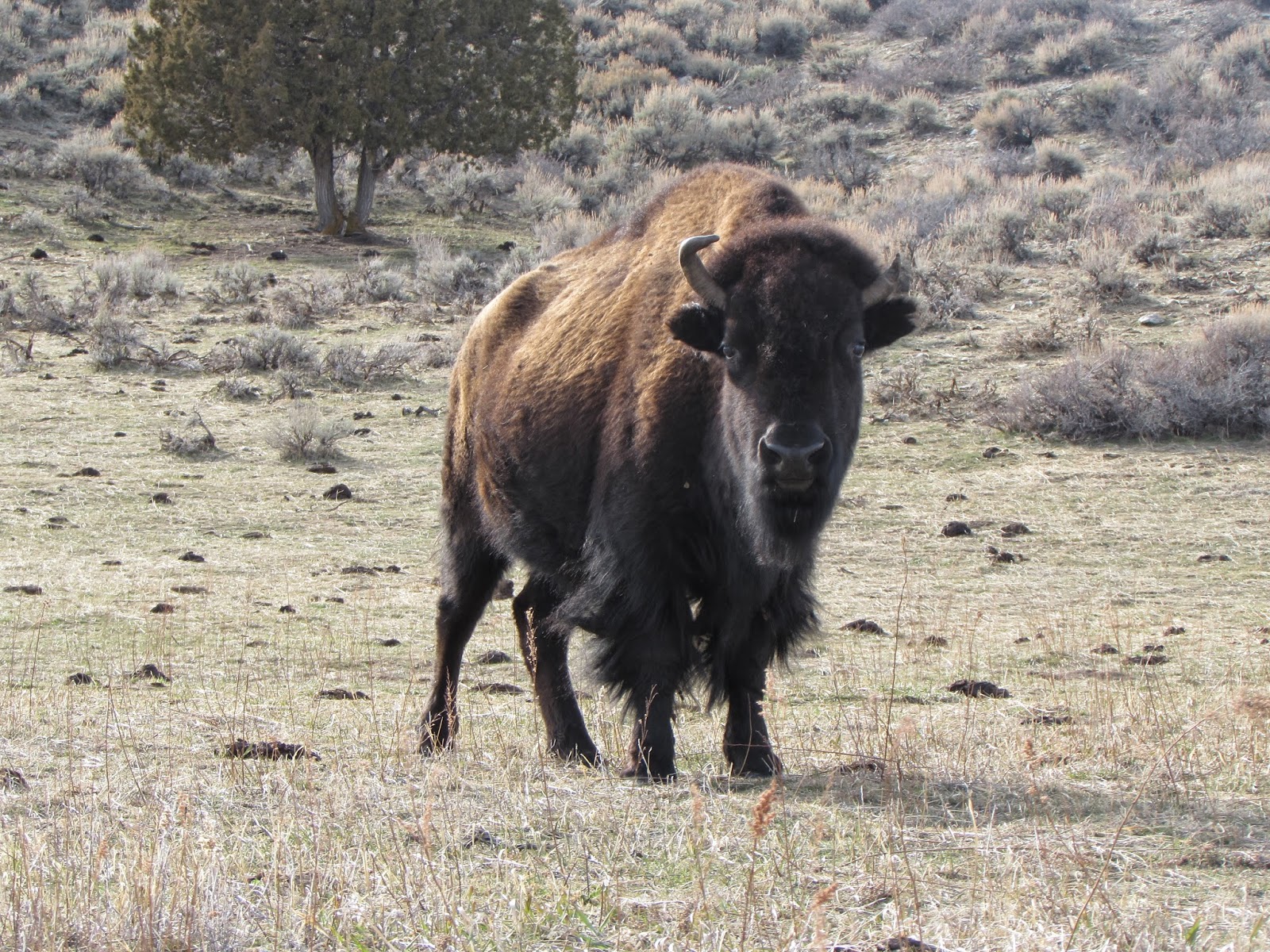
I have been enamored with the buffalo since I was a kid. I love to watch them moving, so slow, over the grassed plains. If need be, they can run and running they are graceful and fast. Over the years I have snapped hundreds of photos of bison and even attempted to once draw one, with no success. Later I recalled that I had also attempted to draw a horse, cow, mountain and my friend Mike, none were critically acclaimed. That’s when I turned to taking photos, with much better success.

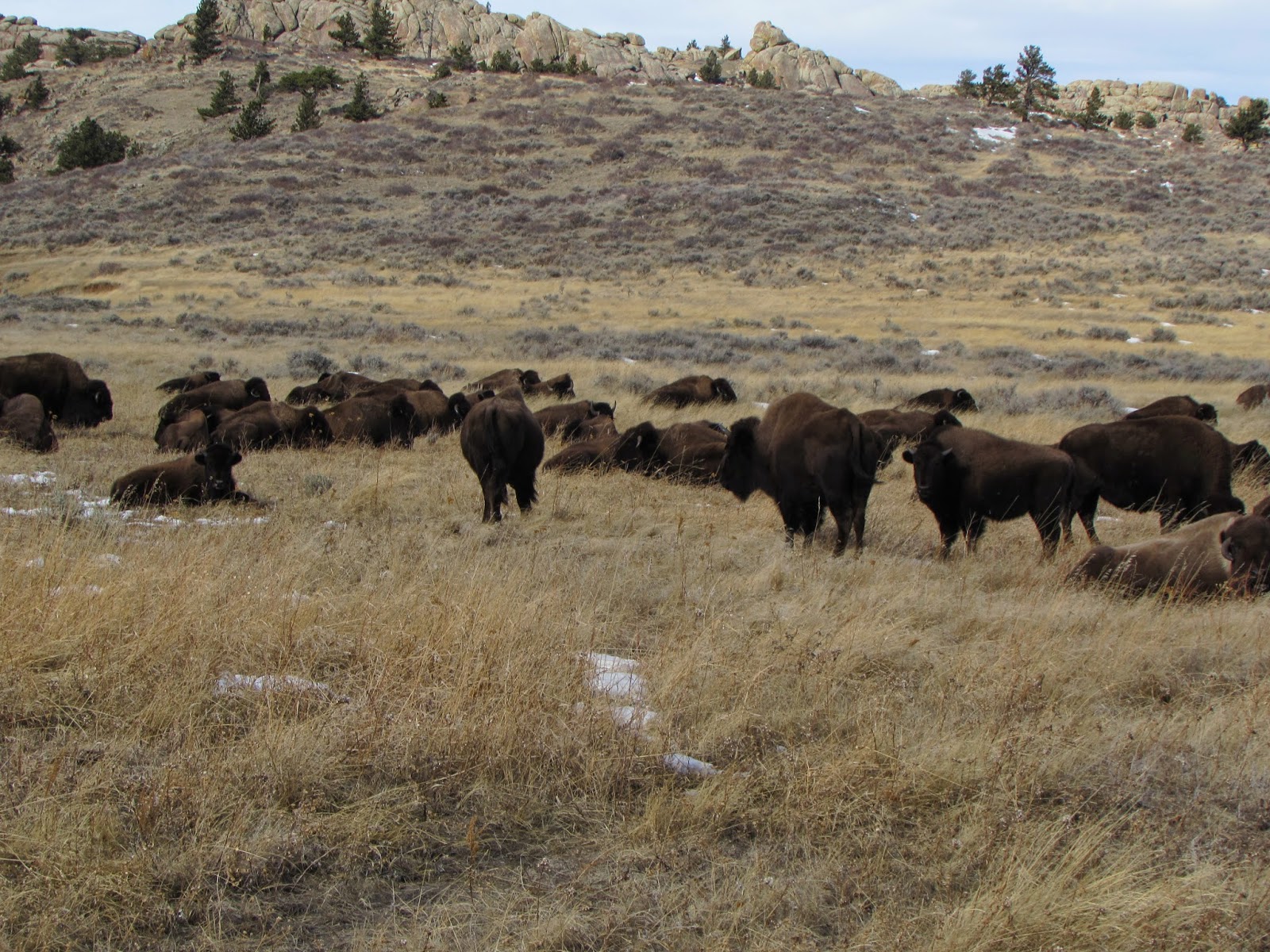
This weekend we traveled with friends, we have known for a lifetime, up into the Laramie Range to take a look at the buffalo that roam a ranch of thousands of acres. I always enjoy it, the roads are not fenced and if there are cross fences they are miles apart. A bit like the buffalo of the old days.
 
 
A fun trip, beautiful weather, good friends, a fine restaurant up on the mountain, and you know what?  I still love looking at the buffalo.
 

Where Did All The Buffalo Go ?


The great era of the mountain man lasted for twenty years. The two decades from 1820 to 1840 opened much of the west and all of Wyoming.  But what did the mountain men do after 1840, the price of fur was down, down so low it wasn’t worth their time to trap. Many turned to the vast buffalo herds of the plains and foothills, either leading hunters to them or hunting themselves.

In the 1840s there were a reported 30 million buffalo and maybe as many as 60 million – by 1882 there were less than one thousand. Theses beasts had roamed America for hundreds of centuries sustaining cultures that dated back to nearly the Stone Age. So what happened? We hunted them to near extinction. They were easy prey, hunted for food to feed railroad workers, shot for sport by hunters from all over the world. Later thousands were killed for their tongue and hump steaks. And then the hide hunters came. $3.00 a hide when a dollar a day was a decent wage. Many hunters employed full time skinners, cooks, teamsters and general help. A good hunter killed hundreds and sometimes thousands in a year.
 

So how did this happen, sadly, government policy? Kill the food source and the Indian problem would go away, at least that was the theory, and it seemed to work. The United States government encouraged the hunting of buffalo to extension. By 1890 the Indian Wars were over and the buffalo were nearly gone.

 
Today the Buffalo are making a strong comeback thanks to a few pure strain herds like the one in Yellowstone. I took these photos on a trip in the Laramie Range (30 miles away) last week end. These buffalo are on a huge ranch on open, unfenced range. They look pretty happy to me.

Eastern Wyoming -A Two Hour Vacation


When I tell people I live in Wyoming, I often hear, “Oh, Yellowstone, I love Wyoming.”
 Well I love Yellowstone myself, the most beautiful place on earth. But I have to explain that I live on the other side of the state, eastern Wyoming. Specifically, Guernsey Wyoming, south of Casper, north of Cheyenne. If that’s not enough I try, “two hundred miles north of Denver."
Then I sometimes here, “Is there anything out there?”
“Well yes, yes there is.”
My wife and I think eastern Wyoming is the greatest place to live on earth, we have mountains and plains, rivers, trees, wildlife and cows. Not too many places to shop and that makes it just about perfect. Monday afternoon we took a two hour ride out west of town and back—so here it is a quick glimpse of eastern Wyoming, just west of Guernsey.
Eastern Wyoming – A Two Hour Vacation.
A nice Texas cow in Wyoming, still like seeing these old Longhorns around, even if this one is not sure which way to let the horns grow.
 

A little history lesson – this is the Oregon Trail crossing at the Bitter Cottonwood. Hasn’t changed much since the trail was the best way west. Actually it hasn’t changed at all. It was a long day, at 17 miles, but this could be done from Fort Laramie in one good day. Travelers liked this camp site because there was an abundance of fire wood.


Not the wild herds of trail days, but this is open range, still no fences in site.


And we do have mountains in Eastern Wyoming, this is the Laramie Range
 

Laramie Peak through the boulders


Mountain pasture buffalo


This is Cottonwood Creek about 20 miles upstream from the crossing at the Bitter Cottonwood. Yes, I know, pretty spectacular.
 

Why do kids always want to race, I declined, 55 miles per hour seemed a bit too fast for me.


Still seems to be a good number of horses in the area. I know nothing about horses, other than I have fell off, been bucked off and been both bitten and kicked, but still really like them, not sure why. This appears to be some type of draft (work) horse, maybe a Morgan.

Sun is setting I’m ready to go home – ahh, home sweet home.


Maybe I will grill and enjoy the view from the back 40 this evening.
Depending on when you read this post, goodnight or good-day.