Showing posts with label westerns. Show all posts

Wyoming In The Movies


Wyoming Fact & Fiction

January 31, 2022

Wyoming in the moviesI spend some time each week looking at the on-screen guides for TV shows that I might want to record. Mostly I'm looking for old black & white movies. I specifically look for anything about, set in, or titled something about Wyoming. This weekend I watched a B-western I found on TCM, Storm Over Wyoming. I have watched quite a few Tim Holt and Richard Martin movies. Although, at times a bit too goofy for my taste, they are generally entertaining.

Storm Over Wyoming is set in the fictional city of Sundown, Wyoming. I have spent time in Sunrise and Sundance Wyoming, but this did not resemble either. As were nearly all of these old B westerns, this one was filmed pretty close to Hollywood, and besides, who really knew what Wyoming looked like anyway? (Kidding!) The movie was another telling of the age-old sheep vs. cattle tail, but all in all, it was pretty good for a 1950 first half of a double feature movie.

Many movies have been set in Wyoming, far more than were ever filmed here. Here is a quick look at three of my favorite movies with Wyoming as part of the main storyline.


Butch Cassidy and the Sundance Kid – A classic new age western full of action, adventure, and humor. Train robberies, bank robberies, and the Wild Bunch on the run. Lots of fun, kind of based on a fact or two. Hard to beat Paul Newman as Butch and Robert Redford as the Sundance Kid. This one came out in 1969. Hard to believe it has been that long.


 Heartland – Based on the book Letters of a Women Homesteader by Elinore Pruitt Stewart. Rip Torn and Conchata Ferrell are terrific in this one set in 1910 Wyoming. The haunting clarinet music of "What a Friend we have in Jesus" as the train rolls toward southwest Wyoming sets the tone for this one. Harsh, sad, honest, and a must-see. There is another movie with the same title. If you want to see this one, make sure it is made from Letters of a Woman Homesteader.

My Friend Flicka – Made in 1943 based on Mary O'Hara's novel, published two years earlier of the same name. O'Hara's book was the first of a trilogy, followed by Thunderhead and the Green Grass of Wyoming. When O'Hara wrote these books, she was married to Helge Sture-Vasa and living on the famous Remount Ranch (they named it) between Laramie and Cheyenne.

My Friend Flicka is the story of a ten-year-old who is given a choice of horses to raise with hope from his parents that it would give him some purpose through responsibility. Unfortunately, he chooses a firey one-year-old who he names Flicka. But it was his choice, and he is allowed to raise, tame, and break the spirited filly, and the two become fast friends.

As a youngster of ten or so, I remember watching the Saturday morning television show – My Friend Flicka.

Lots and lots of movies to pick from, but these are three that I think are worthy of watching.


Wyoming Trivia – two questions today

Q1 – Speaking of movies and TV shows – What writer has a monument to him in Medicine Bow, Wyoming?

Q2 – Many movies have been made about the killing of Nick Rae and Nate Champion on what famous Wyoming ranch?


Answers

Q1 – Owen Wister – Author of The Virginian

Q2 – KC Ranch


Here is the link to all of my books on Amazon

Today's photos were taken last week at Guernsey State Park.


See you next week!


Wyoming Winter and Trivia Too

 January 3, 2022

Like all of you, it looks like I have made a successful jump from 2021 to 2022. I’m not much of a New Year’s Resolution person, but I hope to continue with a few things from 2021. First, I intend to stay more active on this site. Second, I will continue my daily walks – they are great exercise and the perfect thinking/contemplating time. Third, and last, we hope to continue our old traveling schedule after being mostly tethered to home the past two-plus years. That means a couple of long trips and several short trips in 2022.


We live in Wyoming’s North Platte River valley; it is relatively mild compared to the rest of the state. Wednesday – two days away – we are supposed to reach an overnight low of -18 degrees. Now that’s cold, but not close to any records. On February 9, 1933, Yellowstone Park reached an all-time Wyoming record of -66 degrees. Now that’s cold.


I have been retired from the classroom now for ten years. I was able to teach Nebraska history, then the history of the Trans-Continental West, and finally Wyoming history (at both the high school and college level) for more than 40 years. I miss teaching all those History classes. One of the things I miss most is the first or last two minutes of class time which I used for Wyoming trivia. To start the new year - here is some good ol’ classroom trivia. Answers at the very end of this post – don’t peak first.

Q1 – What percentage of land in Teton County is privately owned?

Q2 – What are the two historically significant rivers that flow through Platte County.

Q3 – What year did the first vehicle drive through Yellowstone Park?

That’s it – good luck.


 Happy New Year, may it be your best year yet!

“Ring out the old, ring in the new, Ring, happy bells, across the snow: The year is going, let him go; Ring out the false, ring in the true.”           Alfred Lord Tennyson

-Answers-

1. Teton and Yellowstone Parks dominate Teton county. Only 3% of the land in Teton County is privately owned. Overall The federal government owns 48.2% of Wyoming, and state lands make up 5.6%.

2. The North Platte and Laramie rivers - Trappers, Travelers, and Tribes make these two most significant in Wyoming history.

3. The first car drove through Yellowstone in1902. Not sure of the make of the vehicle, but it was not a Model T made famous by Henry Ford & Co. the T was not introduced for another six years. 


      All photos were taken yesterday - a beautiful day to be out. 


Western Books


I have often read that Owen Wister's publishing of The Virginian, 115 years ago this week, on May 28, 1902, was the start of Westerns in America.  Nice that the setting was Wyoming, which was still pretty new and still a bit wild at that time. But that was not the first western, not even close. Long before the beginning of the 1900s were the Dime Novel Westerns, sometimes shortened to Dime Westerns.


Elk Mountain as seen from the town of Medicine Bow
the setting for the start of Wister's, The Virginian

The Dime Westerns became popular shortly after the Civil War spanning a time period of nearly 40 years before the publication of, The Virginian. The books were short, almost always less than 100 pages, and priced at a dime or 15 cents. These books centered on fictional escapades of real people, many of the settings were, Wyoming, Texas, Colorado, Kansas, Oklahoma and Montana.  Mountain Men, Indians, Soldiers and Bad Guys of all kind made up the many characters of these books. Later, a smaller format, adopted for magazines became popular, these were all set to the standard length of 32 pages.

Today westerns make up less than one percent of the overall book market – so what happened? Maybe, not much. If a reader looks, it is easy to find westerns today, just not the old tired, fake Wild West type of story. 
This is my modern day, set in WyomingYoung Adult or Adult Western Mystery


Suspense-Thrillers and Mystery-Detective along with books classified as Young Adult dominate today's best seller lists. I write books I classify as western-mysteries, some set before 1900 and some in modern time. I still read westerns today, some are thrillers, some mysteries, and some suspense, but all are set in the west.

Guess the Western is not dead, it just lost its singular classification, maybe the old time shoot-um-ups died in the street with their boots on, but today great western stories can be found in just about any popular genre.

Here is a link to my books on Amazon – four of these books could fall into the western category. Click on any of the books and read a free sample.

The second of my Blade Holmes Westen Mysteries
Cover photo from Fort Laramie - each book has Fort Laramie settings.


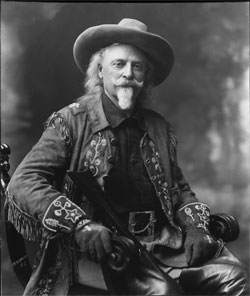
Buffalo Bill the Actor

Buffalo Bill was an actor long before he came up with the idea of his Wild West show. 

 From 1872 until 1886 Cody led a troupe of traveling actors, a "Combination," through much of America presenting frontier melodramas. It was during this period that he honed, what would become, his Wild West Show. Bill Cody’s acting debut was in dime novel writer Ned Buntline’s, The Scouts of the Prairie.

In his 14 years with the traveling troupes, he tired of the same dull presentations of the west and wanted to offer a more real show of the west. It was during this time that he added shooting marksmanship exhibitions, and Indian dancers, and started to use animals onstage.

Cody started his, Buffalo Bill’s Wild West, in 1883 and three years later acted only in his show. Interesting that it was not Buffalo Bill’s Wild West Show, but only Buffalo Bill’s Wild West.

Cody’s portrayal of the Wild West toured widely in the United States and was so popular that eight different years the group visited Europe, putting on shows for commoners and crowned heads alike. Cody's show lasted for three decades, an excellent run by anyone's standards. 

Cody had two homes, one in North Platte, Nebraska and another in Cody, Wyoming. To most historians, this was the setting for his version of the west, central Nebraska through all of Wyoming.


How famous was he because of his show? Writer/western historian, Larry McMurtry says he was the most recognizable person in the world during the last part of the 1800s – pretty famous!

Have a wonderful and blessed Thanksgiving.

What's In a Name


Seventy, or so, years ago, The Wyoming Game and Fish Department did a study, trying to identify all bodies of water in the state. They found 38 Spring Creeks, 30 Cottonwood Creeks, 29 Beaver Creeks, 25 Bear Creeks, 23 Dry Creeks, 21 Horse Creeks, 18 Sand Creeks, 17 Sheep Creeks and 17 Lost Creeks. Makes me wonder if they didn’t have much imagination or if they only had a short book entitled, Best Names for Rivers and Streams, I would have named one after myself, Old Guy River, now that has a ring to it!

 How anyone found their way through the state, or all of the American West, before roads and railroads might be one of the great mysteries of American history. Hope they didn’t tell people to hurry along Spring Creek, turn left when they reached Sand Creek and follow it to Lost Creek, seems they could have ended up about anywhere in the state with directions like that. But the state did have some names for streams that were unusual enough to remember. Dry Donkey, Robbers Gulch, and Nameit are my favorites.

But then again we name towns mostly after people, or maybe people named towns after themselves. Guess that’s why we have towns like Bill, Aladdin, Patrick, Elwood, Merna, and Rosie’s Ridge in Wyoming.

Oh, we also have Jackass Pass up in Fremont and Sublette County, (yep, named after explorer John C. Fremont and trapper William Sublette) but that is another story for another time. Early trappers said the ancient Indian trail was so steep that only a Jackass could make its way on it.

Wanted: Enterprising Young Men


To enterprising young men. The subscriber wishes to engage one hundred young men to ascend the Missouri River to its source, there to be employed for one two or three years. For particulars enquire of Major Andrew Henry near the lead mines in the county of Washington who will ascend with and command the party; or of the subscriber near St. Louis, signed William H. Ashley.

 The Missouri Republican, St. Louis Mo., March 20 1822

And so begin the tails of the great American West, set in the area of the Louisiana Purchase.

Wyoming Humor - Edgar Wilson (Bill) Nye


Like all states Wyoming has had its share of colorful characters, none more colorful than Edgar Wilson (Bill) Nye. Nye came west to Wyoming in 1876 and stayed seven years until 1883. He settled in Laramie and found his true passion and maybe what he was put on this earth to do – writing humor.

Nye practiced law, became postmaster of Laramie and worked for the local paper before started his own, The Laramie Boomerang,  (still a six day a week paper) his newspaper columns became so popular that they were reprinted far from the small town in Southeast Wyoming being picked up by papers all over America and reprinted by more than a dozen newspapers in Europe.

Nye was indeed a first rate humorist, one of the best of his time, later in life he often shared the stage, and equal billing with Mark Twain. Unfortunately Nye’s humor has not been as lasting as Twain’s but in the last quarter of the 1800s he was one funny guy.

One of my favorite excerpts from his writing follows. This writing explains his resignation as Laramie’s Postmaster.

 It is a full newspaper column I have reduced to only four of the thirteen paragraphs.

 Enjoy!

                                                                        Postoffice, Divan, Laramie City, W.T.

Sir.—

I beg leave at this time to officially tender my resignation as postmaster at this place, and in due form to deliver the great seal and the key to the front door of the office. The safe combination is set on the numbers 33, 66 and 99, though I do not remember at this moment which comes first, or how many times you revolve the knob, or which direction you should turn it at first in order to make it operate.

You will find the postal cards that have not been used under the distributing table, and the coal down in the cellar. If the stove draws too hard, close the damper in the pipe and shut the general delivery window.

Tears are unavailing. I once more become a private citizen, clothed only with the right to read such postal cards as may be addressed to me personally, and to curse the inefficiency of the postoffice department. I believe the voting class to be divided into two parties, viz: Those who are in the postal service, and those who are mad because they cannot receive a registered letter every fifteen minutes of each day, including Sunday.

Mr. President, as an official of this Government I now retire. My term of office would not expire until 1886. I must, therefore, beg pardon for my eccentricity in resigning. It will be best, perhaps, to keep the heart-breaking news from the ears of European powers until the dangers of a financial panic are fully past. Then hurl it broadcast with a sickening thud. *

*Excerpt taken from—Bill Nye’s  Western Humor

                                                        Selected and with an Introduction

                                                        By T. A. Larson

                                                       University of Nebraska Press

                                                      Lincoln, NE  1968

If you would like to see the letter in its entirety you can find it here- http://www.lettersofnote.com/2012/10/here-roads-seem-to-fork.html

Good Ol' Cowboy Food


So what did cowboys eat? Well it depended on who was doing the cooking. If it was the cowboy doing the cooking most meals were the same, the three Bs, bacon, biscuits and beans, washed down strong coffee. If it was ranch cooking or trail drive food it was much more varied and likely tastier.

Here is what you might find in a well stocked kitchen or chuck wagon in the days of the Old West

·        Flour

·        Coffee

·        Tea

·        Salt pork

·        Bacon

·        Dried fruit

·        Beans

·        Rice

·        Dried peas

·        Canned tomatoes

·        Canned peaches

·        Condensed milk

·        Corn meal and dried corn

·        Sugar

·        Molasses

·        Vinegar

·        Onion/garlic powder

·        Black pepper

·        Eggs

·        Potatoes

·        Chickens - around the ranch house and even on the trail

·        Other spices such as ginger

·        And of course the ranch always had beef and wild game when they could find it. Many ranches also raised a few, eatin’ hogs, even if they did not like to admit it.
Looks pretty good to me.
 

Fort Laramie-Oh Those Prices


Fort Laramie, beloved in western legend and story may not have been quite so popular in its day. Francis Parkman in his wonderful book, The Oregon Trail, described his visit to the famous fort in 1846. This year was specific as 1846 was the year the fort went from a private concern (one of the trading-posts established by the American Fur Company) to a government owned fort with the purpose of protecting travelers along the trail and protecting settlers, if any, in and around the fort.

Parkman described the fort itself, the buildings within and even spent quite a few words talking about building materials, roofs and windows. But what I found most interesting was the following. “Prices are most extortionate: sugar, two dollars a cup; five-cent tobacco at a dollar and a half; bullets at seventy-five cents a pound. The company is exceedingly disliked in this country.”

Travelers along the trail often needed to re-supply by the time they got to the fort—hope they had a lot of money with them as prices were much more than they were expecting.

Anything to make a buck!


And the Dead Guy Takes Two


And the Dead Guy Takes Two

In the last half of the nineteenth century and early in the twentieth Hartville, Wyoming was a wide open cowboy and miner town. Main Street boosted several bars, gambling houses and even a few upstairs of ill-repute businesses.

In the spring of 1902 a man only know as, the White Swede, came to town intent on a little drinking and gambling. He drank some, partied some, and died. Not a very good story, not until he was dead anyway.

The town of Hartville had no undertakers and no one seemed willing to make the five mile trip over iffy roads to Guernsey to see if an undertaker could be coerced into making a dangerous five mile trip under pitch dark skies. Because the Swede had no known family, and no close friends, the small group in the bar where the heart attack, or some other natural cause took him, decided to wait for morning and then do something about a burial for the poor guy.

The body was moved, out of respect for the dead, to a more suitable room away from the hustle and bustle of Main Street. Two cowboys and a copper miner volunteered to watch the body until morning and helped carry the old Swede to a room a block away from the main action of the town. It didn’t take long for the three helpers to get bored. And what better way to pass the time than to play some cards, poker to be precise. The three started a lively game but it didn’t seem quite right without a fourth. So they propped up the old Swede, put a cigar in his mouth, poured him a shot, sat the bottle near his right hand and dealt him in.

After each deal they put the Swede’s cards in his ever stiffening hand and took turns betting and playing cards for him each time his turn came up. The foursome played through the night with visitors often stopping by to see how this most unusual game was going.

The next day the Swede was buried and the undertaker was paid from the Swedes all night poker winnings. He didn’t clean his playing partners out, but he came close.

*When I first moved to this area, 80 years after the White Swede was laid to rest, the old timers were still telling this most unusual story. To add either more fact or fiction to this story, they mentioned, the White Swede had dark hair, was short and rotund and looked nothing at all like a Swede.

Maybe Next Year


Jan 1, 2013 – Going on official record – “I love the New Year and I love New Year’s Resolutions.”

6:00 a.m. - Eight hours of sleep, healthy, balanced breakfast, went for a walk, did my stretching and lifting workout, spent some hobby time, did some putting away and picking up in my workshop.

8:00 a.m. - New Years are great-reinvigorating, life anew

9:00 a.m. - Feel like I need a nap, have a bit of an upset stomach, my shoulders, hips and feet ache.

10:00 a.m. – Doing much better now, reclining on the couch, watching first of many New Year’s Day Bowl Games, still resting after my workout, and dreaming about the next year.

11:00 a.m. - Very soar, dull pain starting on top of my head and ending on the bottom of my feet, not feeling well at all, will take a handful of pain killers and continue resting on couch.

I really do not like New Year’s—except for the Football

Noon – Drinking soda, eating chips and peanuts, still resting on couch, feeling some better, game has reached halftime, watching shootout on the Western Channel until second half starts.

“Maybe Next Year, never have liked New Years stuff, too much hype, just another day for this ol’ cowboy”

-Happy New Year-

Comanche, The Only Survivor


 A childhood interest in the west: cowboys, Indians, mountain men and explorers lead to a lifelong job as a history teacher (now retired). I remember well my first lesson in the Indian wars, Custer and the famous last stand, what else?

That day we learned everyone died in the fight on the Greasy Grass river (Little Big Horn), everyone. None of us questioned this fact. But what about the Indians, why didn’t we ask? Not sure, but years later I still remember being taught that the Calvary horse Comanche was the only survivor of the Battle of Little Big Horn. Maybe we didn’t really study the Indian wars in the west, we were just told about them. Told about them by a teacher not so many generations removed from the plains battles and maybe still just a little bit prejudiced.   

My question since I became a teacher of western history has always been why had Custer not followed General Terry’s orders, instead following his own wrong instincts? He should have known of the great camp of Cheyenne and Sioux, must have known. Some historians speculate he knew but expected the warriors to fight and retreat to fight another day, (a common practice among plains tribes). But this day they outnumbered Custer and the 265 members of his 7th by such a huge margin that they stood their ground and in less than two hours the battle was one for the history books.

 Hundreds, or maybe thousands of Indians survived and much of what we know of the actual battle comes from their stories. Much has also been made of Benteen and Reno and the rest of the 7th that day, but that will be for another time.

I hope that today’s teachers are doing a better job of presenting both sides of the western Indian wars today than they did in the past. That is if today’s schools have enough time to squeeze in some history as they fight battles over, No Child Left Behind and the multitude of  new government mandates to teach better and for students to learn better than they have in the past. But that will also be left for another time.

Incompetence and Politicians –Governor Moonlight


Colonel Thomas Moonlight was likely the worst commander in the history of Fort Laramie and may well have been responsible for the escalation of the Indian wars in Wyoming and the west.

Black Foot and Two Face (Oglala Chiefs) brought in a white woman, Lucinda Eubanks, who Big Foot had purchased from the Cheyenne who’d kidnapped her on the Little Blue River* in southeast Nebraska, several months earlier. She was in bad shape after being badly abused (by her captors before Big Foot and Two Face) and Moonlight who seemed to make decisions based on emotion and bad judgment  ordered the Sioux Chiefs hanged with trace chains by the neck. The two died a slow agonizing death and were left hanging, as an example, for months. The Sioux retaliated in kind.

And just what terrible punishment did Moonlight face for this torture and killing without due process or a trial of any kind?  He bounced around in the army for a few more years then went into politics in Kansas and was later appointed Governor of Wyoming Territory by President Cleveland (January 5, 1887). Governor Moonlight took the oath of office January 24, 1887 served until April 9, 1889, staying in government service as U.S. Minister to Bolivia for President Cleveland from 1893 to 1897.
*I grew up on the Little Blue River in southeast Nebraska but never heard this story untill I moved to Wyoming-not too far from Fort Laramie. Most of our knowledge of local history was centered around Wild Bill and the Rock Creek Station shoot-out.


Wyoming Statehood


On this day (July 10) in 1890 Wyoming became a state # 44.

 Ten Wyoming facts

1.   Wyoming has the lowest population of all 50 United States.

2. Wyoming Cowboy’s—War Memorial Stadium at over 7,000 feet is the highest Division One Football Stadium in America (Go Pokes)

3. Wyoming was the first state to give women the right to vote.

4. Yellowstone is the first official National Park (1872)

5. Devils Tower was designated as the first National Monument (1906)

6. The majority of Yellowstone Park lies within the boundaries of Wyoming.

7.  Guernsey State Park in Platte County has some of the best examples of CCC (Civilian Conservation Corps) in the United States

8.  The continental divide splits and goes around the desert on all sides leaving the basin without normal drainage.

9. The Wind River actually changes its name in the middle of the stream becoming the Big Horn River at a site at the north end of the Wind River Canyon

10.         Deer have been in my garden at least 4 times this summer—that is why people still hunt in Wyoming. They seem to love tomatoes and strawberries best