Time For A Comeback

It might be time for a comeback - not a 2025 resolution, a simple statement of fact.

This blog started on December 29, 2006, to post some of my Wyoming and the West fiction. Posts were rare, with a total of twelve over the first four years—not much. Then, in 2010, it became a Wyoming history blog with posts about little-known or studied things, people, and places in Wyoming history.


After 331 posts, I have not posted on Wyoming Fact and Fiction since September of 2022. Where Have I been? Well, that is not a long story. By October of 2022, I had reached the point where I could not type, or for that matter walk, except for a few halting steps at a time. Two months later, In December, I had four herniated discs removed from my neck and had vertebras, c3 – c7 fused, and five vertebras bracketed together with titanium. Now I am walking, typing, playing golf, gardening, mowing the yard, and overall, back to normal. It's time, and the blog is back. I'm hoping for once a month to start.  


Our first order of business for this January 2025 post –

Wyoming Triva – answers are at the bottom of the post, and there is no peaking until you have contemplated an answer.

1. How long was Fort Laramie open for business as a full-time military fort?

2. How many senators and how many representatives are in the Wyoming state house?

3. This is the last one – How many years did Butch Cassidy serve in the Wyoming Territorial Prison?


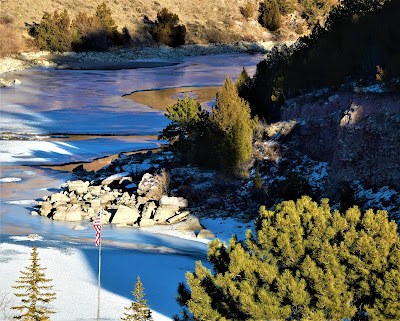
First, before we get to the answers, today's photos are all from within 50 miles of where we live. Beautiful Wyoming at its best!


Answers

1.   1849-1890: 41 years – not long.

2.   31 Senators and 62 Representatives – don't feel bad; my guess is less than 10% of Wyoming residents will get this one right.

3. Butch Cassidy served 18 months in the Wyoming Territorial Prison. He was sentenced to two years for receiving a stolen horse but was released after serving half the sentence


Wyoming History - So How Hot Was It?

 With today's temperature hanging around the century mark - I wondered. How hot is too hot in Wyoming? 


Where we live in Guernsey, an east central town with a population of a bit over 1,100  and at an altitude of 4368 feet, it gets hot. We average 41 days above 90 each year. The good news is that we are also much warmer in winter than most of the state.

Basin, located in north central Wyoming, holds the record for the hottest day in the Cowboy state - 115 on August 8, 1983. We, old-timers, refer to temperatures like that as warmish. 

We lived in Laramie for many years - there, if the temps got to the high 80s, we thought it was hot. Living at 7,200 feet does have its summertime advantages. 

Wyoming Trivia - (answers under the photo - no cheating)

1. How close did the 115 degrees at Basin come to the nation's all-time high?

2. What well-known Wyoming place was called Tso-aa (tree rock) by the Kiowa Tribe?

3. The Sioux name for "people of alien speech" is well known to everyone in Wyoming, but most are surprised that they know it. What is that name?


Trivia Answers

1. The hottest temperature recorded in the U.S. was 134 degrees in Death Valley, California, more than 100 years ago in 1913. Looks like we need another 20 degrees to set a record - pretty sure we will never get there.

2. Devils Tower

3. Cheyenne


All of today's photos are from Guernsey State Park.


Are More Visitors the Answer?

 Are More Visitors the Answer?

Each year, six million people visit Wyoming's best-known tourist sites, Yellowstone, Grand Teton, and Devils Tower. Those are impressive numbers and bring in more than a billion dollars. Interestingly about that, many folks visited Wyoming State Parks last year, bringing in close to another billion dollars. One big difference is that more than sixty percent of State Park visitors are Wyoming residents. Overall visitation to Wyoming State Parks was up over twenty percent last year. Great value for residents with a yearly park pass. Camping in state parks remains popular, with many parks full to overfull each weekend, and sometimes sites are hard to find mid-week – a nice dilemma.


The mining and extraction industries continue to drive the most revenue for the state. With doubts about the future of these industries, although most of the monies are likely safe for another decade or so, something else needs to move up. Tourism ranks second in revenue raised for the state and might be the best candidate for growth. Overall about 12% of jobs in Wyoming are part of the tourism industry. We need the tourists and probably need to do more to encourage growth in the industry.

Agriculture and manufacturing follow as the third and fourth essential money raisers for our state — each industry contributes about a billion dollars to the state coffers each year. With about 1.4 million cows (nearly three per person), Wyoming agriculture centers around the beef industry and remains strong. Wyoming does not have a lot of tillable land. Of all the farm and ranch land in the state, only about 10% is used for crops.

Manufacturing in the state is growing slowly because a big part of manufacturing in the state centers around the oil and gas industry, with refineries in five Wyoming communities facing an uncertain long-term future. Banking on manufacturing and or increasing it might not be sustainable as a goal for the long-term future.

What We Can't Do – We can't do much about the coming decline in the mineral extraction industry. We cannot create another National Park, and we will have a tough time increasing agriculture production in the state. Some might argue that the cattle and maybe sheep/goat industry has room for growth, but with the government controlling half of Wyoming – who knows what will or will not be allowed.

What We Can Do – Work on tourism!


Get people to stay longer. I thought it was a shame that the National Parks destroyed so many mountain goats in Teton Park in 2020. I would love to have seen some moved to state parklands. After all, the 12 Wyoming State Parks make up about 100,000 total acres; an additional park attraction would be a welcome addition. I know the arguments about disease and competition with Big Horn Sheep and local domestic sheep and goat herds. But, others have found a way – why not us. We were thrilled to see a mountain goat in the Black Hills a few years ago – it was a special treat.


Speaking of the Black Hills, I know of Wyoming people who go to Custer State Park to see wild horses and Burros and pay to drive through the park that also features a nice bison heard. Why not here?


We have bison at Hot Springs, and they seem to do well. The addition of bison, wild horses, and mountain goats could make some of our parks even more attractive.

We need to keep expanding for younger people and those new to the state parks scene. Additions, such as ziplines, sledding areas, remote camping areas, and more hiking and biking trails engage a wide range of citizens and visitors. I have noticed some additions recently to parks, like the archery range and hidden treasures in Guernsey, both great ideas.  


I also like the passport/prizes idea that some states use to increase tourist numbers. Any person could purchase a small passport-like book with places to stamp or have signed when visiting a park. Pretty simple - each passport holder gets one year, or half a year, to visit all 12 parks to enter the giveaway. The prizes would be sponsored and funded by private individuals or donors who would be recognized in the passport. (These passports would make terrific Christmas stocking stuffers). With this one, I am hoping that gas prices will not remain where they are now as I write this.


I have a lot more ideas. Some might even be good. Who knows?

What do you think?

My New Slogan for Wyoming

Wyoming

Wide-open spaces & not many people

Time to dream

Hike a trail

Climb a mountain

Breath deeply & look around

It's pretty special

Wyoming


It is time to quit being reactionary and become visionaries for our state.

Have a terrific week!


Health is Back and So is My Writing

It has been an interesting few weeks since I last posted on this site. Two weeks of Covid, a week or more of recovery, and then what we felt like was a well-deserved vacation.

Vacation - We spent some time, as always, looking at history and hiking as we traveled in the American southwest. It was a relatively quick trip, a couple of days in Santa Fe, (I love the architecture there).

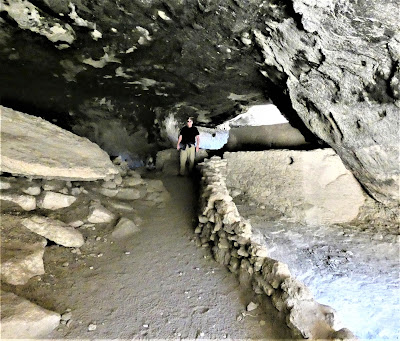
Cliff Dwellings in the Gila National Forest

Then a couple more in Silver City, NM. We found the Silver City area, which we had never visited before, much to our liking.
One of the few sites where visitors can carefully walk through the dwelling area. 

After Silver City, we spent several days in and around Tucson, AZ. All and all, a fine trip, relaxing, educational, warm, and fun, but as always at our age, exhausting at times.

Unlike some petroglyphs, in the Gila Forest were simply painted on rock - no scratching or carving.


Tombstone – We spent a delightful afternoon in Tombstone. It was much like we imagined, very touristy, i.e., Keystone SD or Estes Park Colorado. We saw lots of fictional history and a bit of real history. And as everyone should when you visit Tombstone or Deadwood, we watched some excellent gunfights. It really was lots of fun!

Downtown Tombstone last week. Fairly busy for mid-week. 

Wyoming - Enough about us – did you know Wyoming’s first post office was established today in 1850. Where? Fifteen minutes down the road from where we live – it was established in Fort Laramie. Thanks to Patrick T. Holscher and his excellent book – On This Day in Wyoming History, for that bit of information. 

Captain Benjamin Bonneville

 Wyoming Fact & Fiction

February 7, 2022

Today, I will go way back in Wyoming history to talk about Captain Benjamin Bonneville. Bonneville might be best remembered because of the tales told of him by Washington Irving. Although romanced and glorified, that book published in 1837 – The Adventures of Captain Bonneville, made Bonneville famous. It is a good thing because Bonneville started with leave from the Army but overstayed his time in the west by a couple of years. After a bit of an oral reprimand, the Army reinstated Bonneville to his rank and position in the military after his three-year wandering sabbatical.

So what did Bonneville do? He found his way with one hundred and ten men and twenty-eight wagons over south-pass first traversed by the Ashley party six years earlier. This passage of so many men and wagons opened up what would soon become the Oregon Trail – the new gateway to the west coast. Bonneville traveled from Independence, Missouri, crossed the Little Blue in Nebraska, followed the Platte to the Sweetwater, and then led his men through south pass to the Green River. On the Green, he met Lucien Fontenelle of the American Fur Company and built Fort Bonneville. That fort near present-day Pinedale was completed by early August in 1832. It did not take long for heavy winter snows to cause Bonneville and his men to abandon the fort for a more mild location. The fort was so short-lasting that it was later dubbed Bonneville’s Folly or Fort Nonsense. Although nothing remains of the fort today, the site is marked and on the National Register of Historic Places.


Wyoming Trivia – two questions today

Q1 – Washington Irving might be famous in the west for writing his tales of Captain Bonneville, but he is best known for writing two of the most famous short stories in literary history. Can you name one or both?

Q2 – Before Captain Bonneville reached Green River, there had already been seven mountain man rendezvous in the area. What, located in the town of Pinedale today, celebrates those early Wyoming times?


Answers

Q1 – Rip Van Winkle (1819) & The legend of Sleepy Hollow (1820)

Q2 – The Museum of the Mountain Man


Here is the link to all of my books on Amazon


Today’s photos were taken last week in and around my little town of Guernsey and all taken while on one of my many daily walks.

See you next week!


Wyoming In The Movies


Wyoming Fact & Fiction

January 31, 2022

Wyoming in the moviesI spend some time each week looking at the on-screen guides for TV shows that I might want to record. Mostly I'm looking for old black & white movies. I specifically look for anything about, set in, or titled something about Wyoming. This weekend I watched a B-western I found on TCM, Storm Over Wyoming. I have watched quite a few Tim Holt and Richard Martin movies. Although, at times a bit too goofy for my taste, they are generally entertaining.

Storm Over Wyoming is set in the fictional city of Sundown, Wyoming. I have spent time in Sunrise and Sundance Wyoming, but this did not resemble either. As were nearly all of these old B westerns, this one was filmed pretty close to Hollywood, and besides, who really knew what Wyoming looked like anyway? (Kidding!) The movie was another telling of the age-old sheep vs. cattle tail, but all in all, it was pretty good for a 1950 first half of a double feature movie.

Many movies have been set in Wyoming, far more than were ever filmed here. Here is a quick look at three of my favorite movies with Wyoming as part of the main storyline.


Butch Cassidy and the Sundance Kid – A classic new age western full of action, adventure, and humor. Train robberies, bank robberies, and the Wild Bunch on the run. Lots of fun, kind of based on a fact or two. Hard to beat Paul Newman as Butch and Robert Redford as the Sundance Kid. This one came out in 1969. Hard to believe it has been that long.


 Heartland – Based on the book Letters of a Women Homesteader by Elinore Pruitt Stewart. Rip Torn and Conchata Ferrell are terrific in this one set in 1910 Wyoming. The haunting clarinet music of "What a Friend we have in Jesus" as the train rolls toward southwest Wyoming sets the tone for this one. Harsh, sad, honest, and a must-see. There is another movie with the same title. If you want to see this one, make sure it is made from Letters of a Woman Homesteader.

My Friend Flicka – Made in 1943 based on Mary O'Hara's novel, published two years earlier of the same name. O'Hara's book was the first of a trilogy, followed by Thunderhead and the Green Grass of Wyoming. When O'Hara wrote these books, she was married to Helge Sture-Vasa and living on the famous Remount Ranch (they named it) between Laramie and Cheyenne.

My Friend Flicka is the story of a ten-year-old who is given a choice of horses to raise with hope from his parents that it would give him some purpose through responsibility. Unfortunately, he chooses a firey one-year-old who he names Flicka. But it was his choice, and he is allowed to raise, tame, and break the spirited filly, and the two become fast friends.

As a youngster of ten or so, I remember watching the Saturday morning television show – My Friend Flicka.

Lots and lots of movies to pick from, but these are three that I think are worthy of watching.


Wyoming Trivia – two questions today

Q1 – Speaking of movies and TV shows – What writer has a monument to him in Medicine Bow, Wyoming?

Q2 – Many movies have been made about the killing of Nick Rae and Nate Champion on what famous Wyoming ranch?


Answers

Q1 – Owen Wister – Author of The Virginian

Q2 – KC Ranch


Here is the link to all of my books on Amazon

Today's photos were taken last week at Guernsey State Park.


See you next week!


The Strange Case of Hiram Scott

 January 24, 2022

Wyoming Fact & Fiction

The Strange Case of Hiram Scott – We live in eastern Wyoming, and for us, a trip to Scottsbluff, Nebraska, is an almost weekly affair. It's only an hour away, and the closest Walmart, Target, Home Depot, and Menards are all located there. Statistically, 90% of Americans live within 10 miles of a Walmart store. Humm – we live 62 miles from our closest. That must mean we live in a nearly perfect place. I agree.

The city of Scottsbluff is named after Hiram Scott and his time in Wyoming was both tragic and historic. Scott had come west with General Ashley's party and served as a Captain under Colonel Leavenworth.

In 1827 Scott and his group went back on the North Platte River for a downstream trip to Saint Louis when their canoe overturned. Among the group's losses were all of their ammunition – too wet to ever be of use again. With the ability to hunt lost, the men lived on whatever berries, roots, and shoots they could find. It didn't take long before Scott was ill. We could speculate on why, but lack of food or bad food would lead the list of possibilities.

In the movies, trappers are mostly displayed as loyal and fateful to their companions. Not sure if that was ever true, but it certainly was not in this case. Hiram Scott was thought to be on his death bed and was abandoned by his companions near the site of what would become Fort Laramie. His men, meanwhile, started their long walk east toward civilization.


The following summer, the men who abandoned Scott were back in the west and found what they identified as Scott's remains near present-day Scottsbluff, Nebraska. Fort Laramie is nearly 50 miles from Scottsbluff. According to Washington Irvin, Scott had crawled and stumbled for days to reach where he died.  

Fort Laramie last summer - still looking good.


Wyoming Trivia – two questions today

Q1 – Fort Laramie was the third name for the famous post. Can you name one of its earlier names?

Q2 – Fort Laramie was located on two famous rivers – name them?

Q3 – Wyoming became a state in 1890. What year did neighboring Nebraska become a state? Leeway on this one – within five years.


Answers

Q1 – Fort William & Fort John

Q2 – North Platte River – Laramie River

Q3 - 1867


Here is the link to all of my books on Amazon


See you next week!


Oregon Trail Last week & the Mid 1800s

 January 17, 2022

Wyoming Fact & Fiction

We are back from a quick trip to visit family in southeast Nebraska. My two hometowns, where I grew up in Fairbury, Nebraska, and now in Guernsey, Wyoming, are Oregon Trail towns.

Traveling the Oregon Trail - Every time we go back to visit, I think about those Prairie Schooners rumbling along at 10 to 15 miles per day. My, growing up, home town, sits near one of the first difficult river crossings – the Little Blue. The crossing was treacherous if the wagons got there early in the year.

Little Blue looked peaceful when I snapped this last July.

By the time they reached Guernsey, most wagons were following the south side of the North Platte River. The Mormon Trail runs along the north side of the river, only a few miles from the Oregon Trail on the south by the time it gets here.
North Platte in mid-June in Guernsey, Wy. 

The driving distance from here in Wyoming to where I grew up in Fairbury is 485 miles, about eight to nine hours for us oldsters who stop several times along the way. The wagons would have taken more than a month, likely closer to six weeks. But hundreds of thousands made the trip, with about 20,000 who died along the way. Cholera and other sickness and disease killed most of the thousands who died along the way. Indians, who have killed hundreds of thousands, maybe millions on TV, old-time radio, and movies, actually killed about 400. 

Most who traveled walked instead of overtaxing their animals, primarily Oxen, with extra weight.

Not an Oxen but good looking Longhorn

The wagon itself was only about 4X10. Even in our tiny house world, forty square feet is not much.
A landmark of the trail - Chimney Rock in western Nebraska


One Book You Might Need in Your Library – Patrick T. Holscher’s – On This Day In Wyoming History.

So what happened in Wyoming History today from the book? Kendall Wyoming had a low temperature of -52. Now that is cold! Thanks for the info, Patrick.


Shout Out for this Blog - It is always nice to be noticed, and this week I received word that this blog is now listed in FeedSpot as one of the Top 15 Wyoming Blogs & Websites. Click the link to see the list. I read several of these sites – good stuff, no cost! 


Wyoming Trivia – two questions today

Q1 - What are Oxen?

Q2 - Where did emigrants on the Oregon Trail hope to be by the 4th of July

Trail Ruts near Guernsey - about a 1/2 mile south of our house.


Answers

Q1 - Oxen are no different in origin than other cattle. They are simply neutered bulls trained to pull.

Q2 - Independence Rock


See you next week!


Chief Washakie and President Grant

 Wyoming Fact & Fiction

January 10, 2022

Last weekend I was part of a discussion about listening to books. I don't do a lot of books on audible platforms, but when traveling, we always take one or two along. I enjoy listening and am contemplating putting some of my books on one of the listening programs. That is quite an intro to Chief Washakie – I haven't got around to him yet. Here is the tie-in. My daughter mentioned she was listening to a book and laughing about their pronunciation of Washakie. I have heard the same when listening to some books set in Wyoming. Before moving to Wyoming (1983), I taught in Nebraska and remember butchering the name myself. Guess if you are not from around here, it is difficult to say. But, not as tricky as the Popo Agie.

The first tribes that settled in today's Wyoming in the late 1600s were the Staitans, Comanches, and Shoshones. Like many other plains and foothills tribes, they were bison hunters. It is interesting to note that Shoshone legend and spoken history talked of once living in a land where alligators inhabited the rivers.

Chief Washakie early on realized that friendship with the expanding population would be better than fighting the inevitable. Washakie was instrumental in the success of General Crook (Crook County Wyoming named after him)  fighting the Sioux in Wyoming and Montana.

Because of his help to Crook and the U.S. Army, President Grant sent a silver-trimmed saddle to the Shoshone Chief in appreciation for his service. Some history books have stated that he was given a "fine horse and saddle," but most list the gift as only a saddle. My guess, Washakie, would likely have preferred using one of his fine horses to anything offered up as a gift – he did use the saddle.

According to Virginia Cole Trenholm and Maurine Carley in their 1946 textbook, Wyoming Pageant - Washakie was told he should send some sort of a thank you to the president. Chief Washakie replied, "Do a favor to a white man; he feels it in his head, and the tongue speaks. Do a kindness to an Indian; he feels it in his heart. The heart has no tongue."

Wyoming Trivia – two questions today

1.  Of the four Shoshone branches, which did Chief Washakie and his Wyoming tribe belong to?

2. Washakie was only half Shoshone. What other tribe was he?


Answers for Today's Trivia

1. Wyoming hosted the Eastern Shoshone. Other branches were the Northern, Western, and Goshute. 

2. Chief Washakie was born in 1804 with a Flathead father and Shoshone mother.

See you next week!